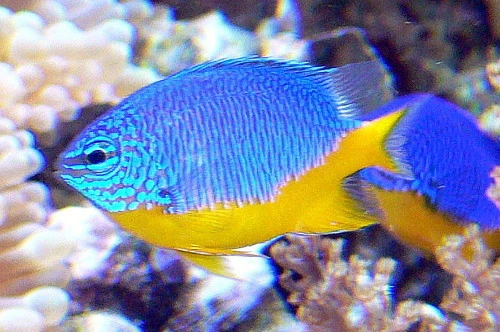
Azure demoiselle (Chrysiptera hemicyanea)
Source-cited species reference: taxonomy from WoRMS, biology from FishBase, occurrence map from GBIF, conservation from IUCN Red List, description from Wikipedia, aquarium from Wikipedia (cited section).

Chrysiptera hemicyanea, known commonly as the azure damselfish, azure demoiselle, half-blue demoiselle, and yellow-dipped damsel, is a species of damselfish.
- Scientific name
- Chrysiptera hemicyanea
- Authority
- (Weber, 1913)
- Family
- Pomacentridae
- Order
- Ovalentaria incertae sedis
- Maximum length
- 7 cm
- Depth range
- 1–38 m
- Habitat zone
- reef-associated
- Iucn red list
- Vulnerable
- Gbif occurrence records
- 151
Classification (WoRMS)
Full classification as recorded by WoRMS: Kingdom: Animalia · Phylum: Chordata · Class: Teleostei · Order: Ovalentaria incertae sedis · Family: Pomacentridae · Genus: Chrysiptera.
Accepted name: Chrysiptera hemicyanea · Authority: (Weber, 1913) · Taxonomic status: accepted · AphiaID: 276832.
Synonyms and superseded combinations recorded for this taxon: Abudefduf hemicyaneus Weber, 1913; Chrysiptera hemicyaneus (Weber, 1913); Glyphidodontops hemicyaneus (Weber, 1913).
Source: World Register of Marine Species (WoRMS) — https://www.marinespecies.org/aphia.php?p=taxdetails&id=276832 (CC BY 4.0). Accessed 2026-09-23.
Biology and life history (FishBase)
Measured values published by FishBase for Chrysiptera hemicyanea. Only fields the database actually holds for this species are shown; these are database values, not aquarium guidance.
Maximum length: 7 cm · Depth range: 1–38 m · Habitat zone: reef-associated · Body shape: fusiform / normal · Vulnerability index: 10 of 100 · Fishery importance: commercial · Aquarium trade: commercial.
FishBase notes: Adults inhabit lagoon and near shore reefs, usually among branching corals. Found in small aggregation, usually with Acropora corals (Ref. 48636). Feed on plankton about 0.3 to 0.5 m above substratum. Oviparous, distinct pairing during breeding (Ref. 205). Eggs are demersal and adhere to the substrate (Ref. 205). Males guard and aerate the eggs (Ref. 205). Diurnal species (Ref. 113699).
Source: FishBase species summary (SpecCode 6919) — https://www.fishbase.se/summary/Chrysiptera-hemicyanea.html (CC BY-NC 3.0 — non-commercial use only). Accessed 2026-09-23.
Distribution and occurrence records (GBIF)
151 georeferenced occurrence records for Chrysiptera hemicyanea are published through GBIF from 7 countries or marine areas. The map above plots 28 distinct locations from a sample of 151 records, omitting 3 inland records that carry an institution's coordinates rather than a collection site; it shows where the species has been observed and reported, not a modelled range.
Most records by country or area: Australia (107); Indonesia (24); Philippines (10); Papua New Guinea (6); Solomon Islands (2); Cyprus (1); Malta (1).
Marine regions with a valid WoRMS distribution record: Maltese part of the Mediterranean Sea - Eastern Basin.
Source: GBIF Occurrence Search (taxonKey 2399258) — https://www.gbif.org/occurrence/search?taxon_key=2399258&has_coordinate=true (records CC0 / CC BY); WoRMS distribution records (MarineRegions) — https://www.marinespecies.org/aphia.php?p=taxdetails&id=276832 (CC BY 4.0); Natural Earth 110m basemap — https://www.naturalearthdata.com/ (public domain). Accessed 2026-09-23.
Conservation status (IUCN Red List)
The IUCN Red List assesses Chrysiptera hemicyanea (Weber, 1913) as Vulnerable (code VU). No trend, population estimate or threat analysis is given here, because none is available from this source without the Red List API; follow the source link for the full assessment, including its date.
Source: IUCN Red List of Threatened Species (taxon 188406) — https://www.iucnredlist.org/species/188406/0; GBIF IUCN Red List category endpoint (taxonKey 2399258) — https://api.gbif.org/v1/species/2399258/iucnRedListCategory. Accessed 2026-09-23.
Description and natural history (Wikipedia)
The generic name, Chrysiptera, is a compound of the Greek words chrysos, meaning "golden" and pteron meaning "fin" or "wing", while the specific name, hemicyanea, means "half blue" referring to the blue head and upper body.
It is native to the eastern Indian Ocean and western Pacific. It has also recently been filmed in the Mediterranean Sea off Malta.
Being a reef species, these fish are found in greatest population in whats known as the Coral triangle, which is one of the largest concentrations of coral reefs in the world, located form the Solomon Islands to Indonesia, Bali and the Philippines.
Typically found in waters 1 to 38 m deep and are non migratory.
This tropical marine fish reaches 7 cm in length. It is mostly bright blue in color, with a bright yellow bottom. Different species in this genus have varied amounts of gold coloring.
As a tropical species, these species are found in coral reefs habitats near the equator. They inhabit lagoons or near shore reefs and are typically found in rock structures or around branching corals like Acropora corals. This species is a reef dependent species that needs corals or other structures for protection from predators. Primary eat plankton and small invertebrates.
The reproduction of Chrysiptera hemicyanea is not well studied. Reproduction in the genus Chrysiptera involves mating pairs, followed by a benthic egg-laying life cycle, where eggs are adhered to a substrate and a male stays around to guard and aerate the eggs. In addition this genus has a shorter larval stage when compared to other damselfish and because of these two things have issues distributing. Population has the ability to double in 15 months.
The primary way to protect this species is to maintain their primary habitat which is coral reefs. In current times coral reefs are beginning to disappear in most areas due to coral bleaching. Coral bleaching occurs when warmer average temperatures cause corals to begin to overheat and die, turning them white. Global warming is thought of as the primary cause reef destruction, and will only worsen in the coming decades. It is projected that by the middle of the century there will be severe damage to global coral reefs. As coral reefs die out it may become necessary to supplement structure like artificial reefs or any type of structure that fish has hide in.
This fish is a popular species in the home aquarium along with some closely related species like Chrysiptera talboti and C. rollandi. In captivity they are quite hardy and easy to take care of. They can tolerate some minor changes in water chemistry and are recommended for beginners in the saltwater aquarium trade. This species will eat just about anything including fish flakes and frozen brine shrimp.
Even though they are considered a schooling fish (especially stay around the SPS corals), they are quite aggressive and territorial. Fish that invade the area are harassed, sometimes to death. The best way to avoid this is to place fish in a large enough tank with plenty of structure like coral or live rock.
Recently this species has been successfully bred in captivity to try and increase the supply to the aquarium trade and decrease the environmental impact.
Source: Wikipedia: Chrysiptera hemicyanea — https://en.wikipedia.org/wiki/Chrysiptera_hemicyanea (CC BY-SA 4.0). Accessed 2026-09-23.
Frequently Asked Questions
What is the Azure demoiselle (Chrysiptera hemicyanea)?
The Azure demoiselle is a small damselfish species in the family Pomacentridae, first described by Weber in 1913. It is also widely known under the names azure damselfish, half-blue demoiselle, and yellow-dipped damsel.
How large does the Azure demoiselle (Chrysiptera hemicyanea) grow?
This species reaches a maximum total length of about 7 cm, making it a compact reef fish suitable for smaller reef aquariums.
At what depths can you find the Azure demoiselle (Chrysiptera hemicyanea)?
The species inhabits a depth range from just 1 m down to roughly 38 m, covering both shallow reef flats and moderately deep slopes.
What taxonomic group does the Azure demoiselle (Chrysiptera hemicyanea) belong to?
It sits within the damselfish family Pomacentridae, placed in the order Ovalentaria incertae sedis, and was originally described by Weber in 1913.
Why do aquarists and reef-keeping fans care about the Azure demoiselle (Chrysiptera hemicyanea)?
Its vivid blue coloration and small 7-cm size make it a popular centerpiece for nano and mid-size reef tanks. Because it tolerates depths from 1 to 38 m in the wild, it is generally considered an adaptable species for captive reef environments.
Spotted an error? Know more?
Reader corrections go straight into our review queue. Suggest an edit · How this site is sourced