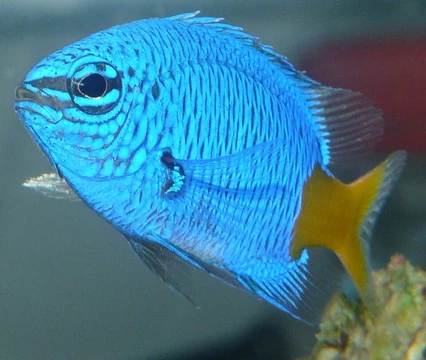
Goldtail demoiselle (Chrysiptera parasema)
Source-cited species reference: taxonomy from WoRMS, biology from FishBase, occurrence map from GBIF, conservation from IUCN Red List, description from Wikipedia, aquarium from Wikipedia (cited section).

Chrysiptera parasema, also known as yellowtail damselfish, yellowtail blue damsel, goldtail demoiselle and other variations, is a saltwater species of fish from the Indo-Pacific. It was described by Henry Weed Fowler in 1918.
- Scientific name
- Chrysiptera parasema
- Authority
- (Fowler, 1918)
- Family
- Pomacentridae
- Order
- Ovalentaria incertae sedis
- Maximum length
- 7 cm
- Depth range
- 1–16 m
- Habitat zone
- reef-associated
- Iucn red list
- Least Concern
- Gbif occurrence records
- 48
Classification (WoRMS)
Full classification as recorded by WoRMS: Kingdom: Animalia · Phylum: Chordata · Class: Teleostei · Order: Ovalentaria incertae sedis · Family: Pomacentridae · Genus: Chrysiptera.
Accepted name: Chrysiptera parasema · Authority: (Fowler, 1918) · Taxonomic status: accepted · AphiaID: 276836.
Synonyms and superseded combinations recorded for this taxon: Abudefduf parasema Fowler, 1918; Chryseptera parasema (Fowler, 1918).
Source: World Register of Marine Species (WoRMS) — https://www.marinespecies.org/aphia.php?p=taxdetails&id=276836 (CC BY 4.0). Accessed 2026-09-23.
Biology and life history (FishBase)
Measured values published by FishBase for Chrysiptera parasema. Only fields the database actually holds for this species are shown; these are database values, not aquarium guidance.
Maximum length: 7 cm · Depth range: 1–16 m · Habitat zone: reef-associated · Body shape: fusiform / normal · Vulnerability index: 10 of 100 · Aquarium trade: never/rarely.
FishBase notes: Adults inhabit coral-rich areas of sheltered lagoon and inshore coral reefs (Ref. 9710). They occur in small groups on Acropora patches (Ref. 48636). Oviparous, distinct pairing during breeding (Ref. 205). Eggs are demersal and adhere to the substrate (Ref. 205). Males guard and aerate the eggs (Ref. 205). Diurnal species (Ref. 113699).
Source: FishBase species summary (SpecCode 12448) — https://www.fishbase.se/summary/Chrysiptera-parasema.html (CC BY-NC 3.0 — non-commercial use only). Accessed 2026-09-23.
Distribution and occurrence records (GBIF)
48 georeferenced occurrence records for Chrysiptera parasema are published through GBIF from 9 countries or marine areas. The map above plots 19 distinct locations from a sample of 48 records, omitting 3 inland records that carry an institution's coordinates rather than a collection site; it shows where the species has been observed and reported, not a modelled range.
Most records by country or area: Philippines (20); Indonesia (14); Japan (7); Malaysia (2); Aruba (1); Germany (1); Hong Kong (1); Papua New Guinea (1); Timor-Leste (1).
Marine regions with a valid WoRMS distribution record: Chinese Exclusive Economic Zone.
Source: GBIF Occurrence Search (taxonKey 2399271) — https://www.gbif.org/occurrence/search?taxon_key=2399271&has_coordinate=true (records CC0 / CC BY); WoRMS distribution records (MarineRegions) — https://www.marinespecies.org/aphia.php?p=taxdetails&id=276836 (CC BY 4.0); Natural Earth 110m basemap — https://www.naturalearthdata.com/ (public domain). Accessed 2026-09-23.
Conservation status (IUCN Red List)
The IUCN Red List assesses Chrysiptera parasema (Fowler, 1918) as Least Concern (code LC). No trend, population estimate or threat analysis is given here, because none is available from this source without the Red List API; follow the source link for the full assessment, including its date.
Source: IUCN Red List of Threatened Species (taxon 188563) — https://www.iucnredlist.org/species/188563/0; GBIF IUCN Red List category endpoint (taxonKey 2399271) — https://api.gbif.org/v1/species/2399271/iucnRedListCategory. Accessed 2026-09-23.
Description and natural history (Wikipedia)
C. parasema is a small marine fish that reaches 2.8 - 3 in in length. It has a spiny dorsal fin and is laterally compressed.
C. parasema is blue with a distinctive yellow caudal fin (tail fin). The yellow coloring may extend up to the back of the anal and dorsal fins, especially in species from Papua New Guinea. These fish may also have yellow pelvic or pectoral fins. However, yellow is never found on the backs or bellies of Yellowtail Blue damsels. A yellow belly likely indicates that the fish is actually an Azure demoiselle, whereas yellow areas on the nose or chin may indicate that it is a blue devil damsel.
Yellowtail blue damsels prefer densely populated coral groupings in sheltered lagoons and inshore reefs, and generally remain between at a depth of between 3 – 52 ft.
In the wild, male C. parasema have their own territories, located near a nesting site. Each territory contains eggs from previous females. The females will swim around inspecting each male and its territory before choosing one based on its size and the number of eggs in its territory. As a part of the evaluation, the female will display a light ring around her eyes, and the male will respond with its own displays. The next day, the female will spawn with the chosen male. An individual male can have up to 10,000 eggs from different females. Males often abandon their territories to claim territories with more eggs, as this makes them appear more favorable to the females.
The eggs hatch after up to 4 days, depending on temperature, and the male is responsible for guarding and caring for the eggs. The subsequent larval stage can take 10 to 50 days.thumb|Various C. parasema colorations within the span of a few minutes. The dark coloration in the image at top left is an indication of stress, caused by the lights being turned on. The color gradually changed to light blue as the damselfish adjusted.
Chrysiptera parasema contain chromatophores and can change color in response to external stimuli. When stressed, they can turn darker to conserve energy.
Adults are usually found alone or in pairs, while juveniles are more likely to remain in small groups.
C. parasema are omnivores. In nature, they feed on plankton, algae, and small benthic crustaceans.
Chrysiptera parasema is a popular fish in the saltwater aquarium hobby. Because of its usually low price it is often recommended as a way for novice marine aquarium keepers to gain experience. Though these hardy fish are sometimes used to cycle a tank, aquariums discourage against this practice, encouraging the use of live rock instead. Thirty gallons is typically quoted as the minimum tank size required to permanently house this fish. In a properly maintained tank, C. parasema will live for 4–6 years or longer, up to 15 years.
C. parasema prefers peaceful tank mates and abundant hiding spots, as they are frequently preyed upon in nature. It is a favorite species among aquarists because it is active, but less aggressive than most damselfish.
However, these fish will sometimes harass more passive fish in an aquarium. In addition, despite its comparatively peaceful nature, this species can be territorial with members of its own species. They tend to become more aggressive when kept singly. This aggression can sometimes be reduced by keeping them in small groups of odd numbered fish (three to seven). They do show schooling behavior when kept in large groups.
Despite its hardy nature, C. parasema also must not be placed in an aquarium with larger predatory fish such as lionfish, and grouper which will often see it as a food source.
In captivity, C. parasema shows a preference for spirulina, flake foods, and mysis shrimps. However, they tend to go after most fish foods, whether frozen, freeze dried, or live. These fish tend to feed towards the bottom of the tank.
Source: Wikipedia: Chrysiptera parasema — https://en.wikipedia.org/wiki/Chrysiptera_parasema (CC BY-SA 4.0). Accessed 2026-09-23.
Frequently Asked Questions
What is the Goldtail demoiselle (Chrysiptera parasema)?
It is a small saltwater damselfish native to Indo-Pacific reefs, classified in the family Pomacentridae. You will also see it listed under names like yellowtail damselfish or yellowtail blue damsel.
How large does Chrysiptera parasema grow?
Adults top out at roughly 7 centimeters in total length, placing it firmly in the small-reef-fish category.
Where and at what depth is the Goldtail demoiselle found?
Its range spans the Indo-Pacific, and it typically occupies shallow reef habitats from about 1 meter down to around 16 meters.
Is the Goldtail demoiselle suitable for a home saltwater aquarium?
Yes, it is a recognized marine aquarium species, though keepers should replicate the shallow-reef conditions it naturally inhabits and provide adequate swimming space for a 7 cm fish.
Who originally described Chrysiptera parasema and when?
Henry Weed Fowler gave the species its formal scientific description in 1918. It is placed in the order Ovalentaria incertae sedis within the damselfish family.
Spotted an error? Know more?
Reader corrections go straight into our review queue. Suggest an edit · How this site is sourced