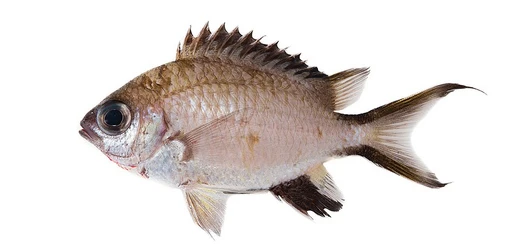
Scissors Chromis (Chromis gunting)
Source-cited species reference: taxonomy from WoRMS, biology from FishBase, conservation from IUCN Red List, description from Wikipedia.

Chromis gunting is a species of marine fish of the damselfishes in the family Pomacentridae. This species was first described in 2019, along with Chromis bowesi and Chromis hangganan, discovered and known only from Verde Island Passage, in Puerto Galera and Batangas, in the Philippines. It is characterized by 11 dorsal fin rays, 11-12 anal fin rays, 16-17 pectoral fin ray, 3 procurrent caudal fin rays, 14-16 tubed lateral-line scales, 19-20 gill rakers. The species body length is 2.1-2.2 standard length, with a light brown colored body when fresh that has a silver area on the anterior end and a bilateral black margin on the exterior side of the tail.
- Scientific name
- Chromis gunting
- Authority
- Arango, Pinheiro, Rocha, Greene, Pyle, Copus, Shepherd & Rocha, 2019
- Family
- Pomacentridae
- Order
- Ovalentaria incertae sedis
- Maximum length
- 7.739999771118164 cm
- Depth range
- 90–130 m
- Habitat zone
- reef-associated
- Iucn red list
- Least Concern
A Late-Blooming Discovery in Philippine Waters
Chromis gunting belongs to the damselfish family Pomacentridae and represents a relatively recent addition to the scientific record. The species was formally described in 2019, arriving alongside two close relatives, Chromis bowesi and Chromis hangganan. What makes this trio remarkable is their extraordinarily restricted range: all three are known exclusively from the Verde Island Passage, a marine corridor stretching through Puerto Galera and Batangas in the Philippines. No populations of any of these species have been documented outside this narrow geographic window, suggesting they may be endemic to this particular stretch of water. Their simultaneous description highlights how much of the deep-water fish fauna in this region remained uncharacterized until the late twentieth century. The fact that three distinct Chromis species could coexist in the same passage without being formally recognized underscores the ongoing work taxonomists still face in cataloguing marine biodiversity, particularly in understudied tropical waters where deep collections are logistically challenging.
Form and Coloration
The morphology of Chromis gunting is defined by a precise suite of fin-ray counts and body proportions. It carries eleven dorsal fin rays, between eleven and twelve anal fin rays, sixteen to seventeen pectoral fin rays, three procurrent caudal fin rays, fourteen to sixteen tubed lateral-line scales, and nineteen to twenty gill rakers. The largest specimen examined for the original description measured roughly 7.7 centimeters, with a body length of 2.1 to 2.2 standard lengths. In fresh specimens the body shows a light brown tone, a silvery patch on the anterior end, and a bilateral black margin along the outer edge of the tail. In mature individuals the coloration shifts: the upper body is brown, transitioning to pink across the midsection and settling into silvery gray ventrally. A black fringe traces the dorsal-fin spine and both lobes of the caudal fin as well as the caudal peduncle. The soft dorsal fin bears black rays, the anterior two-thirds of the anal fin is black while the posterior third is transparent with a yellow tint, the pectoral fins are transparent with a gray base, and the pelvic fins are light brown, almost transparent, with yellowish tints and gray rays.
Depth and Range
Chromis gunting is a deep-water damselfish whose known range is confined to Philippine waters. Records place it particularly around Batangas and Oriental Mindoro, both of which fall within the broader Verde Island Passage where the species was originally collected. The fish inhabits a depth window of approximately 90 to 130 meters, a range that sits within the 75-to-150-meter band shared by all three sister species described from the same passage. This depth preference places Chromis gunting well beyond the range accessible to recreational scuba divers, meaning that specimens have almost certainly been obtained through specialized deep-water collection methods rather than casual observation. The restricted horizontal range, combined with the narrow vertical band, points to a highly localized population structure. Because no records exist outside the Verde Island Passage, the species' full ecological niche, reproductive biology, and population dynamics remain largely unknown. The fact that all three Chromis species from this passage occupy overlapping but subtly different depth windows within the same 75-to-150-meter envelope raises questions about how they partition resources and avoid direct competition in what is, for them, a single shared habitat.
The Scissors in the Name
The specific epithet "gunting" is drawn directly from the Tagalog word for scissors, and the connection is immediately visible to anyone who examines the fish's tail. The caudal fin of Chromis gunting bears a bilateral black margin along its outermost edge, and the two lobes of the tail, each outlined in that dark border, give the impression of a pair of scissors held slightly open. This scissorlike silhouette is the single most distinctive visual feature of the species and the one that set it apart from its two co-described relatives during the 2019 taxonomic work. In fresh specimens the black margin is especially crisp against the light brown body and the silvery anterior region, making the tail's shape stand out prominently. The bilateral symmetry of the dark edging, combined with the two-lobed structure of the caudal fin, creates a visual effect that is both striking and immediately memorable. That a common household tool in the local language could so aptly capture the geometry of a deep-water fish's tail speaks to the kind of intuitive, observation-driven naming that still anchors much of biological taxonomy in the regions where species are first encountered.
Frequently Asked Questions
What is Scissors Chromis (Chromis gunting)?
Chromis gunting is a small marine damselfish belonging to the family Pomacentridae, formally described in 2019 by Arango, Pinheiro, Rocha, Greene, Pyle, Copus, Shepherd, and Rocha. It was identified alongside two other new Chromis species from the same Philippine waters.
Where is Scissors Chromis (Chromis gunting) found?
This species is currently known only from the Verde Island Passage, off Puerto Galera and Batangas in the Philippines. It inhabits relatively deep waters, typically between 90 and 130 meters.
What do Scissors Chromis (Chromis gunting) look like?
Fresh specimens show a light brown body with a distinct silver patch toward the head. Morphologically they carry 11 dorsal fin rays, 11–12 anal fin rays, 16–17 pectoral fin rays, and 14–16 tubed lateral-line scales, among other diagnostic counts.
How large does Scissors Chromis (Chromis gunting) get?
The maximum recorded standard length for this species is approximately 7.7 centimeters, making it a small reef-associated damselfish. Its body proportions are noted at roughly 2.1–2.2 times the standard length in the original description.
Why is Scissors Chromis (Chromis gunting) notable to fish enthusiasts and researchers?
It is a recently validated species (2019) known from a single, geographically restricted area in the Philippines, which makes it a focal point for biogeographic and conservation studies. Its limited range and deep-water habitat (90–130 m) mean very little is still known about its ecology or population status.
Spotted an error? Know more?
Reader corrections go straight into our review queue. Suggest an edit · How this site is sourced