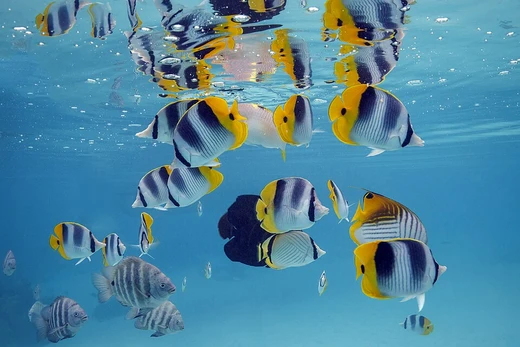
Scrawled butterflyfish
A coral-dwelling butterflyfish with curved black bars on whitish body.

The scrawled butterflyfish (Chaetodon meyeri) is a marine fish from the family Chaetodontidae, also called Meyer's butterflyfish or the maypole butterflyfish. Its range spans the Indian and Pacific Oceans, from the eastern coast of Africa between Somalia and Durban, east to the Line Islands and Hawaii. Northward it reaches Japan's Ryukyu Islands, and southward it extends to the Great Barrier Reef, New Caledonia, and Tonga. Vagrants have turned up in the eastern Pacific near the Galapagos Islands, Ecuador, and Mexico's Revillagigedo Islands.
The body is whitish or bluish-white, with curved and diagonal black bars on the flanks; the curved bars bend toward the rear. A black bar edged in yellow runs through the eye, and a similar bar crosses the snout around the mouth. The dorsal fin has 12–13 spines and 23–25 soft rays, while the anal fin has 3 spines and 18–20 soft rays. Maximum total length is 20 centimetres (7.9 inches).
This species lives at depths of 2 to 25 metres (6.6 to 82.0 feet), in clear lagoons and seaward reefs rich in coral. Juveniles are usually solitary among branching corals, while adults typically form pairs and maintain a home range. They are oviparous and breed in pairs. An obligate corallivore, they are thought to feed on coral mucus rather than the coral tissue itself.
The scrawled butterflyfish was first formally described in 1801 by German naturalists Marcus Elieser Bloch and Johann Gottlob Theaenus Schneider, with the type locality given as Ambon Island, Indonesia. The specific name honors someone named Meyer—likely Johan Frederik Meijer, a bookkeeper on Ambon who kept a small natural-history cabinet in the Netherlands during the 1700s—since the type specimen came from the Museo Meyeri Lugduni Batavorum (Meyer's Museum in Leiden). It is closely related to the mailed butterflyfish (C. reticulatus) and the ornate butterflyfish (C. ornatissimus). These three form the subgenus "Citharoedus," but that name is invalid because it had already been used for a mollusc genus. They are probably close to the subgenus Corallochaetodon, which includes the melon butterflyfish (C. trifasciatus). If the genus Chaetodon is split, these species might be placed in Megaprotodon.
Quick Facts
- Genus
- Chaetodon
- Parent
- Chaetodon (Citharoedus)
- Species
- meyeri
Facts from the source article.
Lore & Background
The scrawled butterflyfish has a whitish or bluish-white body marked with curved and diagonal black bars on its flanks, with the curve of the curved bars towards the rear. A yellow-edged black bar runs through the eye, and a similar bar is on the snout around the mouth. It has 12–13 spines and 23–25 soft rays in its dorsal fin, and 3 spines and 18–20 soft rays in its anal fin. It attains a maximum total length of 20 centimetres.
It has an Indo-Pacific distribution, found along the eastern coast of Africa from Somalia to Durban, across the Indian and Pacific Oceans as far east as the Line Islands and Hawaii. Its range extends north to the Ryukyu Islands of Japan and south to the Great Barrier Reef, New Caledonia and Tonga. Vagrants have been recorded in the eastern Pacific Ocean at the Galapagos Islands, Ecuador, and the Revillagigedo Islands of Mexico.
It is found at depths between 2 and 25 metres, inhabiting areas rich in coral in clear lagoons and seaward reefs. Juveniles are normally solitary and live among branching corals, while adults typically live as pairs and have a home range. It is oviparous and breeds in pairs. It is an obligate corallivore, but it is thought that they feed on the mucus of the coral rather than the actual coral tissue.
Reader's Guide
The scrawled butterflyfish was first formally described in 1801 by the German naturalists Marcus Elieser Bloch and Johann Gottlob Theaenus Schneider, with the type locality given as Ambon Island in Indonesia. The identity of the person that the specific name honours is not given by Bloch and Schneider, but the type specimen was in the collection of the Museo Meyeri Lugduni Batavorum, or Meyer's Museum, in Leiden, Netherlands. This Meyer could have been Johan Frederik Meijer, a bookkeeper at Ambon Island who had kept a small natural-history cabinet in the Netherlands during the 1700s.
It is a close relative of the mailed butterflyfish (C. reticulatus) and the ornate butterflyfish (C. ornatissimus). Together they make up the subgenus called 'Citharoedus', but as this name had already been used for a mollusc genus when it was given to the fish, it is not valid. They are probably quite close to the subgenus Corallochaetodon, which contains for example the melon butterflyfish (C. trifasciatus). Like these, they might be separated in Megaprotodon if the genus Chaetodon is split up.
Its significance lies in its obligate corallivorous feeding habit, which ties it closely to coral reef health, and its wide Indo-Pacific distribution. The species is also notable for the taxonomic uncertainty surrounding its subgeneric placement and the historical ambiguity of its specific epithet.
Did You Know?
- The scrawled butterflyfish is also known as Meyer's butterflyfish or the maypole butterflyfish.
- It has a yellow-edged black bar running through the eye and a similar bar on the snout around the mouth.
More in Butterflyfish, Part 2 1-24
Spotted an error? Know more?
Reader corrections go straight into our review queue. Suggest an edit · How this site is sourced