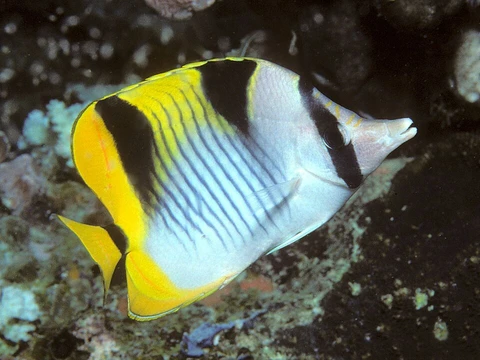
Blackwedged butterflyfish (Chaetodon falcula)
Source-cited species reference: taxonomy from WoRMS, biology from FishBase, occurrence map from GBIF, conservation from IUCN Red List, description from Wikipedia.

Chaetodon falcula, the blackwedged butterflyfish or falcula butterflyfish, is a species of marine ray-finned fish a butterflyfish belonging to the family Chaetodontidae. It is found in the Indian Ocean.
- Scientific name
- Chaetodon falcula
- Authority
- Bloch, 1795
- Family
- Chaetodontidae
- Order
- Acanthuriformes
- Maximum length
- 20 cm
- Depth range
- 1–15 m
- Habitat zone
- reef-associated
- Iucn red list
- Least Concern
- Gbif occurrence records
- 552
Classification (WoRMS)
Full classification as recorded by WoRMS: Kingdom: Animalia · Phylum: Chordata · Class: Teleostei · Order: Acanthuriformes · Family: Chaetodontidae · Genus: Chaetodon.
Accepted name: Chaetodon falcula · Authority: Bloch, 1795 · Taxonomic status: accepted · AphiaID: 218726.
Synonyms and superseded combinations recorded for this taxon: Anisochaetodon falcula (Bloch, 1795); Chaetodon dizoster Valenciennes, 1831; Chaetodon facula Bloch, 1795; Tetragonoptrus dizoster (Valenciennes, 1831).
Source: World Register of Marine Species (WoRMS) — https://www.marinespecies.org/aphia.php?p=taxdetails&id=218726 (CC BY 4.0). Accessed 2026-09-23.
Biology and life history (FishBase)
Measured values published by FishBase for Chaetodon falcula. Only fields the database actually holds for this species are shown; these are database values, not aquarium guidance.
Maximum length: 20 cm · Depth range: 1–15 m · Habitat zone: reef-associated · Body shape: short and / or deep · Vulnerability index: 10 of 100 · Fishery importance: commercial · Aquarium trade: commercial.
FishBase notes: Found on the reef edge and upper slope. Usually in current-prone habitats; juveniles secretive in corals (Ref. 48636). Generally seen in pairs or in small aggregations (Ref. 4858). Feed mainly on invertebrates (Ref. 6113). Oviparous (Ref. 205). Form pairs during breeding (Ref. 205). Indian Ocean species counterpart of sibling Chaetodon ulietensis which is found in western and central Pacific (Ref. 90102).
Source: FishBase species summary (SpecCode 8014) — https://www.fishbase.se/summary/Chaetodon-falcula.html (CC BY-NC 3.0 — non-commercial use only). Accessed 2026-09-23.
Distribution and occurrence records (GBIF)
552 georeferenced occurrence records for Chaetodon falcula are published through GBIF from 34 countries or marine areas. The map above plots 103 distinct locations from a sample of 552 records, omitting 8 inland records that carry an institution's coordinates rather than a collection site; it shows where the species has been observed and reported, not a modelled range.
Most records by country or area: Maldives (221); Seychelles (61); India (58); Mayotte (29); Thailand (23); French Polynesia (22); Tanzania, United Republic of (19); Madagascar (17); Réunion (15); British Indian Ocean Territory (13); Kenya (11); Micronesia (Federated States of) (10); French Southern Territories (10); Mozambique (8); Indonesia (7).
Marine regions with a valid WoRMS distribution record: Seychellois Exclusive Economic Zone; Mozambican Exclusive Economic Zone; Mauritian Exclusive Economic Zone; Kenyan Exclusive Economic Zone; Tanzanian Exclusive Economic Zone; Madagascar; Chagos; Chinese Exclusive Economic Zone.
Source: GBIF Occurrence Search (taxonKey 2385419) — https://www.gbif.org/occurrence/search?taxon_key=2385419&has_coordinate=true (records CC0 / CC BY); WoRMS distribution records (MarineRegions) — https://www.marinespecies.org/aphia.php?p=taxdetails&id=218726 (CC BY 4.0); Natural Earth 110m basemap — https://www.naturalearthdata.com/ (public domain). Accessed 2026-09-23.
Conservation status (IUCN Red List)
The IUCN Red List assesses Chaetodon falcula Bloch, 1795 as Least Concern (code LC). No trend, population estimate or threat analysis is given here, because none is available from this source without the Red List API; follow the source link for the full assessment, including its date.
Source: IUCN Red List of Threatened Species (taxon 165607) — https://www.iucnredlist.org/species/165607/0; GBIF IUCN Red List category endpoint (taxonKey 2385419) — https://api.gbif.org/v1/species/2385419/iucnRedListCategory. Accessed 2026-09-23.
Description and natural history (Wikipedia)
Chaetodon falcula has a white body which is marked with a number of thin vertical dark grey lines. It has two clear black saddle-like blotches on the dorsal part of the body, a vertical black eye band and a black caudal peduncle. The dorsal, anal and caudal fins are yellow. The yellow continues onto the body adjacent to the dorsal and anal fins. There are 12–13 spines in the dorsal fin and 23–25 soft rays while the anal fin contains 3 spines and 20–21 soft rays. This species attains a total length of 20 cm.
Chaetodon falcula is found in the Indian Ocean where it occurs along the East African coast between Kenya and South Africa, Madagascar and the other western and central islands of the Indian Ocean, Sri Lanka, southern India, including the Andaman and Nicobar Islands, and from the waters of western Thailand east as far as Java. It occurs in the Cocos (Keeling) Islands, which are part of Australia, too.
Chaetodon falcula is found at depths of 1 to 15 m. They are found on the reef edge and upper slope normally in habitats subjected to strong currents although the juveniles hide among corals. Typically seen in pairs or small aggregations, of up to 20 fish. Their diet is made up of feeds of the polyps, worms, sea anemones, crustaceans, sponges, the feet of sea urchin and other invertebrates. This species forms distinct pairs to breed and the pelagic eggs are scattered in open water.
Chaetodon falcula was first formally described in 1795 by the German physician and naturalist Marcus Elieser Bloch (1723–1797) with the type locality given as Tharangambadi in India. The specific name falcula is a diminutive of the Latin falx or falcis meaning a "sickle" or a "scythe" and is a reference to the wedge shaped black saddle blotches which Bloch illustrated as sickle-shaped, which they are not in modern photographs.
With its sister species, the similar-looking Pacific double-saddle butterflyfish (C. ulietensis), C. falcula belongs to the large subgenus Rabdophorus which might warrant recognition as a distinct genus. Other fairly close relatives are the quite differently-shaped but similarly-coloured lined (C. lineolatus) and spot-naped butterflyfishes (C. oxycephalus), while the blue-cheeked butterflyfish (C. semilarvatus) is the sister species to all of these. Vertical lines are present in all of these species, while a white body with yellow behind and black on back and caudal peduncle are shared by all but C. semilarvatus.
Source: Wikipedia: Chaetodon falcula — https://en.wikipedia.org/wiki/Chaetodon_falcula (CC BY-SA 4.0). Accessed 2026-09-23.
Spotted an error? Know more?
Reader corrections go straight into our review queue. Suggest an edit · How this site is sourced