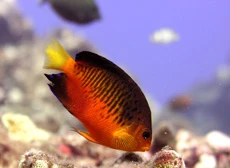
Mango angelfish (Centropyge shepardi)
Source-cited species reference: taxonomy from WoRMS, biology from FishBase, occurrence map from GBIF, conservation from IUCN Red List, description from Wikipedia.

Centropyge shepardi, the mango angelfish, Shepard's angelfish or Shepard's pygmy angelfish, is a species of marine ray-finned fish, a marine angelfish belonging to the family Pomacanthidae. It is found in the Western Pacific Ocean.
- Scientific name
- Centropyge shepardi
- Authority
- Randall & Yasuda, 1979
- Family
- Pomacanthidae
- Order
- Acanthuriformes
- Maximum length
- 9 cm
- Depth range
- 1–56 m
- Habitat zone
- reef-associated
- Iucn red list
- Least Concern
- Gbif occurrence records
- 2,730
Morphology and Coloration
The mango angelfish presents a compact, oval-bodied silhouette, with its dorsal and anal fins tapering from a rounded base to a slightly pointed tip. Its most striking feature is the warm orange ground color, which shifts across a spectrum from a deep, near-red hue to a pale apricot tone, with the upper portion of the body typically appearing a shade darker than the belly. Most individuals display dark vertical bars across the flanks, though in some specimens this barring is confined to a small patch just behind the gill cover, and in rare cases it vanishes entirely. A notable sexual dimorphism exists: males sport a vivid blue border along the soft-rayed sections of both the dorsal and anal fins. The fin architecture is precise—the dorsal fin bears fourteen spines alongside sixteen to eighteen soft rays, while the anal fin carries three spines and seventeen to eighteen soft rays. Despite these elaborate markings, the species remains small, reaching a maximum total length of just nine centimetres, or roughly three and a half inches.
Geographic Range and Range Limits
Centropyge shepardi occupies a relatively narrow slice of the western Pacific Ocean. Its confirmed core range encompasses the Northern Marianas Islands, the waters surrounding Guam, and the Ogasawara Islands off southern Japan. In more recent years, sightings have extended to Yoron Island and Okinoerabu Island, also in the southern Japanese archipelago, suggesting a broader presence than previously documented. A record from the Izu Islands of Japan has been noted in the literature, though this is widely regarded as likely representing a vagrant individual rather than a resident population. Claims of the species occurring in Palau and the Philippines have also surfaced, but these reports remain unverified and await further confirmation. Overall, the distribution pattern points to a species with a geographically constrained footprint, concentrated among scattered island groups in the western Pacific rather than forming a continuous band across open ocean.
Reef Life and Reproductive Behavior
Within its limited range, the mango angelfish is a common sight on exposed outer reef slopes, typically at depths between ten and fifty-six metres, though it occasionally appears on lagoon reefs as well. It favors habitats where living and dead coral are intermingled, creating a mosaic of holes and caves that offer shelter. Socially, the species forms small harem groups of three to seven individuals. Its diet is predominantly herbivorous, consisting largely of algae. Reproduction follows a broadcast-spawning strategy. Spawning is believed to commence in September and occurs at dusk. During the courtship sequence, the male actively displays toward a chosen female, pushing and chasing her until she releases her eggs into the water column, at which moment he simultaneously releases his sperm. The fertilized eggs hatch within two to three days. As an oviparous species, the mango angelfish invests no parental care beyond this brief spawning event.
Taxonomic History and Aquarium Presence
The mango angelfish was formally described in 1979 by ichthyologists John Ernest Randall and Fujio Yasuda, with the type locality specified as the western side of Cocos Island in Guam. The specific epithet shepardi was chosen to honor John W. Shepard of the University of Guam, who played a pivotal role in the species' discovery. Shepard demonstrated that this angelfish coexisted sympatrically with Centropyge bispinosa in Guamanian waters and, crucially, directed Randall and Yasuda's attention to the differing number of pectoral fin rays between the two species—a key diagnostic distinction that separated them. In modern taxonomic treatments, some authorities assign the species to the subgenus Centropyge within the family Pomacanthidae. Despite its vivid coloration, the mango angelfish is a rare sight in the aquarium trade; when specimens do reach the market, they command a notably high price, reflecting both their limited geographic availability and the difficulty of collecting them from their preferred outer-reef habitats.
Frequently Asked Questions
What is the Mango angelfish (Centropyge shepardi)?
It is a small marine angelfish in the family Pomacanthidae, also called Shepard's angelfish or Shepard's pygmy angelfish. The species was formally described by Randall and Yasuda in 1979 and belongs to the order Acanthuriformes.
Where does the Mango angelfish live in the wild?
This species is restricted to the Western Pacific Ocean, where it occupies reef habitats at depths between about 1 and 56 meters. Its range is fairly narrow compared to some other Centropyge relatives.
How big does a Mango angelfish get?
Adults top out at roughly 9 centimeters in total length, which is why it is often referred to as a pygmy angelfish. That compact size sets it apart from the much larger reef angelfish species in the same family.
What role does the Mango angelfish play in its reef ecosystem?
As a small Pomacanthid, it feeds on invertebrates and detritus among reef structures, helping regulate microfauna populations in its Western Pacific habitat. It occupies a mid-level foraging niche alongside other small reef fish.
Why is the Mango angelfish of interest to fish-keeping hobbyists?
Its modest 9-cm size, striking coloration, and limited Western Pacific distribution make it a desirable yet hard-to-source species for marine aquariums. Because it was only described in 1979, reliable husbandry information is still thinner than for more widely known angelfish.
Related in Mango angelfish
Links follow this subject's own source article.
Elsewhere in Mango angelfish
Spotted an error? Know more?
Reader corrections go straight into our review queue. Suggest an edit · How this site is sourced