Where Mango angelfish has been recorded
GBIF occurrence records for Centropyge shepardi, mapped and tabulated by country.

2,730 georeferenced occurrence records with coordinates are published for Centropyge shepardi through GBIF, from 4 countries or marine areas. This page maps those records and lists where they come from. Occurrence records reflect where people have looked as well as where the species lives, so well-surveyed coastlines are over-represented.
- Georeferenced records
- 2,730
- Countries / areas
- 4
- Mapped locations
- 28
- Records sampled for the map
- 2,730
- Inland records omitted
- 0
- Gbif taxonkey
- 2396539
Physical Appearance and Morphology
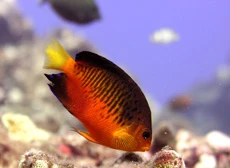
The mango angelfish presents a compact, oval body plan that distinguishes it visually from many larger reef angelfish. Its dorsal and anal fins sweep outward with rounded tips that can appear slightly pointed, giving the silhouette a soft, flowing quality. The base coloration is a warm orange that shifts across a spectrum from deep, almost red tones to a pale apricot wash, with the upper portion of the body typically carrying a marginally darker shade than the belly. Dark vertical bars usually stripe the flanks, though in some individuals these markings shrink to a small smudge behind the gill cover, and on rare occasions they vanish entirely. A striking sexual dimorphism appears in the males, whose soft-rayed sections of the dorsal and anal fins are edged with a vivid blue border. Structurally, the dorsal fin carries fourteen spines alongside sixteen to eighteen soft rays, while the anal fin features three spines and seventeen to eighteen soft rays. The species caps out at a modest nine centimetres in total length, a size that keeps it firmly in the pygmy angelfish category.
Geographic Range and Distribution
Centropyge shepardi occupies a relatively narrow slice of the western Pacific Ocean, making its range one of the more restricted among pygmy angelfishes. Its confirmed strongholds include the Northern Marianas Islands, Guam, and the Ogasawara archipelago off southern Japan. More recently, sightings have extended its known footprint to Yoron Island and Okinoerabu Island, also in southern Japan, suggesting either a gradual range expansion or simply improved survey coverage in those waters. A record from the Izu Islands of Japan has been noted, though researchers suspect these fish were likely vagrants swept far from their core habitat rather than members of a resident population. Claims of mango angelfish in Palau and the Philippines have also surfaced, but these reports remain unverified and await further confirmation from field observations. Overall, the species paints a picture of a localized reef dweller whose presence is patchy across a scattered set of island groups rather than continuous across a broad oceanic expanse.
Habitat, Social Structure, and Reproduction
Within its limited range, the mango angelfish is a fairly common sight on the outer slopes of exposed reefs, typically ranging from ten to fifty-six metres below the surface. It occasionally turns up on lagoon reefs as well, but its preferred terrain is a mosaic of living and dead coral riddled with crevices, holes, and small caves that offer ready shelter. Socially, the species forms tight harems of three to seven individuals, a grouping structure that likely centers on a dominant male. Nutritionally, it is predominantly herbivorous, grazing heavily on algae that coats the reef substrate. Reproduction follows a broadcast-spawning pattern: the species is oviparous, and spawning events are thought to kick off around September, timed to dusk. During the courtship sequence, the male actively displays toward a chosen female, nudging and chasing her in an escalating display until she releases her eggs into the water column, at which moment he simultaneously discharges his sperm. The resulting free-floating eggs develop and hatch within just two to three days, a remarkably brief embryonic period for a marine fish.
Taxonomic History and Naming
The formal scientific recognition of the mango angelfish dates to 1979, when ichthyologists John Ernest Randall and Fujio Yasuda published its original description. They designated the western side of Cocos Island in Guam as the type locality, anchoring the species to a specific reef site. The specific epithet shepardi is a tribute to John W. Shepard of the University of Guam, a local marine biologist who played a pivotal role in the species' discovery. Shepard had demonstrated that this orange pygmy angel coexisted in the same waters as Centropyge bispinosa on Guam, proving the two were distinct rather than mere color variants. He also flagged a key morphological difference in the number of pectoral fin rays between the two species, a detail that helped Randall and Yasuda separate them taxonomically. In broader classification, some authorities nest the species within the subgenus Centropyge, underscoring its close ties to other small reef angelfish. In the aquarium trade, the mango angelfish remains a rarity; when specimens do reach the market, they command a notably high price, reflecting both their limited availability and the difficulty of sourcing them from their scattered island habitats.
Frequently Asked Questions
How many countries or marine areas has the Mango angelfish been recorded in?
GBIF currently holds georeferenced occurrence data placing Centropyge shepardi in four distinct countries or marine areas. The distribution page breaks those down across 28 mapped locations.
How many occurrence records back up the Mango angelfish distribution map?
There are 2,730 georeferenced records with coordinates published through GBIF under taxon key 2396539. Every one of those 2,730 records was sampled for the map, so nothing was excluded.
Why do some coastlines show up more often than others on the Mango angelfish record map?
Occurrence data reflects where researchers and divers have actually looked, not just where the fish lives. Heavily surveyed coastlines naturally accumulate more sightings, so they appear over-represented relative to less-explored reef areas.
Are there any inland or freshwater records for the Mango angelfish?
No. The dataset contains zero inland records, which makes sense given that Centropyge shepardi is a strictly marine reef-dwelling angelfish.
Where can I see the full list of where Mango angelfish has been recorded?
The distribution page on the fan encyclopedia maps all 2,730 GBIF records and tabulates them by country. It also lists the source of each record so fans can trace the data back to its origin.
Related in Mango angelfish
Links follow this subject's own source article.
Elsewhere in Mango angelfish
Spotted an error? Know more?
Reader corrections go straight into our review queue. Suggest an edit · How this site is sourced