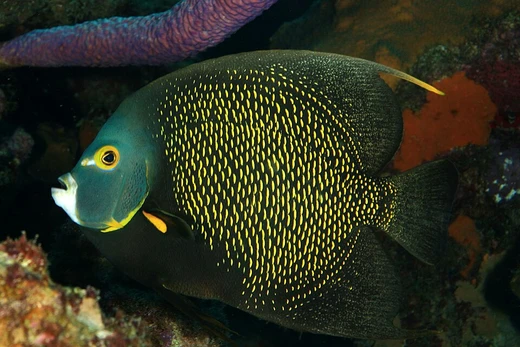
Centropyge ferrugata
A Western Pacific angelfish with black-spotted brownish-orange body.
Last updated

Izuzuki diver · via Wikipedia: Centropyge ferrugata · CC BY-SA 2.5
The rusty angelfish reaches a maximum size of 10 cm in total length.[1][2] A burnt orange body with black flecks on the upper half characterizes Centropyge ferrugata.[2][3]
Scientific classification
- KingdomAnimalia
- PhylumChordata
- ClassActinopterygii
- DivisionTeleostei
- OrderAcanthuriformes
- FamilyPomacanthidae
- GenusCentropyge
- SpeciesCentropyge ferrugata
Named by Randall & Burgess, 1972
Close relatives
Other species of Centropyge with a Codexery entry.
- Bicolor angelfish Centropyge bicolor
- Blue velvet angelfish Centropyge deborae
- Centropyge abei Centropyge abei
- Centropyge eibli Centropyge eibli
- Centropyge fisheri Centropyge fisheri
- Centropyge flavipectoralis Centropyge flavipectoralis
- Centropyge heraldi Centropyge heraldi
- Centropyge joculator Centropyge joculator
Sources: Wikipedia taxobox: Centropyge ferrugata (CC BY-SA 4.0) · order, family and genus agree with WoRMS AphiaID 278834 (CC BY 4.0)
Conservation status
Least Concern (LC)
- LC▲ this species
- NT
- VU
- EN
- CR
- EW
- EX
Source: IUCN Red List assessment · GBIF copy of the Red List category
Where the centropyge ferrugata has been recorded
Each dot is a place where the species has been observed and reported (72 records, half-degree grid) — not a modelled range. 2 inland records left out (institution coordinates). 1 isolated far-off record not drawn.
Map: drawn by Codexery. Data: GBIF occurrence search (records CC0 / CC BY) · Natural Earth basemap (public domain) · place coordinates: Wikipedia (CC BY-SA 4.0)
Quick Facts
- Dorsal fin spines
- 14
- Dorsal fin soft rays
- 17
- Anal fin spines
- 3
- Anal fin soft rays
- 17-18
- Type locality
- reef one half mile off the harbour of Ishigaki City, Ishigaki, Ryukyu Islands
Facts from the source article.
Biology and range
This species inhabits the western Pacific Ocean.[1][2] Seaward rocky reefs and rubble zones with thick algal growth are its preferred habitats.[4] Individuals may be solitary or form small aggregations.[5][2] Grazing on filamentous algae mats is a common feeding behavior.[5]
What the specialist sources record
The Saltcorner! account notes the diet consists mainly of algae and detritus, yet also consumes coral polyps, sponges, and small snails.[2] The same source states all Centropyge species start life as unsexed individuals, but begin their adult life as females.[2] The reefapp.net account lists this species as liking to eat tubeworms.[6] The ETYFish Project database records the first formal description in 1972 by John Ernest Randall and Warren E. Burgess, with the type locality given as a reef off Ishigaki City, Ryukyu Islands.[7][8]
The GBIF database holds 255 occurrence records for this taxon as of 7 October 2026.[9] The WoRMS database records the species as accepted in the family Pomacanthidae, order Acanthuriformes.[10]
References
- Wikipedia, "Centropyge ferrugata" (CC BY-SA 4.0) en.wikipedia.org
- "Centropyge ferrugata", Saltcorner!, 2012. facts only, no text reused. saltcorner.com
- Wikipedia, "Centropyge ferrugata" (CC BY-SA 4.0), which cites: "Centropyge ferrugata", Saltcorner!, 2012 (we also read that source) en.wikipedia.org
- Wikipedia, "Centropyge ferrugata" (CC BY-SA 4.0), which cites: Pyle, R., "Centropyge ferrugata", 2010 (original not read by us) en.wikipedia.org
- Wikipedia, "Centropyge ferrugata" (CC BY-SA 4.0), which cites: ; Pyle, R., "Centropyge ferrugata", 2010; "Centropyge ferrugata", Saltcorner!, 2012; "Centropyge ferrugata", reefapp.net (we also read that source) en.wikipedia.org
- "Centropyge ferrugata", reefapp.net. facts only, no text reused. reefapp.net
- Wikipedia, "Centropyge ferrugata" (CC BY-SA 4.0), which cites: ; "Order ACANTHURIFORMES (part 1): Families LOBOTIDAE, POMACANTHIDAE, DREPANEIDAE and CHAETODONTIDAE", The ETYFish Project Fish Name Etymology Database, 21 July 2020 (we also read that source) en.wikipedia.org
- "Order ACANTHURIFORMES (part 1): Families LOBOTIDAE, POMACANTHIDAE, DREPANEIDAE and CHAETODONTIDAE", The ETYFish Project Fish Name Etymology Database, 21 July 2020. facts only, no text reused. etyfish.org
- GBIF Backbone Taxonomy and occurrence index, Centropyge ferrugata (taxon key 2396542). CC BY 4.0 (backbone); counts are facts. gbif.org
- World Register of Marine Species, Centropyge ferrugata (AphiaID 278834). CC BY 4.0. marinespecies.org
Each numbered sentence above was checked against the source it cites before publication. Sentences citing Wikipedia adapt text from the English Wikipedia article Centropyge ferrugata (contributors), used under CC BY-SA 4.0; this entry is available under the same licence. Other sources were used for facts only; no text or images are copied from them.
More in Marine Angelfish
Test yourself
Three questions drawn from this entry’s sources. Pick an answer to check it.
Answers checked against the source article
Sources
Compiled from Wikipedia and the sources listed below. Text from Wikipedia is available under CC BY-SA 4.0; this entry is adapted from it.
- Wikipedia: Centropyge ferrugata (CC BY-SA 4.0).
- Classification: the source article's taxobox; order, family and genus checked against WoRMS, the World Register of Marine Species (CC BY 4.0).
- Conservation status: IUCN Red List assessment.
- Occurrence records: GBIF (CC0 / CC BY). Basemap: Natural Earth (public domain).
- Word definitions: the Codexery glossary, each quoted from its Wikipedia article.
Spotted an error? Know more?
Reader corrections go straight into our review queue. Suggest an edit · How this site is sourced