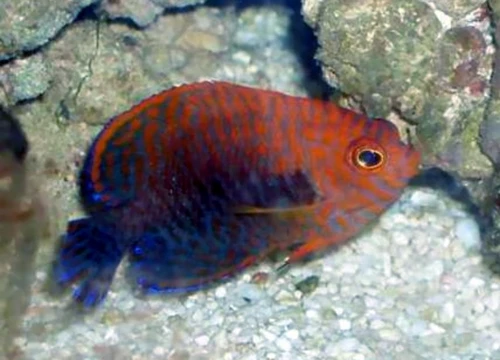
Russet angelfish (Centropyge potteri)
Source-cited species reference: taxonomy from WoRMS, biology from FishBase, occurrence map from GBIF, conservation from IUCN Red List, description from Wikipedia.

Centropyge potteri, commonly known as the russet angelfish, Potter's angelfish or Potter's pygmy angelfish, is a species of marine ray-finned fish, a marine angelfish belonging to the family Pomacanthidae. It is found in the central Pacific Ocean.
- Scientific name
- Centropyge potteri
- Authority
- (Jordan & Metz, 1912)
- Family
- Pomacanthidae
- Order
- Acanthuriformes
- Maximum length
- 12.5 cm
- Depth range
- 5–138 m
- Habitat zone
- reef-associated
- Iucn red list
- Least Concern
- Gbif occurrence records
- 5,846
Vibrant Coloration & Sexual Dimorphism
The russet angelfish presents one of the most striking visual profiles among small marine angelfish. Its body glows in a vivid orange, overlaid with a series of thin vertical stripes ranging from deep blue to near-black. The dorsal, caudal, and anal fins are edged with a brilliant blue border, while the pectoral and pelvic fins shift between orange and bright yellow. Males distinguish themselves through an expanded patch of blue across the midsection that extends downward onto the belly, a feature that sets them apart from females. Perhaps most remarkable is the existence of a deep-water colour morph: below roughly 60 metres, individuals display stripes in black or purple tones with burgundy undertones, a dramatic shift from the shallower orange-and-blue palette. Despite this bold display, the species remains compact, reaching a maximum total length of just 10 centimetres. These visual traits, combined with the species' restricted Pacific range, make the russet angelfish a visually distinctive yet geographically limited member of the Pomacanthidae family.
Harem Life & Elaborate Courtship
Socially, the russet angelfish organises into small groups structured as harems, with a single male presiding over as many as eight females. The species is a protogynous hermaphrodite: every individual begins life as a female, and should the male disappear, the dominant female undergoes a sex change to fill the vacancy. Spawning is seasonal, occurring between December and May, typically timed around nightfall. A breeding pair selects a prominent rock outcropping within their territory as the spawning site. The male initiates courtship by swimming alongside the female in a vertical orientation with a sinuous motion. He then positions himself above her, halts, raises his dorsal and anal fins, flutters his pectorals, executes a slight sideward turn, and begins a slow drift. If the female does not respond, he restarts the sinuous approach, repeating until she cooperates. As readiness builds, the pair's red tones intensify and they produce audible grunts and clicks. The male guides the female to the outcropping, and roughly 90 centimetres above it, he nuzzles her vent. She releases her eggs, he immediately deposits his milt, and both fish dart for cover, the female chasing and nipping at his caudal fin before they retreat to their nighttime shelter.
Central Pacific Range & Reef Habitat
The russet angelfish is a strictly central Pacific species, with its known range encompassing the Hawaiian Islands and Johnston Atoll. It inhabits seaward reef environments, favouring areas of rock, coral, or rubble rather than open lagoon settings. Adults are typically encountered at depths between 10 and 120 metres, placing them well below the shallow recreational diving zone for much of their range. Juveniles, however, have occasionally been recorded in waters as shallow as 5 metres, suggesting a transitional phase in which young fish exploit shallower habitats before moving to deeper reef structure. As a benthopelagic species, the russet angelfish forages near the seafloor, feeding on algae and detritus found on reef surfaces. This dietary strategy, combined with its preference for structured reef habitats, positions it as a small but ecologically integrated member of the central Pacific reef community. Its restricted geographic footprint, confined to these central Pacific island and atoll locations, underscores how geographically limited this species' distribution truly is.
Taxonomic History & Aquarium Presence
The russet angelfish was formally described in 1912 by two American ichthyologists, David Starr Jordan and Charles William Metz, who designated Honolulu on the island of Oahu as the type locality. The species' specific epithet, potteri, honours Frederick A. Potter, who held the post of first director of the Waikiki Aquarium from 1904 to 1940. Taxonomically, the russet angelfish is classified as a marine ray-finned fish within the family Pomacanthidae, and some authorities further place it within the subgenus Centropyge. Beyond its scientific nomenclature, the species has a presence in the ornamental aquarium trade. Its compact maximum size of 10 centimetres and vivid orange-and-blue coloration make it a visually appealing candidate for marine aquaria. The fish's restricted range to the Hawaiian Islands and Johnston Atoll, combined with its preference for deeper seaward reef habitats at depths reaching 120 metres, means that specimens available to hobbyists originate from a geographically narrow source. The russet angelfish thus occupies a small but notable niche at the intersection of Hawaiian marine biology, early aquarium science, and the modern ornamental fish trade.
Related in Russet angelfish
Links follow this subject's own source article.
Elsewhere in Russet angelfish
Spotted an error? Know more?
Reader corrections go straight into our review queue. Suggest an edit · How this site is sourced