Where Russet angelfish has been recorded
GBIF occurrence records for Centropyge potteri, mapped and tabulated by country.

5,846 georeferenced occurrence records with coordinates are published for Centropyge potteri through GBIF, from 3 countries or marine areas. This page maps those records and lists where they come from. Occurrence records reflect where people have looked as well as where the species lives, so well-surveyed coastlines are over-represented.
- Georeferenced records
- 5,846
- Countries / areas
- 3
- Mapped locations
- 34
- Records sampled for the map
- 3,000
- Inland records omitted
- 8
- Gbif taxonkey
- 2396492
Physical Form and Coloration
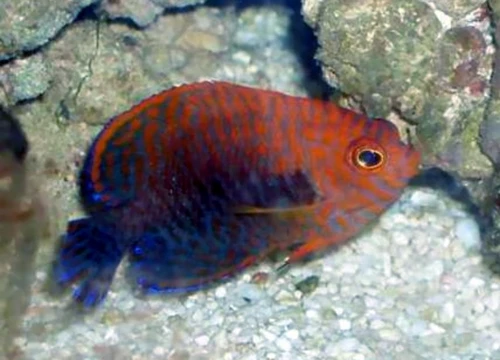
Centropyge shepardi presents as a compact, oval-bodied marine angelfish whose overall silhouette is defined by gently rounded dorsal and anal fins that taper to a slight point at their trailing edges. The species' most striking visual feature is its warm orange ground coloration, which can shift across a spectrum from a deep, almost red hue to a pale apricot tone. The upper portion of the body typically carries a marginally darker shade than the underside, creating a subtle gradient. Dark vertical bars usually cross the flanks, though in some individuals these markings shrink to a small blotch behind the gill cover, and on rare occasions the barring disappears entirely. Sexual dimorphism is visible in the males, whose soft-rayed sections of both the dorsal and anal fins are edged in a vivid blue. Structurally, the dorsal fin carries fourteen spines alongside sixteen to eighteen soft rays, while the anal fin bears three spines and seventeen to eighteen soft rays. The species reaches a maximum total length of just nine centimetres, underscoring its pygmy status among marine angelfishes.
Geographic Range and Range Limits
The mango angelfish occupies a notably restricted slice of the western Pacific Ocean, making its distribution one of the more limited among its pygmy angelfish relatives. Its confirmed core range encompasses the Northern Marianas Islands, Guam, and the Ogasawara Islands off southern Japan. More recently, populations have been documented on Yoron Island and Okinoerabu Island, both in southern Japan, suggesting a gradual westward or southward expansion of its known range. A record from the Izu Islands of Japan has been noted, though this is widely interpreted as representing vagrant individuals rather than an established population. Additionally, sightings from Palau and the Philippines have been reported in the literature, but these accounts remain unconfirmed and await verification. The species' overall footprint is thus confined to a scattered chain of island groups stretching from the Mariana arc down through the Ryukyu chain, with its presence beyond these core areas still debated among ichthyologists.
Reef Life, Social Structure, and Reproduction
Within its limited range, Centropyge shepardi is a fairly common sight on the reef, typically encountered between ten and fifty-six metres depth. It favours exposed outer reef slopes and, less frequently, lagoon reefs, showing a clear preference for zones where live and dead coral are intermixed and where abundant holes and caves offer shelter. Socially, the species forms small harems of three to seven individuals, a structure that centres on a dominant male. Its diet is overwhelmingly herbivorous, consisting largely of algae scraped from the reef substrate. Reproduction follows a broadcast-spawning pattern: spawning is believed to commence in September and occurs at dusk. The courtship ritual involves the male displaying to a chosen female, then pushing and chasing her until she releases her eggs, at which moment the male releases his sperm. The resulting eggs are free-floating and hatch after just two to three days, completing a brief but well-defined reproductive cycle typical of many reef-dwelling angelfishes.
Taxonomic History and the Man Behind the Name
The formal scientific description of Centropyge shepardi was published in 1979 by ichthyologist John Ernest Randall, who lived from 1924 to 2020, together with Fujio Yasuda. The type locality was designated as the western side of Cocos Island in Guam. The species' specific epithet is a tribute to John W. Shepard of the University of Guam, whose fieldwork proved that this angelfish coexists in the same waters as Centropyge bispinosa on Guam. Crucially, Shepard also drew Randall and Yasuda's attention to a key diagnostic difference: the two species possess different numbers of pectoral fin rays, a distinction that helped separate them taxonomically. In terms of broader classification, some taxonomic authorities assign the species to the subgenus Centropyge within the family Pomacanthidae. In the aquarium trade, the mango angelfish remains a rarity; on the occasions it does reach the market, it commands a notably high price, reflecting both its limited availability and the difficulty of sourcing specimens from its scattered island range.
Related in Russet angelfish
Links follow this subject's own source article.
Elsewhere in Russet angelfish
Spotted an error? Know more?
Reader corrections go straight into our review queue. Suggest an edit · How this site is sourced