
Caribbean reef shark (Carcharhinus perezii)
Source-cited species reference: taxonomy from WoRMS, biology from FishBase, occurrence map from GBIF, conservation from IUCN Red List, description from Wikipedia.
The Caribbean reef shark (Carcharhinus perezi) is a species of requiem shark, belonging to the family Carcharhinidae. It is found in the tropical waters of the western Atlantic Ocean from Florida to Brazil, and is the most commonly encountered reef shark in the Caribbean Sea. With a robust, streamlined body typical of the requiem sharks, this species is difficult to tell apart from other large members of its family such as the dusky shark (C. obscurus) and the silky shark (C. falciformis). Distinguishing characteristics include dusky-colored fins without prominent markings, a short free rear tip on the second dorsal fin, and tooth shape and number.
- Scientific name
- Carcharhinus perezii
- Authority
- (Poey, 1876)
- Family
- Carcharhinidae
- Order
- Carcharhiniformes
- Maximum length
- 300 cm
- Depth range
- 1–65 m
- Habitat zone
- reef-associated
- Iucn red list
- Endangered
- Gbif occurrence records
- 26,309
Classification (WoRMS)
Full classification as recorded by WoRMS: Kingdom: Animalia · Phylum: Chordata · Class: Elasmobranchii · Order: Carcharhiniformes · Family: Carcharhinidae · Genus: Carcharhinus.
Accepted name: Carcharhinus perezii · Authority: (Poey, 1876) · Taxonomic status: accepted · AphiaID: 271324.
Synonyms and superseded combinations recorded for this taxon: Carcharhinus perezi (Poey, 1876); Carcharhinus springeri (Bigelow & Schroeder, 1944); Eulamia springeri Bigelow & Schroeder, 1944; Platypodon perezii Poey, 1876.
Source: World Register of Marine Species (WoRMS) — https://www.marinespecies.org/aphia.php?p=taxdetails&id=271324 (CC BY 4.0). Accessed 2026-09-23.
Biology and life history (FishBase)
Measured values published by FishBase for Carcharhinus perezii. Only fields the database actually holds for this species are shown; these are database values, not aquarium guidance.
Maximum length: 300 cm · Depth range: 1–65 m · Habitat zone: reef-associated · Body shape: fusiform / normal · Vulnerability index: 90 of 100 · Fishery importance: commercial · Aquarium trade: never/rarely.
FishBase notes: Found on continental and insular shelves, often near drop-offs on the outer edges of reefs. May rest on the bottom (Ref. 9710). Usually found in reefs, at less than 30 m deep (Ref 26938). Feed on bony fishes, including bigeyes (Priacanthidae). Viviparous (Ref. 50449). Size at birth below 73 cm. A dangerous species implicated in an abortive attack on divers in the Caribbean. Meat is prepared dried salted for human consumption, hides for leather, liver for oil, carcasses for fish meal.
Source: FishBase species summary (SpecCode 879) — https://www.fishbase.se/summary/Carcharhinus-perezii.html (CC BY-NC 3.0 — non-commercial use only). Accessed 2026-09-23.
Distribution and occurrence records (GBIF)
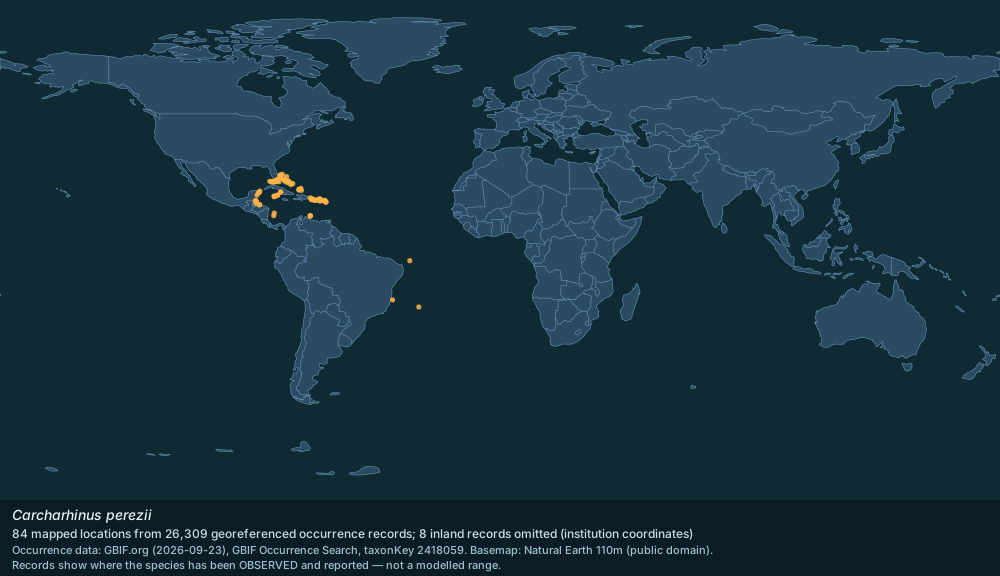
26,309 georeferenced occurrence records for Carcharhinus perezii are published through GBIF from 29 countries or marine areas. The map above plots 84 distinct locations from a sample of 3,000 records, omitting 8 inland records that carry an institution's coordinates rather than a collection site; it shows where the species has been observed and reported, not a modelled range.
Most records by country or area: United States of America (17,850); Puerto Rico (7,394); Bahamas (258); Colombia (178); Belize (96).
The full country table, WoRMS marine regions and the sampling notes are on this species' Distribution page.
Source: GBIF Occurrence Search (taxonKey 2418059) — https://www.gbif.org/occurrence/search?taxon_key=2418059&has_coordinate=true (records CC0 / CC BY); WoRMS distribution records (MarineRegions) — https://www.marinespecies.org/aphia.php?p=taxdetails&id=271324 (CC BY 4.0); Natural Earth 110m basemap — https://www.naturalearthdata.com/ (public domain). Accessed 2026-09-23.
Conservation status (IUCN Red List)
The IUCN Red List assesses Carcharhinus perezi (Poey, 1876) as Endangered (code EN). No trend, population estimate or threat analysis is given here, because none is available from this source without the Red List API; follow the source link for the full assessment, including its date.
Source: IUCN Red List of Threatened Species (taxon 60217) — https://www.iucnredlist.org/species/60217/0; GBIF IUCN Red List category endpoint (taxonKey 2418059) — https://api.gbif.org/v1/species/2418059/iucnRedListCategory. Accessed 2026-09-23.
Description and natural history (Wikipedia)
Measuring up to 3 m long, the Caribbean reef shark is one of the largest apex predators in the reef ecosystem, feeding on a variety of fishes and cephalopods. They have been documented resting motionless on the sea bottom or inside caves, unusual behavior for an active-swimming shark. If threatened, it may perform a threat display in which it frequently changes direction and dips its pectoral fins. Like other requiem sharks, it is viviparous with females giving birth to 4–6 young every other year. Caribbean reef sharks are of some importance to fisheries as a source of meat, leather, liver oil, and fishmeal, but recently they have become more valuable as an ecotourist attraction. In the Bahamas and elsewhere, bait is used to attract them to groups of divers in controversial "shark feedings". This species is responsible for a small number of attacks on humans. The shark attacks usually happen in spring and summer.
The Caribbean reef shark was originally described as Platypodon perezi by Felipe Poey in 1876, in the scientific journal Anales de la Sociedad Española de Historia Natural. The type specimens were six individuals caught off the coast of Cuba. The genus Platypodon was synonymized with Carcharhinus by later authors.
Based on morphological similarities, Jack Garrick in 1982 grouped this species with the bignose shark (C. altimus) and the sandbar shark (C. plumbeus), while Leonard Compagno in 1988 placed it as the sister species of the grey reef shark (C. amblyrhynchos). A phylogenetic analysis based on allozyme data, published by Gavin Naylor in 1992, indicated that the Caribbean reef shark is the sister taxon to a clade formed by the Galapagos shark (C. galapagensis), dusky shark (C. obscurus), oceanic whitetip shark (C. longimanus), and the blue shark (Prionace glauca). However, more work is required to fully resolve the interrelationships within Carcharhinus.
The earliest fossil teeth of the species are known from the Early Miocene of northern Brazil, Delaware (US), and Venezuela. Most fossil teeth of C. perezi are known from the east coast of the Americas, as with the modern distribution of the species, but they are also known from the Late Miocene of Portugal and the Pliocene of Italy.
The Caribbean reef shark occurs throughout the tropical western Atlantic Ocean, from North Carolina in the north to Brazil in the south, including Bermuda, the northern Gulf of Mexico, and the Caribbean Sea. However, it is extremely rare north of the Florida Keys. It prefers shallow waters on or around coral reefs, and is commonly found near the drop-offs at the reefs' outer edges. This shark is most common in water shallower than 30 m, but has been known to dive to 378 m.
A heavy-bodied shark with a "typical" streamlined shape, the Caribbean reef shark is difficult to distinguish from other large requiem shark species. It usually measures 2 - 2.5 m long; the maximum recorded length is 3 m and the maximum reported weight is 70 kg. The coloration is dark gray or gray-brown above and white or white-yellow below, with an inconspicuous white band on the flanks. The fins are not prominently marked, and the undersides of the paired fins, the anal fin, and the lower lobe of the caudal fin are dusky.
The snout is rather short, broad, and rounded, without prominent flaps of skin beside the nostrils. The eyes are large and circular, with nictitating membranes (protective third eyelids). There are 11–13 tooth rows in either half of both jaws. The teeth have broad bases, serrated edges, and narrow cusps; the front 2–4 teeth on each side are erect and the others increasingly oblique. The five pairs of gill slits are moderately long, with the third gill slit over the origin of the pectoral fins. The first dorsal fin is high and falcate (sickle-shaped). There is a low interdorsal ridge running behind it to the second dorsal fin, which is relatively large with a short free rear tip. The origin of the first dorsal fin lies over or slightly forward of the free rear tips of the pectoral fins, and that of the second dorsal fin lies over or slightly forward of the anal fin. The pectoral fins are long and narrow, tapering to a point. The dermal denticles are closely spaced and overlapping, each with five (sometimes seven in large individuals) horizontal low ridges leading to marginal teeth.
Despite its abundance in certain areas, the Caribbean reef shark is one of the least-studied large requiem sharks. They are believed to play a major role in shaping Caribbean reef communities. These sharks are more active at night, with no evidence of seasonal changes in activity or migration. Juveniles tend to remain in a localized area throughout the year, while adults range over a wider area.
Caribbean reef sharks are sometimes seen resting motionless on the sea floor or inside caves; it is the first active shark species in which such a behavior was reported. In 1975, Eugenie Clark investigated the famed "sleeping sharks" inside the caves at Isla Mujeres off the Yucatan Peninsula, and determined that the sharks were not actually asleep as their eyes would follow divers. Clark speculated that freshwater upwellings inside the caves might loosen parasites on the sharks and produce an enjoyable "narcotic" effect. If threatened, Caribbean reef sharks sometimes perform a threat display, in which they swim in a short, jerky fashion with frequent changes in direction and repeated, brief (1–1.2 second duration) drops of the pectoral fins. This display is less pronounced than the better-known display of the grey reef shark (C. amblyrhynchos).
Juvenile Caribbean reef sharks are preyed upon by larger sharks such as the tiger shark (Galeocerdo cuvier) and the bull shark (C. leucas). Few parasites are known for this species; one is a dark variegated leech often seen trailing from its first dorsal fin. Off northern Brazil, juveniles seek out cleaning stations occupied by yellownose gobies (Elacatinus randalli), which clean the sharks of parasites while they lie still on the bottom. Horse-eye jacks (Caranx latus) and bar jacks (Carangoides ruber) routinely school around Caribbean reef sharks.
The Caribbean reef shark feeds on a wide variety of reef-dwelling bony fishes and cephalopods, as well as some elasmobranchs such as eagle rays (Aetobatus narinari) and yellow stingrays (Urobatis jamaicensis). It is attracted to low-frequency sounds, which are indicative of struggling fish. In one observation of a 2 m long male Caribbean reef shark hunting a yellowtail snapper (Lutjanus crysurus), the shark languidly circled and made several seemingly "half-hearted" turns towards its prey, before suddenly accelerating and swinging its head sideways to capture the snapper at the corner of its jaws. Young sharks feed on small fishes, shrimps, and crabs. Caribbean reef sharks are capable of everting their stomachs, which likely serves to cleanse indigestible particles, parasites, and mucus from the stomach lining.
Reproduction is viviparous; once the developing embryos exhaust their supply of yolk, the yolk sac develops into a placental connection through which they receive nourishment from their mother. Mating is apparently an aggressive affair, as females are often found with biting scars and wounds on their sides. At the Fernando de Noronha Archipelago and Atol das Rocas off Brazil, parturition takes place at the end of the dry season from February to April, while at other locations in the Southern Hemisphere, females give birth during the Amazon summer in November and December. The average litter size is four to six, with a gestation period of one year. Females become pregnant every other year. The newborns measure no more than 74 cm long; males mature sexually at 1.5 - 1.7 m long and females at 2 - 3 m.
Normally shy or indifferent to the presence of
Source: Wikipedia: Caribbean reef shark — https://en.wikipedia.org/wiki/Caribbean_reef_shark (CC BY-SA 4.0). Accessed 2026-09-23.
Gallery
Related in Caribbean reef shark
Links follow this subject's own source article.
Elsewhere in Caribbean reef shark
Spotted an error? Know more?
Reader corrections go straight into our review queue. Suggest an edit · How this site is sourced