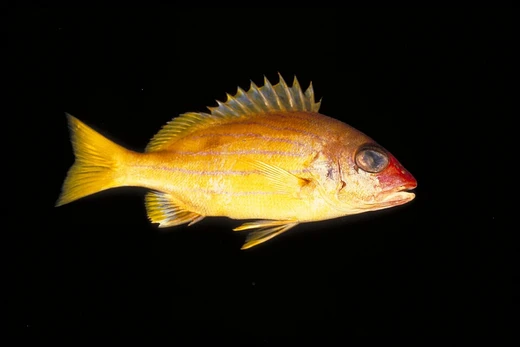
Bluestriped snapper (Lutjanus notatus)
Source-cited species reference: taxonomy from WoRMS, biology from FishBase, occurrence map from GBIF, conservation from IUCN Red List, description from Wikipedia.

The bluestriped snapper (Lutjanus notatus) is a species of marine ray-finned fish, a snapper belonging to the family Lutjanidae. It is found in the southwestern Indian Ocean.
- Scientific name
- Lutjanus notatus
- Authority
- (Cuvier, 1828)
- Family
- Lutjanidae
- Order
- Eupercaria incertae sedis
- Maximum length
- 25 cm
- Depth range
- 10–50 m
- Habitat zone
- reef-associated
- Iucn red list
- Least Concern
- Gbif occurrence records
- 134
Classification (WoRMS)
Full classification as recorded by WoRMS: Kingdom: Animalia · Phylum: Chordata · Class: Teleostei · Order: Eupercaria incertae sedis · Family: Lutjanidae · Genus: Lutjanus.
Accepted name: Lutjanus notatus · Authority: (Cuvier, 1828) · Taxonomic status: accepted · AphiaID: 218476.
Synonyms and superseded combinations recorded for this taxon: Diacope angulus Bennett, 1831; Diacope caeruleovittata Valenciennes, 1830; Diacope coeruleovittata Valenciennes, 1830; Diacope duodecemlineata Valenciennes, 1830; Diacope duodecimlineata Valenciennes, 1830; Diacope notata Cuvier, 1828; Lutianus duodecemlineatus (Valenciennes, 1830); Lutianus duodecimlineatus (Valenciennes, 1830); Lutjanus caeruleovittatus (Valenciennes, 1830); Lutjanus duodecemlineatus (Valenciennes, 1830); Lutjanus duodecimlineatus (Valenciennes, 1830); Lutjanus octolineatus Fourmanoir, 1957.
Source: World Register of Marine Species (WoRMS) — https://www.marinespecies.org/aphia.php?p=taxdetails&id=218476 (CC BY 4.0). Accessed 2026-09-23.
Biology and life history (FishBase)
Measured values published by FishBase for Lutjanus notatus. Only fields the database actually holds for this species are shown; these are database values, not aquarium guidance.
Maximum length: 25 cm · Common length: 20 cm · Depth range: 10–50 m · Habitat zone: reef-associated · Body shape: fusiform / normal · Vulnerability index: 15 of 100 · Fishery importance: commercial · Aquarium trade: never/rarely.
FishBase notes: Adults inhabit coral reefs where they occur usually solitarily or in small groups of about 5 to 10 individuals. They feed on fish and crustaceans (Ref. 5213).
Source: FishBase species summary (SpecCode 168) — https://www.fishbase.se/summary/Lutjanus-notatus.html (CC BY-NC 3.0 — non-commercial use only). Accessed 2026-09-23.
Distribution and occurrence records (GBIF)
134 georeferenced occurrence records for Lutjanus notatus are published through GBIF from 10 countries or marine areas. The map above plots 24 distinct locations from a sample of 134 records, omitting 7 inland records that carry an institution's coordinates rather than a collection site; it shows where the species has been observed and reported, not a modelled range.
Most records by country or area: Mozambique (76); South Africa (25); Madagascar (13); Réunion (7); Mauritius (5); Mayotte (3); Maldives (2); Indonesia (1); India (1); Philippines (1).
Marine regions with a valid WoRMS distribution record: Mozambican Exclusive Economic Zone; Madagascar; Mauritian Exclusive Economic Zone; Réunion Exclusive Economic Zone; South Africa (country).
Source: GBIF Occurrence Search (taxonKey 2384968) — https://www.gbif.org/occurrence/search?taxon_key=2384968&has_coordinate=true (records CC0 / CC BY); WoRMS distribution records (MarineRegions) — https://www.marinespecies.org/aphia.php?p=taxdetails&id=218476 (CC BY 4.0); Natural Earth 110m basemap — https://www.naturalearthdata.com/ (public domain). Accessed 2026-09-23.
Conservation status (IUCN Red List)
The IUCN Red List assesses Lutjanus notatus (Cuvier, 1828) as Least Concern (code LC). No trend, population estimate or threat analysis is given here, because none is available from this source without the Red List API; follow the source link for the full assessment, including its date.
Source: IUCN Red List of Threatened Species (taxon 154742) — https://www.iucnredlist.org/species/154742/0; GBIF IUCN Red List category endpoint (taxonKey 2384968) — https://api.gbif.org/v1/species/2384968/iucnRedListCategory. Accessed 2026-09-23.
Description and natural history (Wikipedia)
The bluestriped snapper was first formally described in 1828 by the French zoologist Georges Cuvier with the type locality given as the Indian Ocean. The specific name, notatus, means "marked", a reference to the black spot which is often visible below the dorsal fin.
The bluestriped snapper has a relatively deep body which has a standard length that is 2.5 to 2.7 times as long as the body at its deepest point. It has a steeply sloped forehead, and the preopercular incision and knob are well developed. The vomerine teeth are arranged in a crescent shaped patch with no central rearwards extension and there are no teeth on the tongue. The dorsal fin has 11-12 spines and 12-13 soft rays while the anal fin contains 3 spines and 7-8 soft rays. The rear of the dorsal fin and the anal fin are rounded. The pectoral fins have 15-16 rays and the caudal fin is truncate or weakly emarginate. This fish attains a maximum total length of 25 cm, although 20 cm is more typical. The head and the part of the back behind the head ate brownish, the flanks are yellow and the abdomen is pale yellowish white. There is a series of 6 thin blue horizontal stripes on the flanks, the highest three sloping upwards towards the base of the dorsal fin. There is a frequently dark spot on the lateral line, similar in size to the pupil, below the front of the soft rayed part of the dorsal fin. The fins are mostly yellow.
The bluestriped snapper is found in the southwestern Indian Ocean. It has been recorded from South Africa, Mozambique, Madagascar, Mauritius and Réunion. It has been recorded from India. The adults are found over coral reefs. They are found at depths between 10 and 50 m.
The bluestriped snapper is normally a solitary species but it has been known to form small schools of 5-10 individuals. It is a predatory fish which feeds on other fishes and benthic invertebrates.
The bluestriped snapper is fished for by artisanal fisheries wherever it occurs, however, only small quantities are observed in local markets They are taken with handlines, traps and gill nets.
Source: Wikipedia: Bluestriped snapper — https://en.wikipedia.org/wiki/Bluestriped_snapper (CC BY-SA 4.0). Accessed 2026-09-23.
Spotted an error? Know more?
Reader corrections go straight into our review queue. Suggest an edit · How this site is sourced