
Bluering angelfish (Pomacanthus annularis)
Source-cited species reference: taxonomy from WoRMS, biology from FishBase, occurrence map from GBIF, conservation from IUCN Red List, description from Wikipedia.

luluchouette · CC BY 4.0
The bluering angelfish (Pomacanthus annularis), also known as the annularis angelfish and the blue king angelfish, is a species of marine ray-finned fish, a marine angelfish belonging to the family Pomacanthidae. It is member of the genus Pomacanthus, composed of large marine angelfish.
- Scientific name
- Pomacanthus annularis
- Authority
- (Bloch, 1787)
- Family
- Pomacanthidae
- Order
- Acanthuriformes
- Maximum length
- 45 cm
- Depth range
- 1–60 m
- Habitat zone
- reef-associated
- Iucn red list
- Least Concern
- Gbif occurrence records
- 436
Taxonomy & Naming
The bluering angelfish carries a taxonomic history that stretches back nearly two and a half centuries. In 1795, the German physician and naturalist Marcus Elieser Bloch, who lived between 1723 and 1799, formally described the species under the name Chaetodon tricolor, designating the Indian Ocean as its type locality. Over time, classification shifted as scientists recognized it belonged to the family Pomacanthidae and the genus Pomacanthus, a group defined by its large marine angelfish members. Some taxonomic authorities go a step further, assigning the species to the subgenus Acanthochaetodon. The current specific epithet, annularis, is a direct reference to the distinctive ring-shaped blue mark positioned above the gill cover, a feature that makes the fish instantly recognizable. Beyond its scientific name, the species is also commonly called the annularis angelfish or the blue king angelfish, names that capture its regal coloration and the prominent circular marking that gives the species its identity.
Physical Appearance & Developmental Transformation
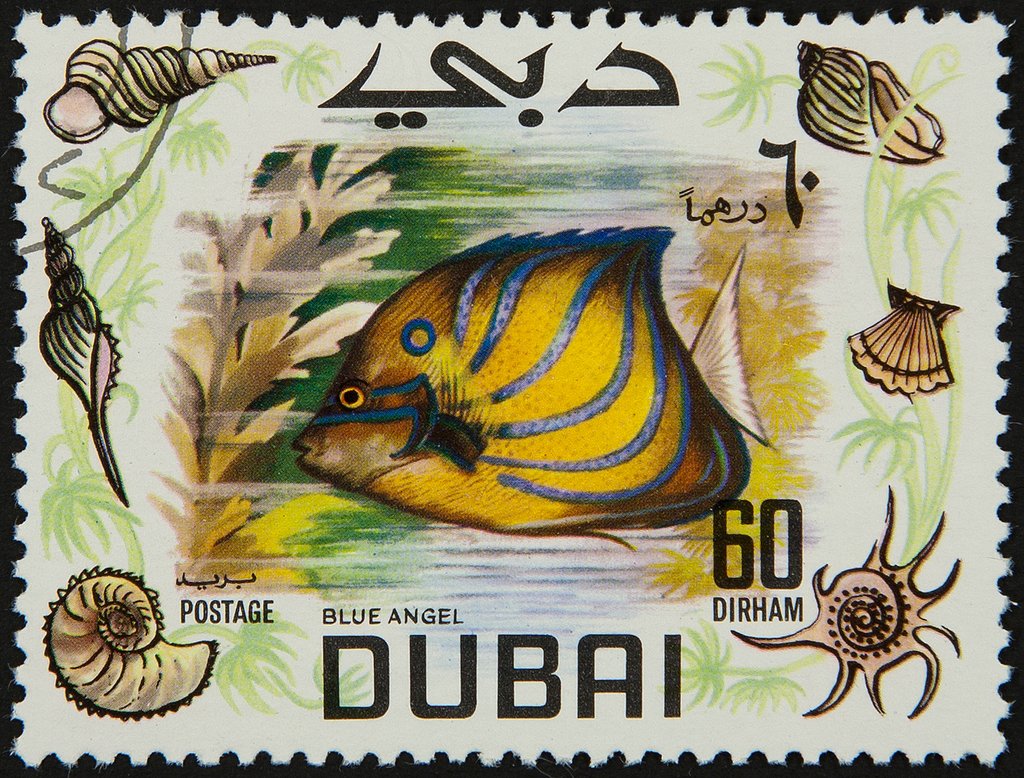
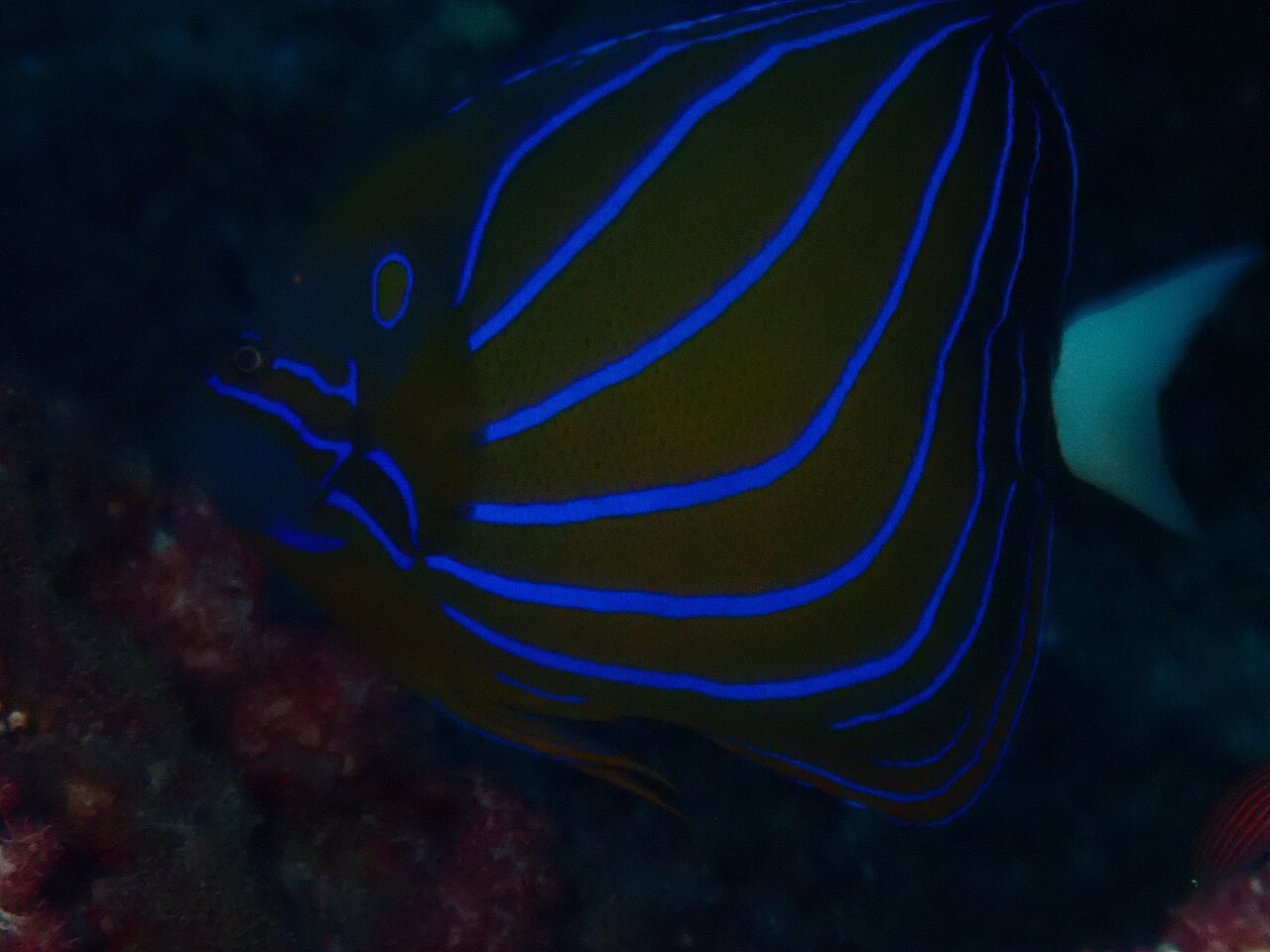
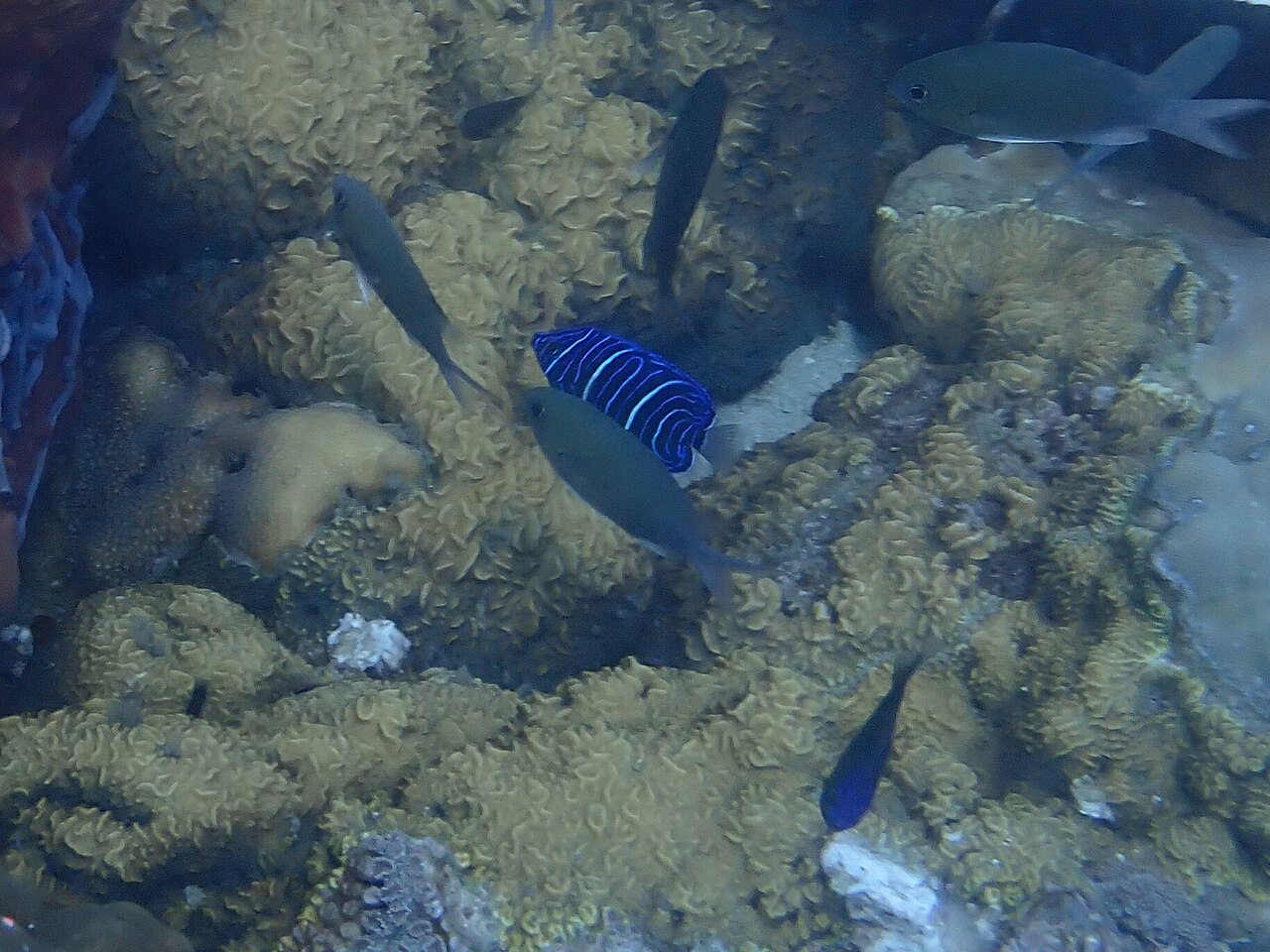
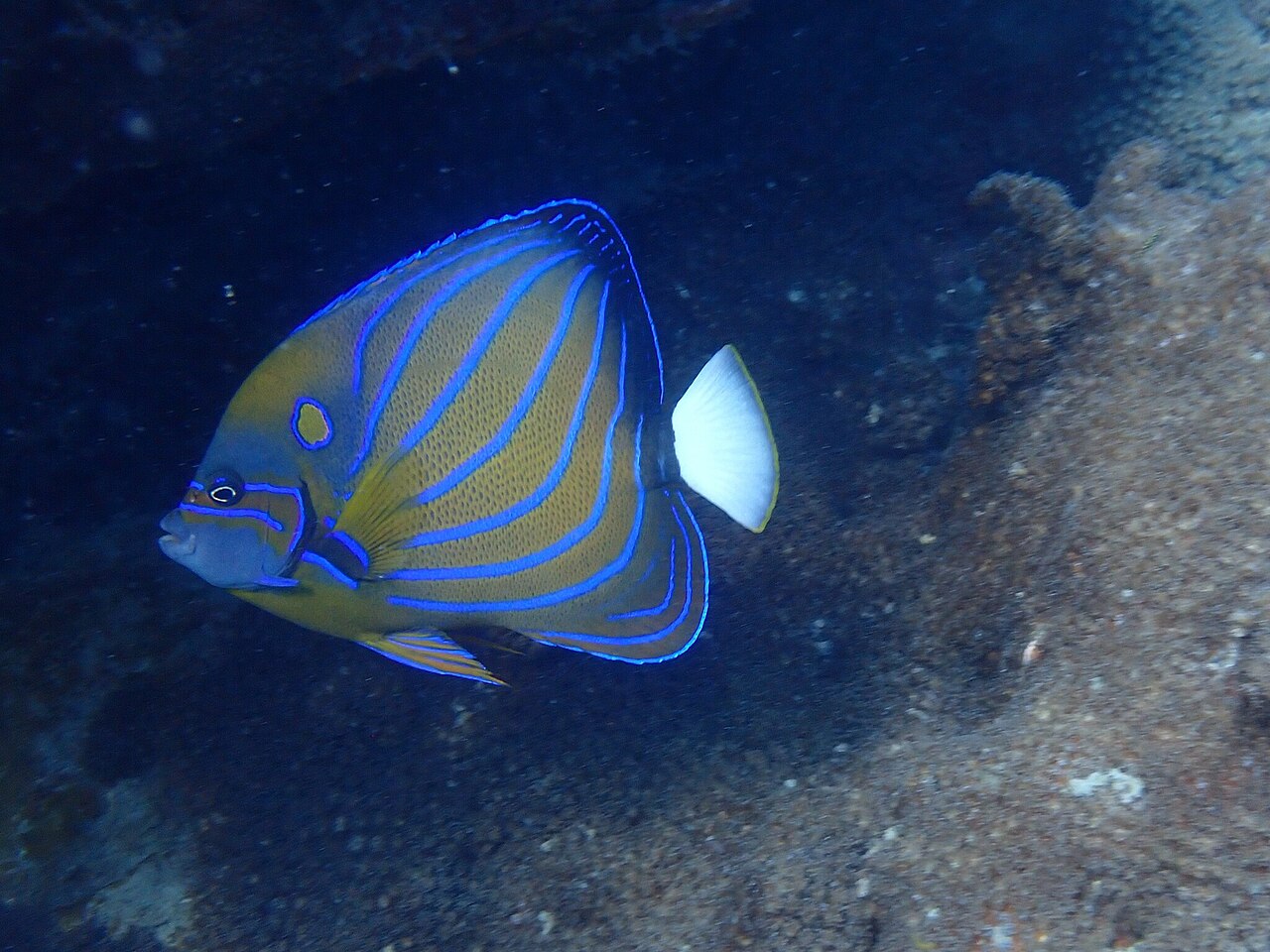
No other marine fish undergoes a more dramatic visual transformation than the bluering angelfish. Juveniles present as a dark, almost shadowy form, their bodies a deep bluish-black punctuated by thin, curved lines in white or pale blue. As they mature into adulthood, the entire palette inverts: the body becomes predominantly yellow, overlaid with bold arcing blue lines that sweep across the flanks. A striking blue circle sits above the operculum, and two parallel blue stripes cross the face—one threading through the eye and the other running just below it. The dorsal fin often extends into an elongated tip, while the tail fin is white edged with a yellow margin. Fin structure is consistent: the dorsal fin bears thirteen spines alongside twenty to twenty-one soft rays, and the anal fin carries three spines with twenty soft rays. At full growth, the species reaches a maximum total length of forty-five centimeters, roughly eighteen inches, making it one of the more substantial members of the large marine angelfish genus.
Social Structure & Reproductive Biology
The social world of the bluering angelfish is structured around a harem system shared with other members of the genus Pomacanthus. A single male establishes and defends a territory, within which he controls a small group of females. Observers frequently encounter these fish in pairs, suggesting the male-female bond is a constant feature of daily life. Reproduction follows a courtship ritual after which the pair releases eggs and sperm simultaneously into the water. Perhaps most remarkably, every individual begins life as a female. The species is a sequential hermaphrodite: during development, juveniles transition into males, and this biological shift is accompanied by the complete color transformation from the dark juvenile phase to the bright yellow-and-blue adult phase. Juveniles favor very shallow waters over rock or dead coral substrates where short filamentous algae grow, while adults expand their diet to include zooplankton, sponges, filamentous algae, and tunicates.
Range, Habitat & Human Encounter
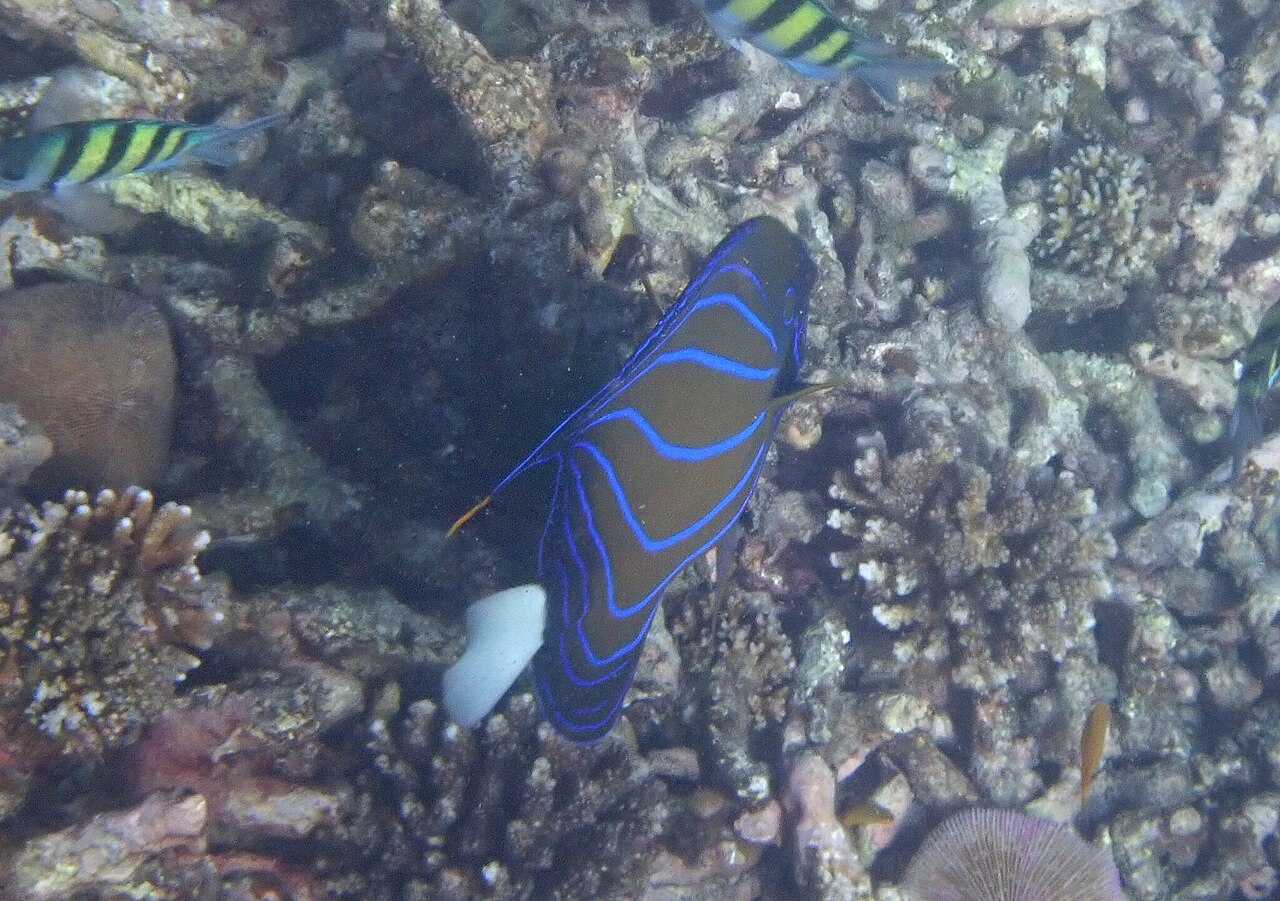
The bluering angelfish occupies a broad swath of the Indo-West Pacific, stretching from the coastlines of East Africa eastward through the waters surrounding Indonesia and New Guinea, and as far as New Caledonia. Its range extends northward to the southern waters of Japan, giving the species a distribution that spans tropical and subtropical latitudes. Within this range, the fish is a creature of coastal rocky coral reefs, though it is not strictly limited to open reef structures. Divers and researchers have also recorded individuals sheltering in underwater caves and resting among the remains of shipwrecks. The depth window for this species is relatively narrow, spanning from three to thirty meters—roughly ten to ninety-eight feet—placing it firmly in the sunlit zone where its preferred food sources thrive. Despite its striking appearance, the bluering angelfish is only infrequently encountered in the aquarium trade, suggesting that keeping one in captivity remains a rarity rather than a common practice among hobbyists.
Gallery
Frequently Asked Questions
Who is the Bluering angelfish (Pomacanthus annularis)?
The Bluering angelfish is a large marine angelfish in the family Pomacanthidae, also called the annularis angelfish or blue king angelfish. It sits within the genus Pomacanthus, the group that gathers the bigger species of marine angelfish.
How big does the Bluering angelfish (Pomacanthus annularis) grow?
This species reaches a maximum recorded length of roughly 45 centimeters, which firmly places it in the 'large angelfish' tier of its genus. That size makes it one of the more imposing members of the Pomacanthus lineup.
Where does the Bluering angelfish (Pomacanthus annularis) live?
It is a marine species documented at depths from about 1 meter down to 60 meters. Its geographic occurrence has been mapped through sources such as GBIF, confirming a presence in tropical and subtropical waters.
When and by whom was the Bluering angelfish first described?
The species was originally described by Bloch in 1787, giving it one of the longer scientific lineages among marine angelfish. Taxonomically it is placed in the order Acanthuriformes, family Pomacanthidae, genus Pomacanthus.
Why is the Bluering angelfish (Pomacanthus annularis) a notable species for reef enthusiasts?
As a large, visually striking member of the Pomacanthus genus, it has long drawn the attention of marine biologists and reef-keeping hobbyists alike. Its conservation status is monitored on the IUCN Red List, keeping the species on the radar of conservation-minded fans.
Spotted an error? Know more?
Reader corrections go straight into our review queue. Suggest an edit · How this site is sourced