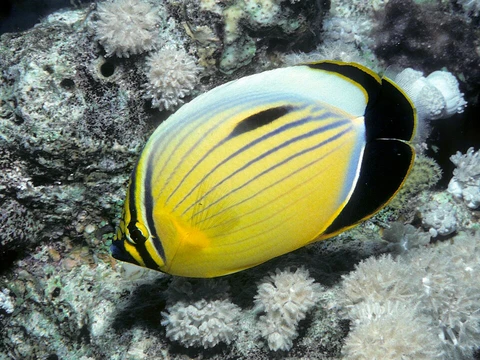
Blacktail butterflyfish (Chaetodon austriacus)
Source-cited species reference: taxonomy from WoRMS, biology from FishBase, occurrence map from GBIF, conservation from IUCN Red List, description from Wikipedia.

The blacktail butterflyfish (Chaetodon austriacus), also known as black-tailed butterflyfish or exquisite butterflyfish, is a species marine ray-finned fish, a butterflyfish belonging to the family Chaetodontidae. It is native to the western Indian Ocean but has reached the Mediterranean Sea as a Lessepsian migrant through the Suez Canal.
- Scientific name
- Chaetodon austriacus
- Authority
- Rüppell, 1836
- Family
- Chaetodontidae
- Order
- Acanthuriformes
- Maximum length
- 13 cm
- Depth range
- 1–15 m
- Habitat zone
- reef-associated
- Iucn red list
- Least Concern
- Gbif occurrence records
- 1,055
Classification (WoRMS)
Full classification as recorded by WoRMS: Kingdom: Animalia · Phylum: Chordata · Class: Teleostei · Order: Acanthuriformes · Family: Chaetodontidae · Genus: Chaetodon.
Accepted name: Chaetodon austriacus · Authority: Rüppell, 1836 · Taxonomic status: accepted · AphiaID: 218732.
Synonyms and superseded combinations recorded for this taxon: Chaetodon klunzingeri Kossman & Räuber, 1877; Chaetodon trifasciatus austriacus Rüppell, 1836; Chaetodon trifasciatus klunzingeri Kossman & Räuber, 1877; Citharoedus austriacus (Rüppell, 1836); Mesochaetodon corallochaetodon austriacus (Rüppell, 1836).
Source: World Register of Marine Species (WoRMS) — https://www.marinespecies.org/aphia.php?p=taxdetails&id=218732 (CC BY 4.0). Accessed 2026-09-23.
Biology and life history (FishBase)
Measured values published by FishBase for Chaetodon austriacus. Only fields the database actually holds for this species are shown; these are database values, not aquarium guidance.
Maximum length: 13 cm · Depth range: 1–15 m · Habitat zone: reef-associated · Body shape: short and / or deep · Vulnerability index: 15 of 100 · Fishery importance: commercial · Aquarium trade: commercial.
FishBase notes: Found in coral rich areas; juveniles confined to single coral heads (Ref. 9710). Territorial and usually in pairs. Mainly diurnal. Oviparous (Ref. 205). Form pairs during breeding (Ref. 205).
Source: FishBase species summary (SpecCode 6514) — https://www.fishbase.se/summary/Chaetodon-austriacus.html (CC BY-NC 3.0 — non-commercial use only). Accessed 2026-09-23.
Distribution and occurrence records (GBIF)
1,055 georeferenced occurrence records for Chaetodon austriacus are published through GBIF from 8 countries or marine areas. The map above plots 46 distinct locations from a sample of 1,055 records, omitting 7 inland records that carry an institution's coordinates rather than a collection site; it shows where the species has been observed and reported, not a modelled range.
Most records by country or area: Egypt (847); Saudi Arabia (102); Israel (58); Jordan (31); Yemen (8).
The full country table, WoRMS marine regions and the sampling notes are on this species' Distribution page.
Source: GBIF Occurrence Search (taxonKey 2385336) — https://www.gbif.org/occurrence/search?taxon_key=2385336&has_coordinate=true (records CC0 / CC BY); WoRMS distribution records (MarineRegions) — https://www.marinespecies.org/aphia.php?p=taxdetails&id=218732 (CC BY 4.0); Natural Earth 110m basemap — https://www.naturalearthdata.com/ (public domain). Accessed 2026-09-23.
Conservation status (IUCN Red List)
The IUCN Red List assesses Chaetodon austriacus Rüppell, 1836 as Least Concern (code LC). No trend, population estimate or threat analysis is given here, because none is available from this source without the Red List API; follow the source link for the full assessment, including its date.
Source: IUCN Red List of Threatened Species (taxon 165634) — https://www.iucnredlist.org/species/165634/0; GBIF IUCN Red List category endpoint (taxonKey 2385336) — https://api.gbif.org/v1/species/2385336/iucnRedListCategory. Accessed 2026-09-23.
Description and natural history (Wikipedia)
The species is native to the Red Sea and southern Oman. A single record was reported in 2011 in the vicinity of Tel Aviv (Israel), a likely migrant from the Red Sea.
Together with the melon (C. trifasciatus) and oval (C. lunulatus) butterflyfishes and probably also the somewhat aberrant Arabian butterflyfish (C. melapterus), the blacktail butterflyfish makes up the subgenus Corallochaetodon. They are probably quite close to the subgenus called Citharoedus (that name is a junior homonym of a mollusc genus), which contains for example the scrawled butterflyfish (C. meyeri). Like that group, they might be separated in Megaprotodon if the genus Chaetodon is split up.
The black-tailed butterflyfish is up to 14 cm long and is orange with thin, curved black stripes. Its anal fin and tail are black. The body of juveniles is whiter above with white bands on the tail. The melon butterflyfish (C. trifasciatus) and the oval butterflyfish (C. lunulatus) are similar in coloration but have less black on the caudal and anal fins.
Black-tailed butterflyfishes tend to be found in coral-rich areas between 0.5 and 20 m deep, on seaward reefs or in lagoons or bays. Adults are generally found in pairs patrolling a territory or range while juveniles are found among coral branches. This species grazes on coral polyps and sea anemone tentacles.
Source: Wikipedia: Blacktail butterflyfish — https://en.wikipedia.org/wiki/Blacktail_butterflyfish (CC BY-SA 4.0). Accessed 2026-09-23.
Frequently Asked Questions
Who is Blacktail butterflyfish (Chaetodon austriacus)?
It is a small, colorful marine butterflyfish in the family Chaetodontidae, first formally described by Rüppell back in 1836. The species tops out at roughly 13 cm in length and is most at home in the shallow waters of the western Indian Ocean.
What are Blacktail butterflyfish (Chaetodon austriacus)'s powers/role?
As a reef-dwelling fish that patrols between 1 and 15 meters depth, it helps keep coral communities in balance by grazing on tiny invertebrates and algal films. Its compact, laterally compressed body lets it slip into tight crevices in live coral to evade predators.
Why is Blacktail butterflyfish (Chaetodon austriacus) important?
It acts as a useful bio-indicator for the health of western Indian Ocean coral reefs. Its successful colonisation of the Mediterranean also makes it a textbook case of how canal connections and warming waters are redrawing marine biogeographic boundaries.
Where can I find Blacktail butterflyfish (Chaetodon austriacus)?
Look for it on shallow reef flats and lagoonal zones in the western Indian Ocean, typically between 1 and 15 meters depth. Sighting reports have also spread into the eastern Mediterranean, where it arrived as a Suez Canal migrant.
Related in Blacktail butterflyfish
Links follow this subject's own source article.
Elsewhere in Blacktail butterflyfish
Spotted an error? Know more?
Reader corrections go straight into our review queue. Suggest an edit · How this site is sourced