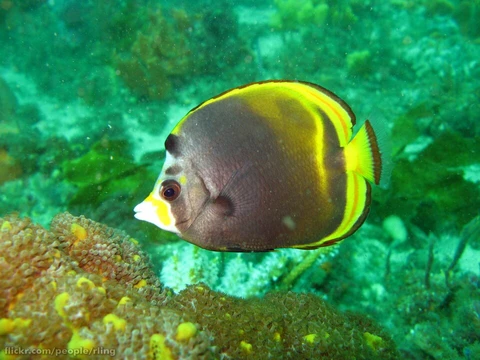
Black butterflyfish (Chaetodon flavirostris)
Source-cited species reference: taxonomy from WoRMS, biology from FishBase, occurrence map from GBIF, conservation from IUCN Red List, description from Wikipedia.

The Black Butterflyfish (Chaetodon flavirostris), also known as the dusky butterflyfish, is a species of marine ray-finnedfish, a butterflyfish belonging to the family Chaetodontidae. It is native to the Pacific Ocean.
- Scientific name
- Chaetodon flavirostris
- Authority
- Günther, 1874
- Family
- Chaetodontidae
- Order
- Acanthuriformes
- Maximum length
- 20 cm
- Depth range
- 2–30 m
- Habitat zone
- reef-associated
- Iucn red list
- Least Concern
- Gbif occurrence records
- 3,286
Classification (WoRMS)
Full classification as recorded by WoRMS: Kingdom: Animalia · Phylum: Chordata · Class: Teleostei · Order: Acanthuriformes · Family: Chaetodontidae · Genus: Chaetodon.
Accepted name: Chaetodon flavirostris · Authority: Günther, 1874 · Taxonomic status: accepted · AphiaID: 273337.
Synonyms and superseded combinations recorded for this taxon: Chaetodon aphrodite Ogilby, 1889; Chaetodon dorsiocellatus Ahl, 1923; Chaetodontops flavirostris (Günther, 1874).
Source: World Register of Marine Species (WoRMS) — https://www.marinespecies.org/aphia.php?p=taxdetails&id=273337 (CC BY 4.0). Accessed 2026-09-23.
Biology and life history (FishBase)
Measured values published by FishBase for Chaetodon flavirostris. Only fields the database actually holds for this species are shown; these are database values, not aquarium guidance.
Maximum length: 20 cm · Depth range: 2–30 m · Habitat zone: reef-associated · Body shape: short and / or deep · Vulnerability index: 10 of 100 · Fishery importance: commercial · Aquarium trade: commercial.
FishBase notes: Found in coral rich to algae-covered rocky areas of lagoon and seaward reefs including estuarine areas. Usually paired (Ref. 9710). Omnivorous and feeds on algae, coral, and small benthic invertebrates. Oviparous (Ref. 205). Form pairs during breeding (Ref. 205). Maintaining this species in captivity is difficult.
Source: FishBase species summary (SpecCode 6527) — https://www.fishbase.se/summary/Chaetodon-flavirostris.html (CC BY-NC 3.0 — non-commercial use only). Accessed 2026-09-23.
Distribution and occurrence records (GBIF)
3,286 georeferenced occurrence records for Chaetodon flavirostris are published through GBIF from 17 countries or marine areas. The map above plots 144 distinct locations from a sample of 3,000 records, omitting 23 inland records that carry an institution's coordinates rather than a collection site; it shows where the species has been observed and reported, not a modelled range.
Most records by country or area: Australia (2,488); New Caledonia (451); Tonga (120); Norfolk Island (109); French Polynesia (79).
The full country table, WoRMS marine regions and the sampling notes are on this species' Distribution page.
Source: GBIF Occurrence Search (taxonKey 2385545) — https://www.gbif.org/occurrence/search?taxon_key=2385545&has_coordinate=true (records CC0 / CC BY); WoRMS distribution records (MarineRegions) — https://www.marinespecies.org/aphia.php?p=taxdetails&id=273337 (CC BY 4.0); Natural Earth 110m basemap — https://www.naturalearthdata.com/ (public domain). Accessed 2026-09-23.
Conservation status (IUCN Red List)
The IUCN Red List assesses Chaetodon flavirostris Günther, 1874 as Least Concern (code LC). No trend, population estimate or threat analysis is given here, because none is available from this source without the Red List API; follow the source link for the full assessment, including its date.
Source: IUCN Red List of Threatened Species (taxon 165688) — https://www.iucnredlist.org/species/165688/0; GBIF IUCN Red List category endpoint (taxonKey 2385545) — https://api.gbif.org/v1/species/2385545/iucnRedListCategory. Accessed 2026-09-23.
Description and natural history (Wikipedia)
The black butterflyfish has a darkish bluish-grey body with a contrasting white mouth, and a narrow yellow band on its snout. There is a dark darker bump on the forehead. The dorsal, anal, and caudal fins are yellow. There is an orange band which runs across the dorsal and anal fins and across the caudal peduncle, these fins also have black margins, as does the tail. Juveniles have paler grey bodies and yellow median fins. The dorsal fin has 12-13 spines and 24-27 soft rays while the anal fin has 3 spines and 20-21 soft rays. This species reaches a maximum total length of 20 cm.
The black butterflyfish is found in the southern Pacific Ocean where it occurs from the Great Barrier Reef and New South Wales, Lord Howe Island east as far as Easter Island, including American Samoa, the Cook Islands, Fiji, French Polynesia, New Caledonia, Niue, Norfolk Island, Pitcairn Island, Samoa, the Solomon Island, Tonga, Vanuatu, and Wallis and Futuna. The record from Easter Island is thought to refer to a vagrant. It is also found in the Indian Ocean in the Cocos (Keeling) Islands.
The black butterflyfish is found at depths of 2 to 20 m in rocky areas which have good coverage of coral and algae in lagoons and on seaward reefs, they can occur in estuaries. It is an omnivorous species, consuming algae, coral, and small benthic invertebrates. They are oviparous and breed as pairs. They also live as a pair. In some areas aggregations are known. The juveniles are found in protected inner reefs.
The black butterflyfish was first formally described in 1874 by the German born British ichthyologist Albert Günther (1830-1914) with the type locality given as Vavau, Tonga. It belongs to the large subgenus Rabdophorus which might warrant recognition as a distinct genus. In this group close relatives appear to be the diagonal butterflyfish (Chaetodon fasciatus), the raccoon butterflyfish (C. lunula) and the Philippine butterflyfish (C. adiergastos), and perhaps also the unusual red-tailed butterflyfish (C. collare). Although the colouration of this group varies quite a lot, they are all largish butterflyfishes with an oval outline, and most have a pattern of ascending oblique stripes on the flanks. Except in the red-tailed butterflyfish, there is at least a vestigial form of the "raccoon" mask, with a white space between the dark crown and eye areas.
The black butterflyfish is occasionally found in the aquarium trade but this species does not thrive in captivity and has a poor survival rate in transit too.
Source: Wikipedia: Black butterflyfish — https://en.wikipedia.org/wiki/Black_butterflyfish (CC BY-SA 4.0). Accessed 2026-09-23.
Frequently Asked Questions
What is the Black butterflyfish (Chaetodon flavirostris)?
It is a small, dusky-colored marine butterflyfish in the family Chaetodontidae, commonly called the dusky butterflyfish. The species was first formally described by Günther in 1874 and sits within the order Acanthuriformes.
Where does the Black butterflyfish live in the wild?
This species is native to the Pacific Ocean and is typically found in shallow reef waters ranging from about 2 to 30 meters below the surface. Its distribution is tied to tropical and subtropical Pacific habitats.
How big does the Black butterflyfish get?
Adults top out at roughly 20 centimeters in total length, placing it among the smaller members of the Chaetodon genus. That modest size makes it a popular subject for larger reef aquariums.
What role does the Black butterflyfish play in its ecosystem?
As a reef-dwelling butterflyfish, it forages on small invertebrates and organic matter in its shallow Pacific habitat, contributing to nutrient cycling on coral reefs. Its presence is one indicator of a healthy, functioning reef community.
Is the Black butterflyfish at risk of extinction?
The species is monitored through the IUCN Red List, but it is not currently flagged as critically threatened. Its broad Pacific range and use of common shallow-reef habitats give it a relatively stable population outlook.
Related in Black butterflyfish
Links follow this subject's own source article.
Elsewhere in Black butterflyfish
Spotted an error? Know more?
Reader corrections go straight into our review queue. Suggest an edit · How this site is sourced