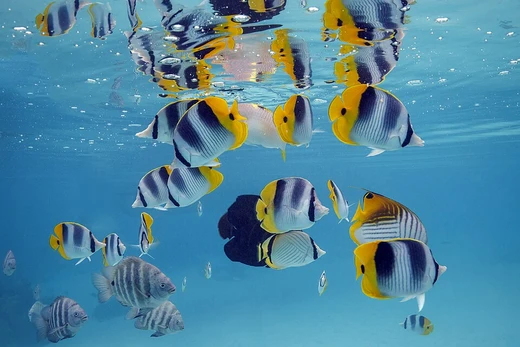
Raccoon butterflyfish
A nocturnal butterflyfish with a raccoon-like facial mask.

The raccoon butterflyfish (Chaetodon lunula) is a marine ray-finned fish in the family Chaetodontidae, known by many common names including the crescent-masked, lunule, halfmoon, moon, and redstriped butterflyfish, as well as simply "raccoon" or "raccoon coralfish." It lives in the Indian and Pacific Oceans. Its most recognizable feature is a facial pattern of black and white bands around the eyes that resembles a raccoon's mask, and it is active mainly at night.
In terms of classification, the species was first described in 1802 by French naturalist Bernard Germain de Lacépède, who placed it in the genus *Pomacentrus* with the type locality given as the Indian Ocean. It belongs to the large subgenus *Rabdophorus*, which some experts think might be a distinct genus. Its closest relative is likely the Red Sea raccoon butterflyfish (*Chaetodon fasciatus*), which looks very similar. Other close relatives include the black butterflyfish (*C. flavirostris*), the Philippine butterflyfish (*C. adiergastos*), and possibly the redtail butterflyfish (*C. collare*). While their colors vary greatly, all are relatively large, oval-shaped butterflyfishes, and most have a pattern of ascending oblique stripes on their sides. Except for the red-tailed species, they all have at least a hint of the "raccoon" mask—a white area between dark patches on the crown and around the eye.
These fish can grow up to 20 cm (nearly 8 inches) long. Their oval bodies are marked with ascending reddish stripes on the flanks, a black spot on the caudal peduncle (the base of the tail), and oblique yellow stripes behind the head. They have 10 to 14 dorsal spines and 3 anal spines.
Raccoon butterflyfish are nocturnal and usually live in small groups. Adults feed mainly on nudibranchs and small invertebrates, but they also eat algae and coral polyps.
Their range is wide across the tropical Indo-Pacific, from East Africa to the Hawaiian and Marquesan islands, north to southern Japan, and also in the southeast Atlantic off South Africa. They prefer seaward reefs and shallow reef flats in lagoons, at depths of over 30 meters.
In an aquarium, they are generally not aggressive toward other fish, except toward lionfish and triggerfish. Their typical lifespan in captivity is five to seven years.
Quick Facts
- Genus
- Chaetodon
- Parent
- Chaetodon (Rabdophorus)
- Species
- lunula
Facts from the source article.
Lore & Background
Chaetodon lunula was first formally described as Pomacentrus lunula in 1802 by the French naturalist Bernard Germain de Lacépède, with the type locality given as 'the Indian Ocean'. It belongs to the large subgenus Rabdophorus, which might warrant recognition as a distinct genus. In this group, its closest relative is probably the very similar Red Sea raccoon butterflyfish or diagonal butterflyfish, C. fasciatus. Other close relatives appear to be the black butterflyfish, C. flavirostris, Philippine butterflyfish, C. adiergastos, and perhaps also the unusual redtail butterflyfish, C. collare. Although the coloration of this group varies greatly, they are all largish butterflyfishes with an oval outline, and most have a pattern of ascending oblique stripes on the flanks. Except in the red-tailed butterflyfish, there is at least a vestigial form of the 'raccoon' mask, with a white space between the dark crown and eye areas.
Reader's Guide
The raccoon butterflyfish is a nocturnal species that usually lives in small groups. Adults feed mainly on nudibranchs and small invertebrates, but also on algae and coral polyps. This species can be found widely throughout the tropical Indo-Pacific region (East Africa to the Hawaiian and Marquesan islands, north to southern Japan) and in the southeast Atlantic (South Africa). It prefers seaward reefs and shallow reef flats of lagoon, at a depth of over 30 m. In the aquarium, the raccoon butterflyfish is generally not aggressive towards other fish, with the exception of lionfish and triggerfish. In captivity, the typical lifespan is five to seven years. It has been observed as a beneficial predator of Aiptasia and Majano sea anemones, eliminating this nuisance pest within a two- to six-week period depending on the anemone population and size of the tank; however, it will eagerly feed on any soft corals and may cause more harm than good to the decoration. In a confined environment, this species is prone to succumbing to 'marine ich', infection by the ciliate Cryptocaryon irritans.
More in Butterflyfish, Part 2 1-24
Spotted an error? Know more?
Reader corrections go straight into our review queue. Suggest an edit · How this site is sourced