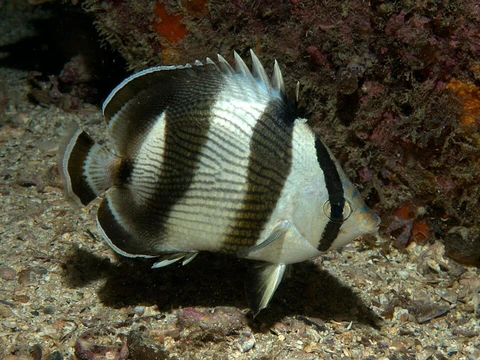
Banded butterflyfish (Chaetodon striatus)
Source-cited species reference: taxonomy from WoRMS, biology from FishBase, occurrence map from GBIF, conservation from IUCN Red List, description from Wikipedia.

The banded butterflyfish (Chaetodon striatus) is a species of marine ray-finned fish, a butterflyfish found in the tropical western Atlantic Ocean from Brazil to Bermuda. Common names include the banded butterflyfish, the butterbun, the butterflyfish, the Portuguese butterfly, the school mistress and the banded mariposa.
- Scientific name
- Chaetodon striatus
- Authority
- Linnaeus, 1758
- Family
- Chaetodontidae
- Order
- Acanthuriformes
- Maximum length
- 16 cm
- Depth range
- 3–70 m
- Habitat zone
- reef-associated
- Iucn red list
- Least Concern
- Gbif occurrence records
- 32,276
Classification (WoRMS)
Full classification as recorded by WoRMS: Kingdom: Animalia · Phylum: Chordata · Class: Teleostei · Order: Acanthuriformes · Family: Chaetodontidae · Genus: Chaetodon.
Accepted name: Chaetodon striatus · Authority: Linnaeus, 1758 · Taxonomic status: accepted · AphiaID: 159663.
Synonyms and superseded combinations recorded for this taxon: Anisochaetodon trivirgatus Weber & de Beaufort, 1936; Chaetodon consuelae Mowbray, 1928; Chaetodon striatus albipinnis Ahl, 1923; Chaetodon striatus dorsimacula Ahl, 1923.
Source: World Register of Marine Species (WoRMS) — https://www.marinespecies.org/aphia.php?p=taxdetails&id=159663 (CC BY 4.0). Accessed 2026-09-23.
Biology and life history (FishBase)
Measured values published by FishBase for Chaetodon striatus. Only fields the database actually holds for this species are shown; these are database values, not aquarium guidance.
Maximum length: 16 cm · Depth range: 3–70 m · Habitat zone: reef-associated · Body shape: short and / or deep · Vulnerability index: 10 of 100 · Fishery importance: commercial · Aquarium trade: commercial.
FishBase notes: Maximum depth from Ref. 126840. Inhabit coral reefs. Occur singly or in pairs. Feed on polychaete worms, coral polyps, crustaceans and mollusk eggs. Oviparous (Ref. 205), monogamous (Ref. 52884). Form pairs during breeding (Ref. 205). Adults may form plankton-feeding aggregations of up to 20 individuals, and occasionally clean other reef fishes which join the group, such as grunts, parrotfishes and surgeon fishes. (Ref: 40093). Generally common (Ref. 9710).
Source: FishBase species summary (SpecCode 3606) — https://www.fishbase.se/summary/Chaetodon-striatus.html (CC BY-NC 3.0 — non-commercial use only). Accessed 2026-09-23.
Distribution and occurrence records (GBIF)
32,276 georeferenced occurrence records for Chaetodon striatus are published through GBIF from 42 countries or marine areas. The map above plots 148 distinct locations from a sample of 3,000 records, omitting 44 inland records that carry an institution's coordinates rather than a collection site; it shows where the species has been observed and reported, not a modelled range.
Most records by country or area: United States of America (20,759); Brazil (5,064); Puerto Rico (2,928); Virgin Islands (U.S.) (770); Bonaire, Sint Eustatius and Saba (386).
The full country table, WoRMS marine regions and the sampling notes are on this species' Distribution page.
Source: GBIF Occurrence Search (taxonKey 7906686) — https://www.gbif.org/occurrence/search?taxon_key=7906686&has_coordinate=true (records CC0 / CC BY); WoRMS distribution records (MarineRegions) — https://www.marinespecies.org/aphia.php?p=taxdetails&id=159663 (CC BY 4.0); Natural Earth 110m basemap — https://www.naturalearthdata.com/ (public domain). Accessed 2026-09-23.
Conservation status (IUCN Red List)
The IUCN Red List assesses Chaetodon striatus Linnaeus, 1758 as Least Concern (code LC). No trend, population estimate or threat analysis is given here, because none is available from this source without the Red List API; follow the source link for the full assessment, including its date.
Source: IUCN Red List of Threatened Species (taxon 165637) — https://www.iucnredlist.org/species/165637/0; GBIF IUCN Red List category endpoint (taxonKey 7906686) — https://api.gbif.org/v1/species/7906686/iucnRedListCategory. Accessed 2026-09-23.
Description and natural history (Wikipedia)
The name is derived from the dark vertical bands on the fish's body. This, combined with a vertical, black bar through the eye, is an antipredator adaptation, the bands disrupting the body's outlines.
The banded butterflyfish grows to a maximum length of about 16 cm. The dorsal fin has 12 spines and 19 to 21 soft rays. The anal fin has 3 spines and 16 to 17 soft rays. The colour of this fish is silvery with a slender black bar passing through its eye, two wide black bars in mid-body and a third wide bar that starts on the rear of the dorsal fin and continues to the caudal peduncle. The pelvic fins and the caudal fin are black.
This fish is native to the tropical and subtropical western Atlantic Ocean at depths down to about 55 m but mostly in less than 20 m. Its range extends from Massachusetts in the United States to Santa Catarina in Brazil, and includes the Caribbean Sea, the Gulf of Mexico, Bermuda and Saint Peter and Saint Paul Archipelago. It is a benthic fish and is found on coral reefs.
The banded butterflyfish is usually seen singly or in pairs, but can occur in small shoals of about twenty individuals. The diet is mainly small invertebrates, crustaceans, coral polyps, polychaete worms, tube worms, sea anemones and various eggs. It also feeds on plankton in the water column, in schools of up to 20 individuals. Sometimes it will act as a cleaning fish and remove the external parasites from surgeon fishes, grunts and parrot fishes.
C. striatus is a common species with a wide range. Although it is sometimes harvested for the reef aquarium trade, this is not thought to significantly impact the population which is believed to be stable. For these reasons, the International Union for Conservation of Nature has rated the fish's conservation status as being of "least concern".
Source: Wikipedia: Banded butterflyfish — https://en.wikipedia.org/wiki/Banded_butterflyfish (CC BY-SA 4.0). Accessed 2026-09-23.
Frequently Asked Questions
What is the Banded butterflyfish (Chaetodon striatus)?
It is a small marine butterflyfish native to the tropical western Atlantic, ranging from Brazilian coastal waters up to Bermuda. Linnaeus first described the species in 1758, and it belongs to the Chaetodontidae family.
Where can you find the Banded butterflyfish in the wild?
This species inhabits tropical western Atlantic waters, stretching from Brazil all the way north to Bermuda. It is typically encountered at depths between 3 and 70 meters, making it a common sight in both shallow and moderately deep reef zones.
How large does a Banded butterflyfish grow?
Adults top out at roughly 16 centimeters in total length, which makes them a modestly sized reef fish. That compact build lets them navigate tight coral structures while remaining easy to spot for snorkelers and divers.
What other common names does the Banded butterflyfish go by?
Depending on the region, people also call it the butterbun, the Portuguese butterfly, the school mistress, or the banded mariposa. Every one of those names refers to the same Chaetodon striatus species.
What is the Banded butterflyfish's taxonomic classification?
It sits in the family Chaetodontidae within the order Acanthuriformes, placing it firmly among the true butterflyfishes. Its binomial name, Chaetodon striatus, was established by Linnaeus in 1758 and remains the accepted authority citation today.
Related in Banded butterflyfish
Links follow this subject's own source article.
Elsewhere in Banded butterflyfish
Spotted an error? Know more?
Reader corrections go straight into our review queue. Suggest an edit · How this site is sourced