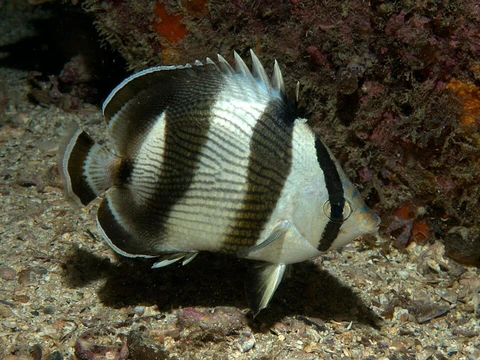
Where Banded butterflyfish has been recorded
GBIF occurrence records for Chaetodon striatus, mapped and tabulated by country.

32,276 georeferenced occurrence records with coordinates are published for Chaetodon striatus through GBIF, from 42 countries or marine areas. This page maps those records and lists where they come from. Occurrence records reflect where people have looked as well as where the species lives, so well-surveyed coastlines are over-represented.
- Georeferenced records
- 32,276
- Countries / areas
- 42
- Mapped locations
- 148
- Records sampled for the map
- 3,000
- Inland records omitted
- 44
- Gbif taxonkey
- 7906686
Countries and areas with the most records (GBIF)
United States of America — 20,759 records; Brazil — 5,064 records; Puerto Rico — 2,928 records; Virgin Islands (U.S.) — 770 records; Bonaire, Sint Eustatius and Saba — 386 records; Colombia — 366 records; Guadeloupe — 288 records; Mexico — 267 records; Curaçao — 181 records; Martinique — 177 records; Belize — 117 records; Honduras — 102 records; Bahamas — 91 records; Cayman Islands — 82 records; Trinidad and Tobago — 77 records.
Source: GBIF Occurrence Search (taxonKey 7906686) — https://www.gbif.org/occurrence/search?taxon_key=7906686&has_coordinate=true (records CC0 / CC BY). Accessed 2026-09-23.
Marine regions with a WoRMS distribution record
North West Atlantic; Gulf of Mexico.
Source: WoRMS distribution records (MarineRegions) — https://www.marinespecies.org/aphia.php?p=taxdetails&id=159663 (CC BY 4.0). Accessed 2026-09-23.
How to read this map
The map plots a sample of 3,000 of the 32,276 records, deduplicated to a half-degree grid, so dense areas do not merge into one blob. The sample covers 38 of the 42 countries or areas with records; the areas absent from the sample hold 5 records in total (Fiji, Ghana, Malaysia, Tonga).
44 records plotting inland were omitted: for a marine species those are almost always the holding institution's coordinates rather than a collection site.
Records show where the species has been observed and reported, not a modelled range.
Source: GBIF Occurrence Search (taxonKey 7906686) — https://www.gbif.org/occurrence/search?taxon_key=7906686&has_coordinate=true (records CC0 / CC BY); WoRMS distribution records (MarineRegions) — https://www.marinespecies.org/aphia.php?p=taxdetails&id=159663 (CC BY 4.0); Natural Earth 110m basemap — https://www.naturalearthdata.com/ (public domain). Accessed 2026-09-23.
Frequently Asked Questions
How many georeferenced Banded butterflyfish records exist in the global database?
GBIF currently holds 32,276 coordinate-tagged occurrence records for Chaetodon striatus. These sightings span 42 different countries or marine areas around the world.
How many locations does the Banded butterflyfish distribution map actually plot?
The page visualizes 148 mapped locations, though only a 3,000-record sample was used to generate the map graphic. An additional 44 inland records were dropped because they fall outside the species' marine range.
Why do some coastlines show far more Banded butterflyfish records than others?
Occurrence data captures both where the fish truly lives and where people have bothered to look. Coastlines with heavy research or aquarium-collecting activity end up over-represented in the record count.
What GBIF taxonKey identifies the Banded butterflyfish?
Chaetodon striatus is linked under GBIF taxonKey 7906686. This identifier ties all 32,276 georeferenced records to the correct taxon across the global biodiversity network.
Where does the Banded butterflyfish distribution data come from?
Every record on the page is sourced from the Global Biodiversity Information Facility (GBIF), which aggregates georeferenced sightings from 42 countries or marine areas. The fan encyclopedia simply maps and tabulates those publicly available records by country.
Related in Banded butterflyfish
Links follow this subject's own source article.
Elsewhere in Banded butterflyfish
Spotted an error? Know more?
Reader corrections go straight into our review queue. Suggest an edit · How this site is sourced