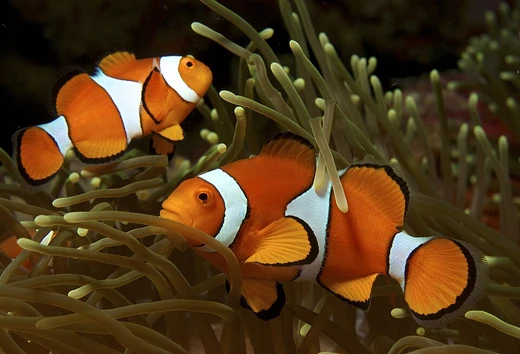
Thielle's anemonefish (Amphiprion thiellei)
Source-cited species reference: taxonomy from WoRMS, biology from FishBase, description from Wikipedia.

Amphiprion thiellei, or Thielle's anemonefish, is thought to be a naturally occurring hybrid anemonefish found in the vicinity of Cebu, Philippines. Like all anemonefishes it forms a symbiotic mutualism with sea anemones and is unaffected by the stinging tentacles of the host anemone. It is a sequential hermaphrodite with a strict dominance hierarchy.
- Scientific name
- Amphiprion thiellei
- Authority
- Burgess, 1981
- Family
- Pomacentridae
- Order
- Ovalentaria incertae sedis
- Maximum length
- 9 cm
- Depth range
- 2–10 m
- Habitat zone
- reef-associated
The Taxonomic Enigma
Few fish in the marine world occupy as puzzling a taxonomic position as Thielle's anemonefish. Originally described by Burgess in 1981 from just two specimens that had passed through aquarium dealers, the species has never been firmly established as a distinct biological entity. By 1992, Fautin and Allen had already cast doubt on its validity, suggesting it might simply be a rare color variant of a known species or the product of hybridization. More than three decades later, that question remains essentially unresolved. The prevailing scientific view now leans toward the hybrid interpretation, yet two competing parentage theories persist: one implicating a cross between A. chrysopterus and A. sandaracinos, the other pointing to A. ocellaris and A. sandaracinos. A telling field observation strengthens the latter hypothesis—no two thiellei have ever been documented together as a breeding pair in the wild, while the fish is frequently observed associating with A. ocellaris. With no comprehensive specimen series ever collected, the creature remains, in a very real sense, a scientific ghost.
A Study in Subtle Coloration
Thielle's anemonefish presents a compact, vividly colored body that reaches no more than 6.5 centimeters in length. Its ground color is a warm reddish orange, overlaid by a single white bar across the head that, in some individuals, extends upward to form a bonnet. Two additional white saddles break the dorsal fin and mark the tail base, giving the fish a distinctive interrupted pattern. The fin counts are modest: ten to eleven dorsal spines, two anal spines, sixteen dorsal soft rays, and fourteen anal soft rays. These markings are what separate thiellei from its closest look-alikes. A. perideraion, for instance, carries a continuous white stripe along the dorsal fin base rather than the broken bonnet-and-saddle arrangement, while A. nigripes is set apart by its dark belly, pelvic fins, and anal fin and a complete lack of dorsal saddles. If the hybrid hypothesis holds, one might expect a range of intermediate color and pattern variation, much as seen in A. leucokranosis. Yet the extremely limited number of wild observations has produced no documented cases of melanism or other dramatic color shifts, leaving the full spectrum of possible variation entirely unknown.
Hierarchy, Sex, and the Mechanics of Hybridization
Like every anemonefish, Thielle's anemonefish lives in a symbiotic mutualism with sea anemones, completely immune to the stinging tentacles of its host. Its reproductive biology follows the classic protandrous pattern of the family: a strict, size-based dominance hierarchy governs the social group, with the largest individual serving as the breeding female, the second-largest as the breeding male, and progressively smaller males filling the lower rungs. Should the dominant female die, the breeding male transforms into a female, and the largest remaining non-breeder assumes the breeding male role. This rigid hierarchy has direct consequences for hybridization. The size disparity between potential parent species is stark: A. chrysopterus can grow to 17 centimeters, while A. sandaracinos reaches only 11 centimeters as a female and a mere 3 to 6.5 centimeters as a male. A. ocellaris is comparably small. The relative sizes of the parents therefore shape the size structure of any hybrid offspring, influencing where they would slot into the dominance hierarchy and how successfully they could reproduce within a group.
A Range Puzzle in the Central Philippines
The only confirmed geographic association for Thielle's anemonefish is the waters around Cebu, in the central Philippines, yet formal field records for the species are conspicuously absent. The most probable host anemones identified for the fish are Heteractis crispa, the Sebae anemone, and Stichodactyla mertensii, Mertens' carpet sea anemone. The latter is significant because it serves as a shared host for all three proposed parent species, satisfying one of the key constraints for hybridization, alongside overlapping depth ranges and geographic distribution. A. sandaracinos and A. ocellaris both range from northern Australia through the central Malay Archipelago into the Philippines, creating a broad zone of potential contact. The distribution of A. chrysopterus is more contested: Fautin and Allen included the Philippines in its range, while Gainsford and colleagues excluded it. This raises an unresolved question. If the parent species overlap across such a wide area, why does thiellei appear to be restricted to the Cebu vicinity rather than occurring throughout the entire zone of contact? The answer, for now, remains unknown.
Frequently Asked Questions
What is Thielle's anemonefish (Amphiprion thiellei)?
Thielle's anemonefish is a small reef fish in the damselfish family Pomacentridae, formally named by Burgess in 1981. It is known from the waters around Cebu in the Philippines and, like all anemonefish, it shelters among the tentacles of a host sea anemone without being harmed by the sting.
Is Thielle's anemonefish (Amphiprion thiellei) a true species or a hybrid?
It is generally regarded as a naturally occurring hybrid rather than a fully independent species, though Burgess gave it a formal name in 1981. Its exact taxonomic standing still sits in a grey area because it was not bred or documented as a reproductively isolated population.
Where can you find Thielle's anemonefish (Amphiprion thiellei) in the wild?
The only known locality is the vicinity of Cebu in the central Philippines, where it occupies shallow reef habitats between roughly 2 and 10 metres depth. It is always seen in close association with a particular host anemone, forming a mutualistic partnership in which the fish gains protection and the anemone benefits from the fish's activity.
How big does Thielle's anemonefish (Amphiprion thiellei) get?
Adults reach a maximum total length of about 9 cm, making it a relatively small member of the anemonefish group. At that size it fits comfortably within the tentacle canopy of its host anemone in the 2-to-10-metre depth band where it is found.
How does Thielle's anemonefish (Amphiprion thiellei) reproduce and organise its social group?
It is a sequential hermaphrodite, so an individual can shift from male to female as it ages. The group operates under a strict dominance hierarchy in which the largest, top-ranking fish becomes the breeding female while smaller members remain subordinate males.
Spotted an error? Know more?
Reader corrections go straight into our review queue. Suggest an edit · How this site is sourced