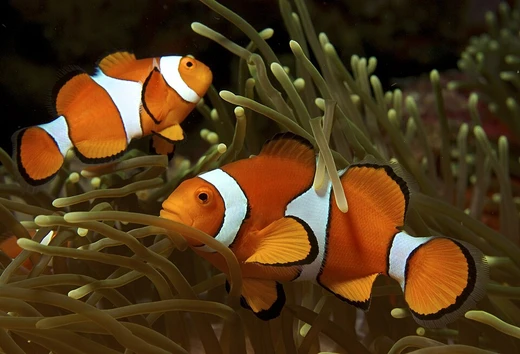
Pacific anemonefish (Amphiprion pacificus)
Source-cited species reference: taxonomy from WoRMS, biology from FishBase, description from Wikipedia.

Amphiprion pacificus, is a species of anemonefish found in the western Pacific Ocean. Like all anemonefishes it forms a symbiotic mutualism with sea anemones and is unaffected by the stinging tentacles of the host anemone. It is a sequential hermaphrodite with a strict sized based dominance hierarchy: the female is largest, the breeding male is second largest, and the male non-breeders get progressively smaller as the hierarchy descends. They exhibit protandry, meaning the breeding male will change to female if the sole breeding female dies, with the largest non-breeder becomes the breeding male. The fish's natural diet includes zooplankton.
- Scientific name
- Amphiprion pacificus
- Authority
- Allen, Drew & Fenner, 2010
- Family
- Pomacentridae
- Order
- Ovalentaria incertae sedis
- Maximum length
- 4.829999923706055 cm
- Depth range
- 4–10 m
- Habitat zone
- reef-associated
Symbiotic Partnership with Sea Anemones
The Pacific anemonefish's most remarkable ecological feature is its deep, mutually beneficial bond with sea anemones. The fish depend on the anemone's stinging tentacles for refuge and predator protection—a sanctuary no other reef fish can claim. In return, the anemonefish acts as a dedicated bodyguard, driving away anemone-eating fish, and performs essential housekeeping by fanning the anemone's tissues and cleaning them. Their metabolic byproducts even draw beneficial microorganisms toward the host, adding another layer of mutual benefit. This partnership is so central to the species' survival that juvenile anemonefish, after dispersing through the open ocean as free-swimming larvae, must locate and settle into a suitable anemone before they can establish themselves on the reef. The relationship is not merely convenient but essential: without an anemone host, the fish lose their primary defence in a predator-rich coral reef environment, making the bond a cornerstone of their entire life strategy.
Social Hierarchy and Protandrous Sex Change
Pacific anemonefish live in structured groups anchored around a single anemone, comprising one breeding female, one breeding male, and several non-breeding individuals. A strict size-based dominance hierarchy governs social order: the breeding female sits at the apex, followed by the breeding male, then the largest non-breeder, and so on down the line. The most striking feature of this system is protandrous sex change. If the breeding female dies or departs, the breeding male undergoes a physiological transformation to assume her reproductive role, and every other member of the group shifts up one rank in the hierarchy. Reproduction itself is a coordinated ritual: the female lays her eggs on a rock surface close to the anemone, after which the male provides fertilisation. Once the young hatch, they disperse into open water as free-swimming larvae before eventually settling back onto the seabed as juveniles, where they must find a new anemone to call home.
Evolutionary Origins and Taxonomic History
The anemonefish lineage split from other living damselfishes roughly 35 million years ago during the late Eocene, with the most recent common ancestor of all extant species dating to about 10.5 million years ago in the Early Miocene. A 2014 study traced their origin to the waters surrounding the Malay Archipelago. Species diversification accelerated around 5 million years ago, producing two major adaptive radiations—one centred on the Malay Archipelago and a later one in the western Indian Ocean. Speciation appears closely tied to the different sea anemone species available in various habitats, which drove ecological separation between populations. Taxonomically, the genus Amphiprion was named in 1801 by Bloch and Schneider. For decades, the maroon clownfish occupied a disputed separate genus, Premnas, but 2021 phylogenetic analyses confirmed it belongs within Amphiprion. The genus sits within the damselfish family Pomacentridae, though its exact subfamily placement remains debated between Amphiprioninae and Pomacentrinae.
Conservation Pressures and Human Influence
The Pacific anemonefish's vivid colouration and social charm have made it a star of the global aquarium trade, a popularity amplified by the 2003 Disney/Pixar film Finding Nemo. Many captive specimens were historically collected directly from the wild, and this sustained harvesting has contributed to measurable population declines in some areas. Marine protected areas, where collection is prohibited, consistently harbour higher anemonefish densities, underscoring the protective value of such zones. Beyond direct harvesting, the species faces broader environmental threats: global warming drives both ocean warming and acidification, conditions that stress coral reef ecosystems and the anemone hosts on which the fish depend. The ocellaris clownfish, a close relative, ranks among the most commonly traded marine fish, illustrating the scale of commercial pressure on the genus. Conservation of anemonefish populations therefore hinges not only on regulating the aquarium trade but also on safeguarding the reef habitats and anemone communities that form the foundation of their entire life cycle.
Frequently Asked Questions
Who is Pacific anemonefish (Amphiprion pacificus)?
It is a small anemonefish species native to the western Pacific Ocean, first formally named in 2010 by Allen, Drew, and Fenner. It belongs to the damselfish family Pomacentridae and reaches a maximum length of roughly 4.8 cm in shallow reef waters between 4 and 10 m depth.
What are Pacific anemonefish (Amphiprion pacificus)'s powers/role?
It forms a protective mutualism with sea anemones, gaining shelter from predators while its host benefits from the fish's presence. It is completely immune to the anemone's stinging tentacles, a shared trait across all anemonefish that lets it live among the host's tentacles without harm.
Why is Pacific anemonefish (Amphiprion pacificus) important?
It offers researchers a clear wild example of rigid size-ranked social hierarchies and sex-change biology in a reef ecosystem. As a species only described in 2010, it also highlights that biodiversity in the western Pacific is still being documented.
What is Pacific anemonefish (Amphiprion pacificus)'s taxonomic placement?
It sits in the family Pomacentridae within the order Ovalentaria incertae sedis, grouping it with other small, reef-associated perciform fishes of the tropical Indo-Pacific. Its genus Amphiprion is the one that contains all the well-known anemonefish species.
Spotted an error? Know more?
Reader corrections go straight into our review queue. Suggest an edit · How this site is sourced