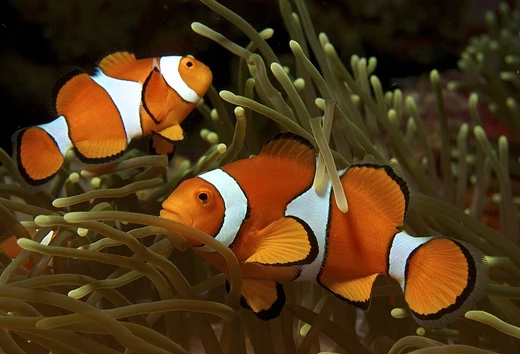
Oman anemonefish (Amphiprion omanensis)
Source-cited species reference: taxonomy from WoRMS, biology from FishBase, occurrence map from GBIF, conservation from IUCN Red List, description from Wikipedia.

Amphiprion omanensis, the Oman anemonefish, is a marine fish belonging to the family Pomacentridae, the clownfishes and damselfishes.
- Scientific name
- Amphiprion omanensis
- Authority
- Allen & Mee, 1991
- Family
- Pomacentridae
- Order
- Ovalentaria incertae sedis
- Maximum length
- 14 cm
- Depth range
- 2–10 m
- Habitat zone
- reef-associated
- Iucn red list
- Least Concern
- Gbif occurrence records
- 30
Symbiotic Partnership with Sea Anemones
The Oman anemonefish, a member of the genus Amphiprion, is defined by a deeply interwoven partnership with sea anemones in the warm, tropical waters of the Indo-Pacific. This is not a one-sided arrangement. The fish depends on the anemone's stinging tentacles as a living shield against larger predators, effectively converting a dangerous organism into a safe harbour. In return, the anemonefish actively guards its host from anemone-eating fish, uses its body to clean and fan the anemone's tissues, and its metabolic waste draws in beneficial microorganisms that enrich the surrounding environment. The mutualism is so fundamental to the species' ecology that an adult cannot thrive in open water without a host. The bond also shapes reproduction: the breeding female deposits her eggs on a rock positioned near the anemone, and the male fertilises them there, anchoring the next generation to the same protective structure.
Social Hierarchy and Sex Change
A group of Oman anemonefish operates under a strict size-based dominance ladder. The breeding female sits at the apex, followed by the breeding male, then the largest non-breeding individual, and so on down the line. What makes this hierarchy remarkable is its fluidity: when the dominant female dies or departs, the breeding male undergoes a sex change and assumes the female's role, while every other member shifts up one rank in the order. Reproduction follows a set ritual within this social unit. The female lays her eggs on a rock near the anemone, and the male fertilises them. Once the eggs hatch, the young disperse into open ocean waters as free-swimming larvae. They drift for a period before settling onto the seafloor, at which point the juveniles must locate a suitable anemone host to begin their adult lives and re-enter the symbiotic cycle.
Taxonomic Identity and Evolutionary Roots
The genus Amphiprion was formally named in 1801 by Marcus Elieser Bloch and Johann Gottlob Theaenus Schneider, drawing on the Greek words for 'on both sides' and 'saw' to reference the saw-shaped edges along the gill cover and beneath the eyes. The Oman anemonefish belongs to this genus within the damselfish family Pomacentridae. Phylogenetically, the clownfish lineage split from other living damselfishes roughly 35 million years ago during the late Eocene, with the most recent common ancestor of all extant species dating to about 10.5 million years ago in the Early Miocene. A 2014 study traced the group's origin to the Malay Archipelago, followed by two major adaptive radiations—one centred on that archipelago and a later one in the western Indian Ocean. Speciation across the genus has been closely tied to the diversity of sea anemone hosts, as different anemone species occupy distinct habitats and thereby drive ecological separation among fish populations.
Conservation Pressures and Cultural Footprint
The Oman anemonefish, like its relatives, has become a star of the global aquarium trade, a popularity amplified by the cultural phenomenon of the 2003 Disney/Pixar film Finding Nemo. Large numbers of individuals have been collected from the wild for this trade, a practice that has contributed to measurable population declines in some regions. Marine protected areas, where collection is prohibited, consistently harbour higher densities of anemonefish, underscoring the direct benefit of legal safeguards. Beyond overharvest, the species faces the broader, slower-moving threat of climate change: rising ocean temperatures and acidification stress the coral reef ecosystems on which the fish depend. The distinctive white bars set against a coloured background and the fish's social, visible behaviour make it an easy target for collectors, yet the same traits that drive its commercial appeal also make it a powerful ambassador for reef conservation.
Frequently Asked Questions
What is the Oman anemonefish (Amphiprion omanensis)?
The Oman anemonefish is a small marine clownfish found in the waters off the Omani coast, belonging to the family Pomacentridae that groups all true anemonefishes with damselfishes. It was formally described by Allen and Mee in 1991.
How big does the Oman anemonefish (Amphiprion omanensis) get?
Adults of this species top out at roughly 14 centimetres in total length, making it one of the smaller members of the Amphiprion genus.
At what depth can you encounter the Oman anemonefish (Amphiprion omanensis)?
This anemonefish is a shallow-water species, typically observed between 2 and 10 metres below the surface on reef habitats.
Who originally described the Oman anemonefish (Amphiprion omanensis)?
G. R. Allen and D. Mee published the species description in 1991, assigning it the binomial name Amphiprion omanensis and placing it firmly within the clownfish group.
How does the Oman anemonefish (Amphiprion omanensis) fit into the broader damselfish lineage?
It sits within the order Ovalentaria incertae sedis, a designation that signals its precise evolutionary slot among damselfishes is still being worked out by taxonomists. What is clear, however, is its family-level placement in Pomacentridae alongside all other true clownfishes.
Spotted an error? Know more?
Reader corrections go straight into our review queue. Suggest an edit · How this site is sourced