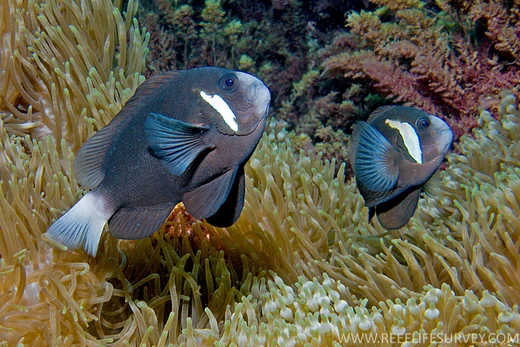
Whitesnout anemonefish (Amphiprion mccullochi)
Source-cited species reference: taxonomy from WoRMS, biology from FishBase, occurrence map from GBIF, conservation from IUCN Red List, description from Wikipedia.

Amphiprion mccullochi, also known as whitesnout anemonefish or McCulloch's anemonefish, is a species of anemonefish found in subtropical waters at Lord Howe Island and Norfolk Island.. It was named for Allan McCulloch, a former Curator of Fishes at the Australian Museum, Sydney. Like all anemonefishes it forms a symbiotic mutualism with sea anemones and is unaffected by the stinging tentacles of the host anemone. It is a sequential hermaphrodite with a strict sized based dominance hierarchy: the female is largest, the breeding male is second largest, and the male non-breeders get progressively smaller as the hierarchy descends. They exhibit protandry, meaning the breeding male will change to female if the sole breeding female dies, with the largest non-breeder becomes the breeding male.
- Scientific name
- Amphiprion mccullochi
- Authority
- Whitley, 1929
- Family
- Pomacentridae
- Order
- Ovalentaria incertae sedis
- Maximum length
- 12 cm
- Depth range
- 2–45 m
- Habitat zone
- reef-associated
- Iucn red list
- Vulnerable
- Gbif occurrence records
- 611
Classification (WoRMS)
Full classification as recorded by WoRMS: Kingdom: Animalia · Phylum: Chordata · Class: Teleostei · Order: Ovalentaria incertae sedis · Family: Pomacentridae · Genus: Amphiprion.
Accepted name: Amphiprion mccullochi · Authority: Whitley, 1929 · Taxonomic status: accepted · AphiaID: 278397.
Source: World Register of Marine Species (WoRMS) — https://www.marinespecies.org/aphia.php?p=taxdetails&id=278397 (CC BY 4.0). Accessed 2026-09-23.
Biology and life history (FishBase)
Measured values published by FishBase for Amphiprion mccullochi. Only fields the database actually holds for this species are shown; these are database values, not aquarium guidance.
Maximum length: 12 cm · Depth range: 2–45 m · Habitat zone: reef-associated · Body shape: short and / or deep · Vulnerability index: 10 of 100 · Fishery importance: commercial · Aquarium trade: commercial.
FishBase notes: Adults inhabit the lagoon and rocky reefs (Ref. 7247). Oviparous, distinct pairing during breeding (Ref. 205). Eggs are demersal and adhere to the substrate (Ref. 205). Males guard and aerate the eggs (Ref. 205). Associated with the anemone Entacmaea quadricolor (Ref. 5911).
Source: FishBase species summary (SpecCode 9208) — https://www.fishbase.se/summary/Amphiprion-mccullochi.html (CC BY-NC 3.0 — non-commercial use only). Accessed 2026-09-23.
Distribution and occurrence records (GBIF)
611 georeferenced occurrence records for Amphiprion mccullochi are published through GBIF from 1 countries or marine areas. The map above plots 5 distinct locations from a sample of 611 records; it shows where the species has been observed and reported, not a modelled range.
Most records by country or area: Australia (611).
Source: GBIF Occurrence Search (taxonKey 5212109) — https://www.gbif.org/occurrence/search?taxon_key=5212109&has_coordinate=true (records CC0 / CC BY); WoRMS distribution records (MarineRegions) — https://www.marinespecies.org/aphia.php?p=taxdetails&id=278397 (CC BY 4.0); Natural Earth 110m basemap — https://www.naturalearthdata.com/ (public domain). Accessed 2026-09-23.
Conservation status (IUCN Red List)
The IUCN Red List assesses Amphiprion mccullochi Whitley, 1929 as Vulnerable (code VU). No trend, population estimate or threat analysis is given here, because none is available from this source without the Red List API; follow the source link for the full assessment, including its date.
Source: IUCN Red List of Threatened Species (taxon 188498) — https://www.iucnredlist.org/species/188498/0; GBIF IUCN Red List category endpoint (taxonKey 5212109) — https://api.gbif.org/v1/species/5212109/iucnRedListCategory. Accessed 2026-09-23.
Description and natural history (Wikipedia)
A. mccullochi is dark brown with a pale snout, a white bar on each side of the head (but not connected on top of the head) and a pale tail. Juveniles have two white bars and the edge of the pectoral fins is yellow. They have 10 dorsal spines, 2 anal spines, 15-17 dorsal soft rays and 13-14 anal soft rays. They reach a maximum length of 12 cm.
Some anemonefish species have color variations based on geographic location, sex and host anemone. A. mccullochi does not show any of these variations.
A. mccullochi is similar in appearance to A. melanopus which is distinguished by its reddish chest, belly and dorsal fin, with a yellowish to slightly red tail. The white bars are also connected over the top of the head. Genetic analysis suggested evolutionary connectivity among samples of A. mccullochi and A. akindynos. Historical hybridization and introgression in the evolutionary past resulted in a complex mitochondrial DNA structure. There were two evolutionary groups with individuals of both species detected in both, thus the species lacked reciprocal monophyly. There were no shared haplotypes between species.
A. mccullochi is endemic to the south western Pacific Ocean at Lord Howe Island, Middleton Reef, Elizabeth Reef and Norfolk Island.
The relationship between anemonefish and their host sea anemones is not random and instead is highly nested in structure. A.
Anemonefish and their host anemones are found on coral reefs and face similar environmental issues. Like corals, anemone's contain intracellular endosymbionts, zooxanthellae, and can suffer from bleaching due to triggers such as increased water temperature or acidification. Characteristics known to elevate the risk of extinction are small geographic range, small local population and extreme habitat specialisation. The small geographic range, small local population and extreme habitat specialisation (it only associates with Entacmaea quadricolor) are all characteristics known to elevate the risk of extinction making A. mccullochi of particular conservation concern.
, A. mccullochi was categorised as Vulnerable on the IUCN Red List. it was listed as Critically Endangered under the Australian EPBC Act.
The specific name honours Whitley's colleague, the Australian ichthyologist Allan Riverstone McCulloch (1885-1925) who collected the type specimen.
This species has bred in captivity.
Source: Wikipedia: Amphiprion mccullochi — https://en.wikipedia.org/wiki/Amphiprion_mccullochi (CC BY-SA 4.0). Accessed 2026-09-23.
Frequently Asked Questions
What is the Whitesnout anemonefish (Amphiprion mccullochi)?
It is a small reef-dwelling fish in the damselfish family, first described by Whitley in 1929 and reaching up to about 12 cm in length. It is one of the few anemonefish species restricted to the subtropical waters around Lord Howe and Norfolk Islands.
Where can I find the Whitesnout anemonefish in the wild?
This species is endemic to the subtropical Pacific, occurring around Lord Howe Island and Norfolk Island. It inhabits depths ranging from roughly 2 to 45 metres, typically sheltering among sea anemones on rocky reefs.
How does the Whitesnout anemonefish survive among anemone tentacles?
Like all members of the anemonefish group, it has developed a mutualistic relationship with its host anemone, meaning it is immune to the stinging nematocysts that would harm most other fish. The fish gains protection from predators while the anemone benefits from the fish's cleaning activity and nutrient exchange.
Why is it also called McCulloch's anemonefish?
The species was named in honour of Allan McCulloch, who served as Curator of Fishes at the Australian Museum in Sydney. The alternate common name 'whitesnout' refers to the pale colouration around its snout region.
How does the Whitesnout anemonefish determine which individual breeds?
It is a sequential hermaphrodite that follows a strict size-based dominance hierarchy within its social group. The largest individual is always the breeding female, the second-largest is the breeding male, and all remaining smaller members are non-breeding males that can shift sex if a higher-ranking fish is removed.
Spotted an error? Know more?
Reader corrections go straight into our review queue. Suggest an edit · How this site is sourced