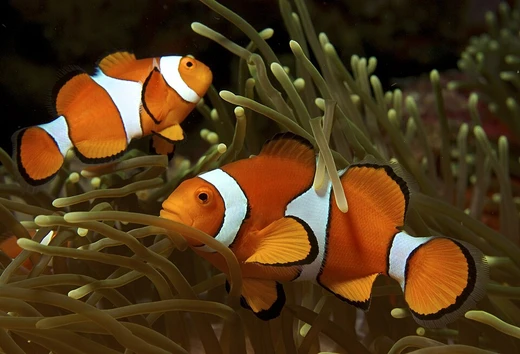
Chagos anemonefish (Amphiprion chagosensis)
Source-cited species reference: taxonomy from WoRMS, biology from FishBase, occurrence map from GBIF, conservation from IUCN Red List, description from Wikipedia.

Jon Slayer · CC BY 3.0
Amphiprion chagosensis, the Chagos anemonefish, is a marine fish belonging to the family Pomacentridae, the clownfishes and damselfishes. It is named for the Chagos Archipelago in the Indian Ocean and it is endemic to the archipelago. The original specimens were collected at Diego Garcia Atoll, Chagos Archipelago.
- Scientific name
- Amphiprion chagosensis
- Authority
- Allen, 1972
- Family
- Pomacentridae
- Order
- Ovalentaria incertae sedis
- Maximum length
- 11 cm
- Depth range
- 10–25 m
- Habitat zone
- reef-associated
- Iucn red list
- Least Concern
- Gbif occurrence records
- 24
Taxonomy, Discovery, and Endemic Status
The Chagos anemonefish, scientifically designated Amphiprion chagosensis, is a small marine species classified within the family Pomacentridae, which encompasses both clownfishes and damselfishes. The species name directly references the Chagos Archipelago, a remote chain of islands situated in the Indian Ocean, to which this fish is entirely endemic. The original specimens that allowed scientists to describe this species were gathered at Diego Garcia Atoll, one of the atolls comprising the archipelago. The formal taxonomic description was published by Allen in 1972, establishing the species in the scientific record. Since then, the Chagos anemonefish has been confirmed as occurring exclusively within the waters surrounding the Chagos Archipelago, with no documented populations found anywhere else in the world's oceans. This strict geographic restriction makes it a true island endemic, a status that underscores both its evolutionary isolation and its vulnerability to any environmental disruption affecting this particular stretch of the Indian Ocean. The species is catalogued in major taxonomic databases, including the Integrated Taxonomic Information System and the World Register of Marine Species, cementing its place in global marine biodiversity records.
Physical Description and Distinguishing Features
Adult Chagos anemonefish reach a maximum total length of ten centimetres, placing them at the smaller end of the anemonefish size range. Their body is a uniform light brown, interrupted by two distinct white bars that encircle the trunk, each bordered with a dark edging. Every fin on the body is a dusky brown, giving the fish a relatively muted and cohesive coloration. Morphologically, the species possesses between ten and eleven dorsal spines, two anal spines, fifteen to seventeen dorsal soft rays, and thirteen to fourteen anal soft rays. Notably, no color variations have been documented within the species, meaning that individuals appear consistent regardless of sex, age, or host anemone. In terms of identification, the Chagos anemonefish is primarily separated from look-alikes by its restricted range. The similar A. akindynos inhabits the Great Barrier Reef and Coral Sea, while A. allardi is found along East Africa. A. bicinctus ranges through the Red Sea but overlaps with the Chagos population. Where ranges do intersect, the Chagos species can be told apart by its narrower headbar, a whitish caudal fin, and subtle differences in predorsal scalation.
Symbiotic Mutualism and Host Anemones
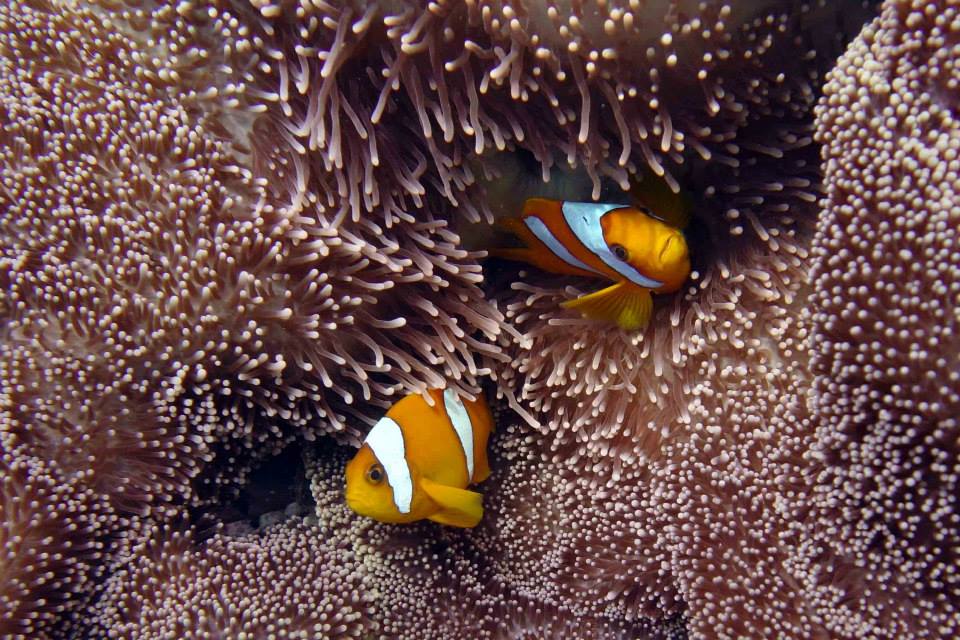
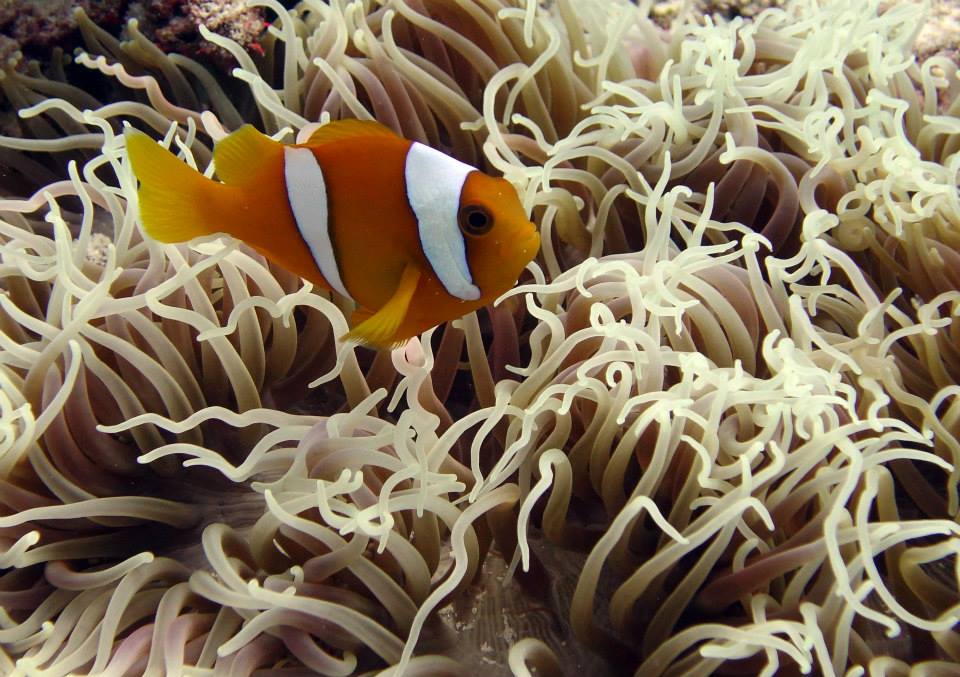
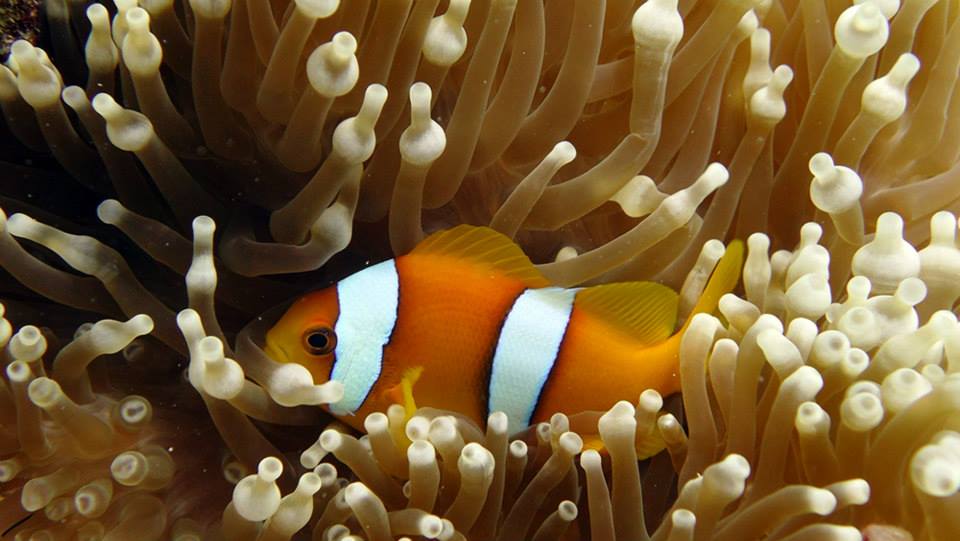
Like all members of the anemonefish subfamily, the Chagos anemonefish lives in a mutualistic partnership with sea anemones, immune to the stinging tentacles that would harm other reef organisms. In this arrangement, the anemone serves as a refuge, shielding the fish from larger predators and providing supplemental nutrition through food scraps and occasionally shed tentacles. The fish reciprocates by actively defending its host from anemone-eating predators and clearing away parasites. Despite this well-understood ecological relationship, relatively little is known about which specific anemone species the Chagos anemonefish preferentially associates with in its native habitat. Photographic records from the Chagos Archipelago have documented the fish in the tentacles of four anemone species: the bubble-tip anemone (Entacmaea quadricolor), the magnificent sea anemone (Heteractis magnifica), the long tentacle anemone (Macrodactyla doreensis), and Mertens' carpet sea anemone (Stichodactyla mertensii). This range of hosts suggests the species is not strictly limited to a single anemone type, though the full breadth of its symbiotic partnerships in the wild remains incompletely characterized.
Social Hierarchy and Reproductive Biology
Within a group of Chagos anemonefish, social interactions are governed by a rigid dominance hierarchy. The largest individual in any aggregation is always the female, who also exhibits the most aggressive behavior toward group members. Reproduction is restricted to just two members of the group: the dominant female and a single male, and fertilization occurs externally. What makes this system particularly remarkable is that all anemonefish, including the Chagos species, are sequential hermaphrodites. Every individual begins life as a male, and as it matures and grows, it transitions into a female. This means that the female at the top of the hierarchy was once a male herself, and her position is maintained through size and dominance rather than a fixed genetic sex. If the female were to die or leave the group, the next-largest male would eventually transform into a female, and a younger male would step up to take the breeding role. This flexible reproductive strategy ensures that a breeding pair is always present as long as at least two individuals remain in the anemone, a resilience that has likely aided the species' persistence in the isolated waters of the Chagos Archipelago.
Gallery
Frequently Asked Questions
What is the Chagos anemonefish (Amphiprion chagosensis)?
It is a small marine fish in the clownfish and damselfish family (Pomacentridae) that lives exclusively in the Chagos Archipelago of the Indian Ocean. The species was first formally described by Allen in 1972 based on specimens gathered at Diego Garcia Atoll.
Where does the Chagos anemonefish live?
This species is entirely endemic to the Chagos Archipelago, meaning no wild populations exist anywhere else on Earth. In its natural habitat it occupies reef environments at depths of roughly 10 to 25 metres.
How large does a Chagos anemonefish grow?
Adults reach a maximum total length of about 11 centimetres, placing it in the smaller end of the Amphiprion genus. It is a modestly sized reef dweller rather than a large open-water fish.
Who named the Chagos anemonefish and when was it described?
The species was formally described and given its binomial name by the ichthyologist G. R. Allen in 1972. The original type specimens came from Diego Garcia Atoll within the Chagos Archipelago.
Why is the Chagos anemonefish considered ecologically or conservation-wise significant?
Because its entire global range is confined to a single archipelago, the survival of the species hinges entirely on the health of that one island group's coral-reef ecosystems. This extreme geographic restriction makes it especially vulnerable to habitat degradation and highlights the conservation value of the Chagos waters.
Spotted an error? Know more?
Reader corrections go straight into our review queue. Suggest an edit · How this site is sourced