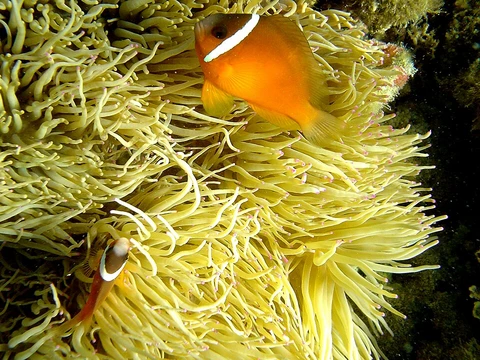
Amphiprion barberi
Source-cited species reference: taxonomy from WoRMS, biology from FishBase, occurrence map from GBIF, description from Wikipedia.

Pauline Walsh Jacobson · CC BY 4.0
Amphiprion barberi is a species of anemonefish that is found in the western Pacific Ocean. It was previously considered a geographic color variation of other anemonefish, initially Amphiprion rubrocinctus from 1972 and then Amphiprion melanopus from 1980 however further study and DNA sequencing resulted in A. barberi being described as a new species in 2008. Like all anemonefishes it forms a symbiotic mutualism with sea anemones and is unaffected by the stinging tentacles of the host anemone. It is a sequential hermaphrodite with a strict sized based dominance hierarchy: the female is largest, the breeding male is second largest, and the male non-breeders get progressively smaller as the hierarchy descends. They exhibit protandry, meaning the breeding male will change to female if the sole breeding female dies, with the largest non-breeder becomes the breeding male.
- Scientific name
- Amphiprion barberi
- Authority
- Allen, Drew & Kaufman, 2008
- Family
- Pomacentridae
- Order
- Ovalentaria incertae sedis
- Maximum length
- 8.579999923706055 cm
- Depth range
- 2–10 m
- Habitat zone
- reef-associated
- Gbif occurrence records
- 632
Taxonomic Journey to Species Recognition
For decades, the small red-orange anemonefish now known as Amphiprion barberi went unrecognized as anything more than a regional color variant of other species. In 1972, specimens from the western Pacific were lumped under Amphiprion rubrocinctus, and by 1980 the same fish had been reassigned to Amphiprion melanopus. It was not until 2008 that Allen, Drew, and Kaufman, drawing on DNA sequencing and additional morphological study, formally described A. barberi as a distinct species. The specific epithet honors Paul Barber of Boston University, whose work on the genetic relationships among Indo-Pacific coral reef organisms provided the conceptual framework that made such a split possible. This taxonomic clarification mattered because the two look-alike species occupy different geographic spaces: A. rubrocinctus is confined to northwestern Australia, while A. melanopus ranges broadly from the Great Barrier Reef northward to the Marshall Islands and Guam, and southward through New Guinea, Vanuatu, New Caledonia, and eastern Indonesia. Recognizing A. barberi as its own species sharpened the picture of endemism in the Fiji–Tonga–Samoa archipelago, a region already celebrated as a hotspot of unique marine life.
Symbiotic Partnership and Range
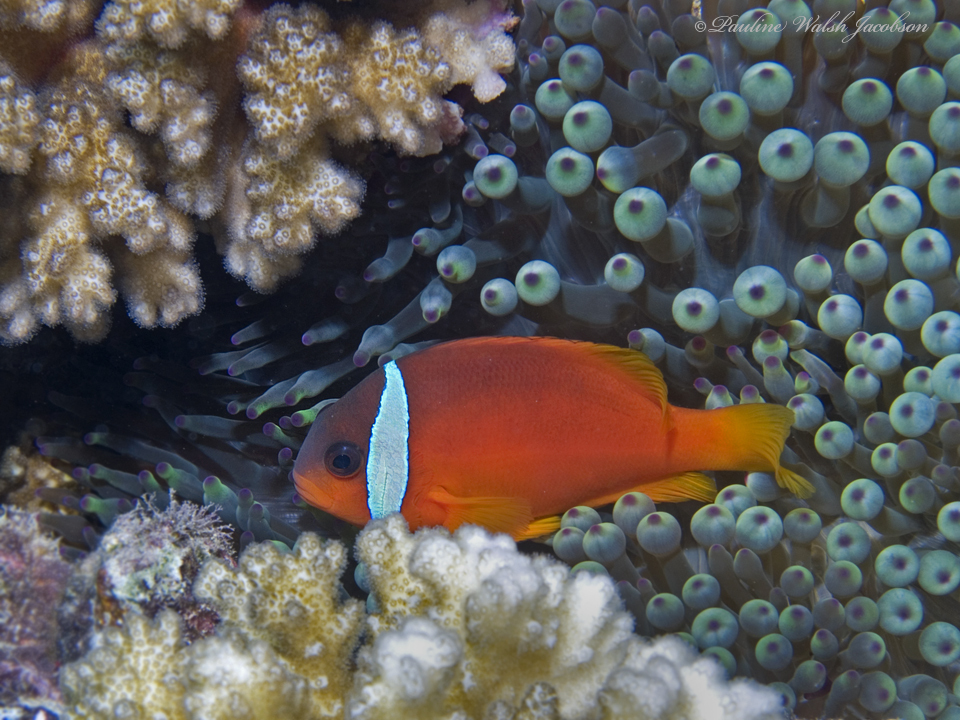
Anemonefishes are inseparable from their stinging hosts, and A. barberi is no exception. Like every member of the family, it lives in a mutualistic partnership with sea anemones, its skin rendering it immune to the nematocysts that would kill most other reef fish. What makes this species notable is the degree of specialization in that relationship. The association between anemonefish and anemones across the western Pacific is highly nested rather than random, and A. barberi is particularly selective: of the six anemone species available in its range, it is hosted by only two—Entacmaea quadricolor, the bubble-tip anemone, and Heteractis crispa, the Sebae anemone. Its entire known distribution is confined to a tight cluster of Polynesian waters: Fiji, Tonga, and the Samoan Islands, a region widely regarded as a hotspot of marine endemism. The fish feeds primarily on zooplankton. Both the fish and its anemone hosts share a vulnerability to environmental stress; anemones, like corals, house intracellular zooxanthellae and can bleach when water temperatures rise or acidity increases, a threat that would ripple directly through the anemonefish's survival.
Social Structure and Sex Change
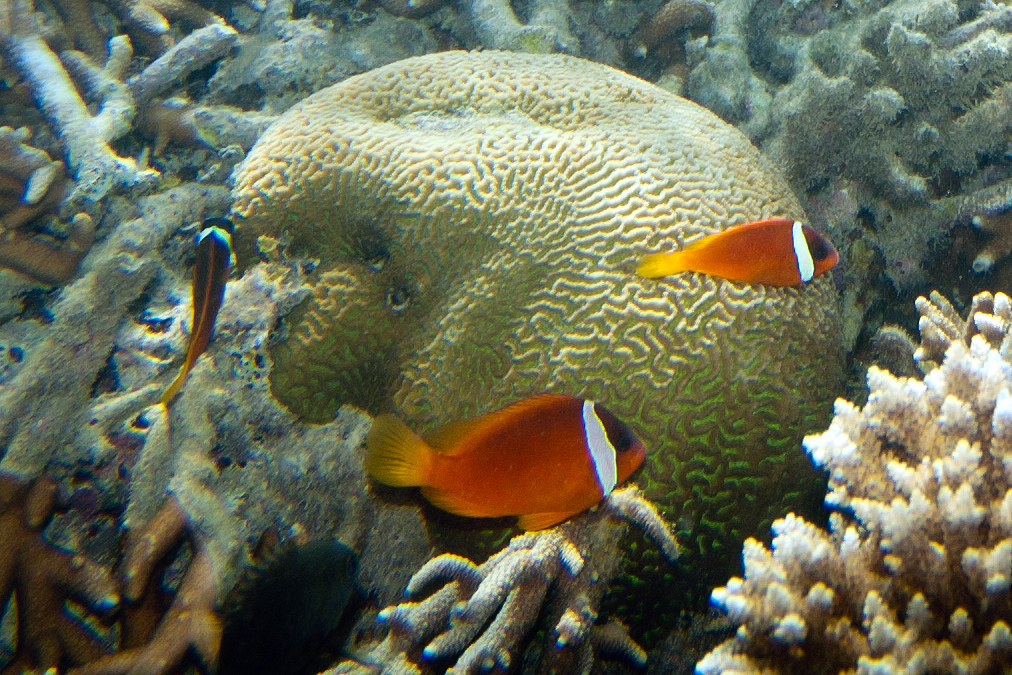
The social organization of A. barberi follows the same rigid template seen across anemonefishes, yet its mechanics are striking. The group operates under a strict size-based dominance hierarchy in which the breeding female is always the largest individual, the breeding male sits second, and the remaining non-breeding males rank progressively smaller as one moves down the ladder. The species is a protandrous sequential hermaphrodite, meaning every individual is born male and can, under the right circumstances, become female. If the dominant breeding female dies, the largest male—the breeding male—undergoes a sex change to assume the female role, and the next-largest non-breeding male steps up to become the new breeding male. This orderly succession ensures that a functional breeding pair is always present without the chaos of multiple simultaneous transitions. The hierarchy is maintained through body size, which in turn is shaped by the fish's position within the group, creating a self-reinforcing social structure that governs reproduction, territory, and daily interactions within the anemone colony.
Appearance and Distinguishing Features
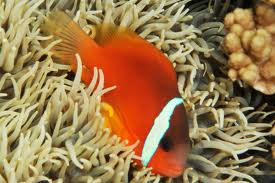
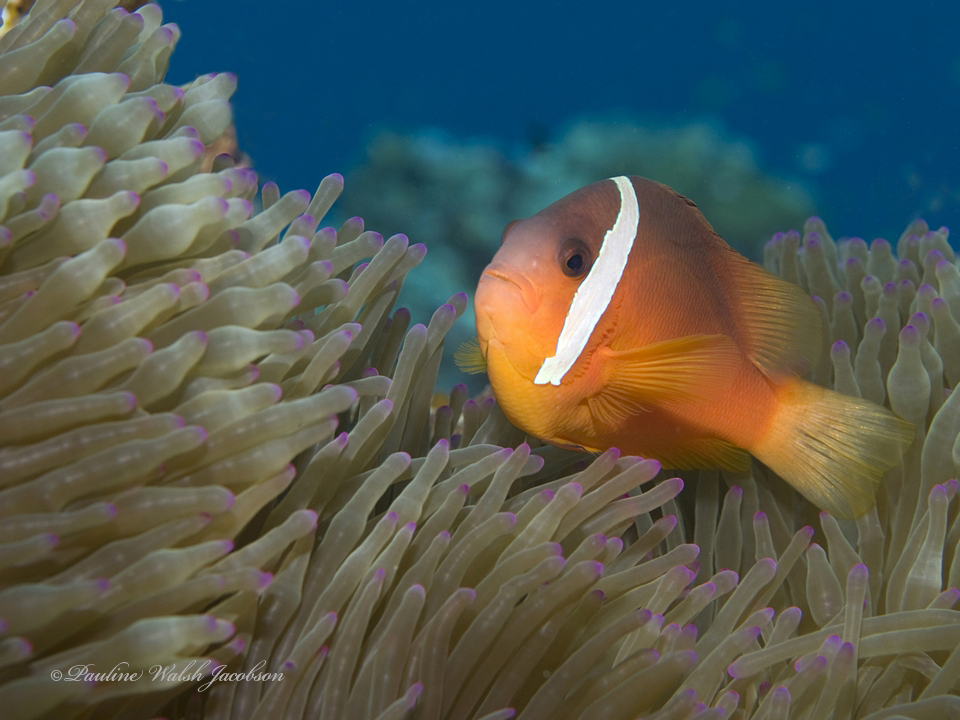
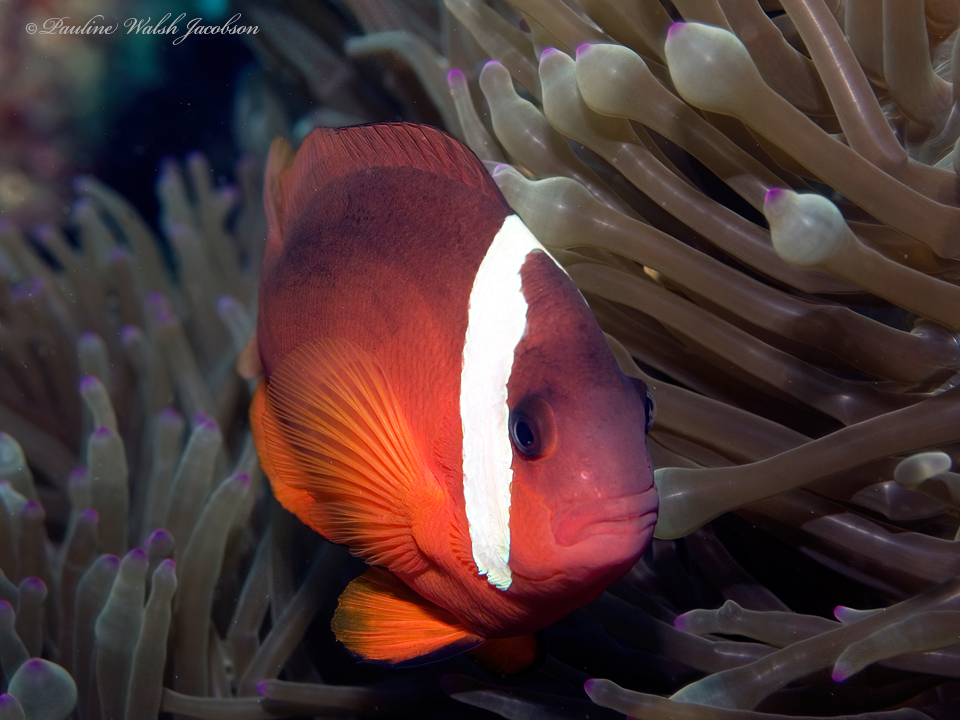
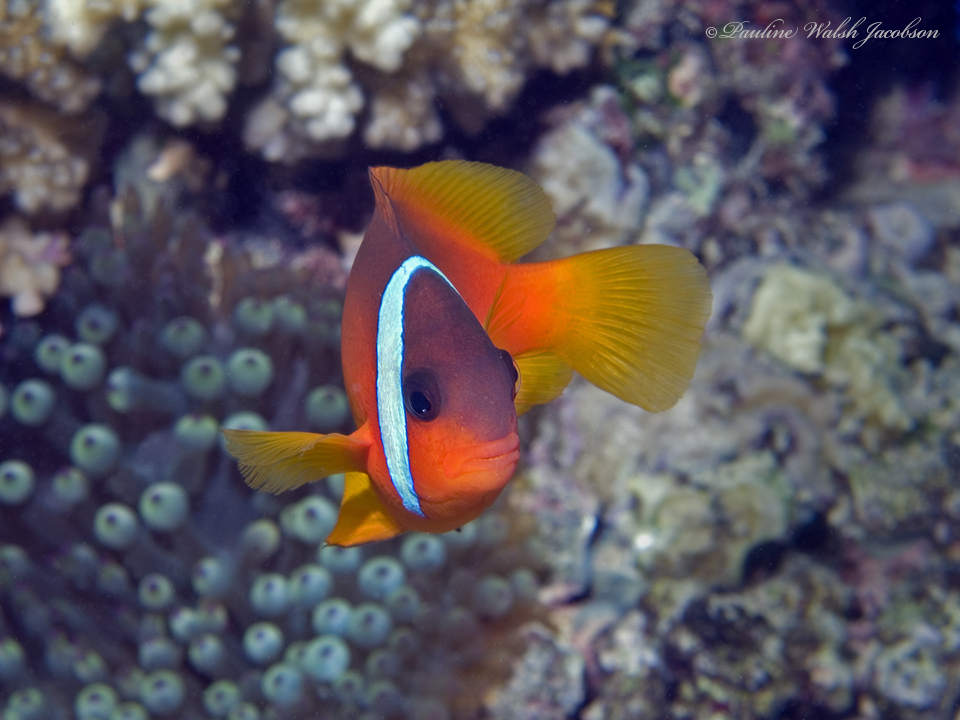
Adult A. barberi presents a vivid red-orange body marked by a single white bar, with the snout, breast, and all three unpaired fins—caudal, dorsal, and anal—sharing that same warm orange tone. The species reaches a maximum total length of 8.5 centimeters, roughly 3¼ inches. Its fin formula includes 10 dorsal spines, 2 anal spines, 16 to 18 dorsal soft rays, and 14 anal soft rays. One of the most distinctive features separating A. barberi from its look-alikes is the absence of any geographic, sexual, or host-anemone-related color variation; every individual appears essentially the same regardless of where in its range it is found or which of its two host species it occupies. By contrast, A. melanopus displays a dark brown to blackish body and carries 19 to 26 spines in the upper-opercular series, whereas A. barberi has only 11 to 19. These measurable differences, combined with the non-overlapping distributions, made the 2008 species split scientifically defensible and visually intuitive for field researchers working across the western Pacific.
Gallery
Frequently Asked Questions
What is Amphiprion barberi?
Amphiprion barberi is a small anemonefish species native to the western Pacific Ocean, belonging to the family Pomacentridae. It lives in a close mutualistic relationship with sea anemones, whose stinging tentacles it can safely touch without harm.
How was Amphiprion barberi confirmed as its own species?
For decades this fish was lumped in as a mere color variant of A. rubrocinctus and later A. melanopus. It was not until genetic sequencing and closer morphological study that Allen, Drew, and Kaufman formally described it as a distinct species in 2008.
Where can you find Amphiprion barberi in the wild?
This anemonefish inhabits shallow reef environments in the western Pacific, typically between 2 and 10 metres depth. It is always associated with a host sea anemone, which provides both shelter and a supplementary food source.
How does the social hierarchy of Amphiprion barberi work?
Like all anemonefish, A. barberi is a sequential hermaphrodite capable of changing sex over its lifetime. The group follows a strict size-based ranking in which the largest individual serves as the breeding female, with smaller males positioned below her in the pecking order.
How large does Amphiprion barberi grow?
Adults of this species reach a maximum total length of roughly 8.6 centimetres, making them a modest-sized reef fish. Their small stature fits comfortably within the limited space of their anemone host.
Spotted an error? Know more?
Reader corrections go straight into our review queue. Suggest an edit · How this site is sourced