Upper Atmosphere Research Satellite
NASA observatory studied Earth's ozone layer from 1991 to 2005.
Last updated
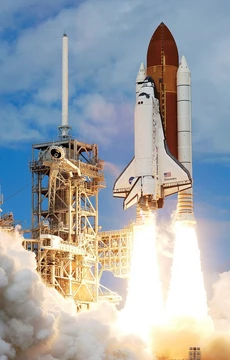
The Upper Atmosphere Research Satellite (UARS) was a NASA orbital observatory deployed from Space Shuttle Discovery during the STS-48 mission on 15 September 1991. It studied Earth's atmosphere, particularly the protective ozone layer, from an operational altitude of 600 km with an orbital inclination of 57 degrees. The 5900 kg satellite's original three-year mission was extended several times, finally ending in June 2005 due to funding cuts, with six of its ten instruments still operational.
Instruments
CLAES was a spectrometer that determined concentrations and distributions of nitrogen and chlorine compounds, ozone, water vapor and methane, producing the first global maps of ozone-depleting chlorinated compounds. It inferred gas amounts by measuring unique infrared signatures, requiring high resolution and sensitivity achieved by combining a telescope with an infrared spectrometer. The instrument was cryogenically cooled with an inner tank of solid neon at −257 °C and an outer tank of solid carbon dioxide at −150 °C; the cryogens evaporated on May 5, 1993, ending its useful life after 19 months.
CLAES looked sideways through the stratosphere and lower mesosphere, creating a global database of vertical distributions of ozone-layer gases and their variations. ISAMS was an infrared radiometer measuring thermal emission from Earth's limb on both sides of the spacecraft, using pressure-modulation for high spectral resolution and stirling-cycle coolers for detector sensitivity. It employed 7 gas cells for CO2 (two cells), CO, CH4, N2O, NO2, and H2O, with the CO2 cells also enabling measurement of ozone, nitric acid, and dinitrogen pentoxide.
End of mission and re-entry
UARS was decommissioned on 14 December 2005 after final perigee lowering burns reduced its orbit to 518 km by 381 km, followed by passivation of systems. On 26 October 2010, the International Space Station performed a debris-avoidance maneuver due to a conjunction with UARS.
NASA announced the impending uncontrolled re-entry on 7 September 2011, noting a small potential risk to the public. By 23 September 2011, the orbit had reduced to 175 by 185 km, with 26 pieces of debris expected to survive, the largest at 158.30 kg possibly reaching the surface at 44 m/s and smaller pieces at up to 107 m/s. At 07:46 UTC on 24 September 2011, NASA stated the satellite penetrated the atmosphere over the Pacific Ocean.
The Joint Space Operations Center later announced the reentry occurred at 04:00 UTC on 24 September just downrange of American Samoa, with a debris field extending 300 to 800 mi northeast.
More in Spacecraft Launched by the Space Shuttle
Sources
Compiled from Wikipedia and the sources listed below. Text from Wikipedia is available under CC BY-SA 4.0; this entry is adapted from it.
- Wikipedia: Upper Atmosphere Research Satellite (CC BY-SA 4.0).
Spotted an error? Know more?
Reader corrections go straight into our review queue. Suggest an edit · How this site is sourced