Magellan (spacecraft)
First interplanetary probe launched from the Space Shuttle.
Last updated
Launched by NASA on May 4, 1989, the 1035-kilogram Magellan probe used synthetic-aperture radar to map Venus’s surface and studied its gravity. It made history as the first interplanetary craft launched from the Space Shuttle, the first to employ the Inertial Upper Stage booster, and the first to use aerobraking to adjust its orbit. As NASA’s fifth successful Venus mission, Magellan ended an eleven-year pause in U.S. interplanetary launches.
Spacecraft design
The spacecraft was designed and built by the Martin Marietta Company, with the Jet Propulsion Laboratory managing the mission for NASA. Elizabeth Beyer served as program manager and Joseph Boyce as lead program scientist at NASA headquarters; for JPL, Douglas Griffith was project manager and R. Stephen Saunders lead project scientist. The synthetic aperture radar was designed and built by Hughes Aircraft Company's Space and Communications Group. To reduce costs, most of Magellan reused flight spare parts and design elements from other spacecraft.
The main body, a spare from the Voyager missions, was a 10-sided aluminum bus containing computers, data recorders, and other subsystems. The spacecraft measured 6.4 meters tall and 4.6 meters in diameter, with an overall mass of 3,445 kilograms. Attitude control was three-axis stabilized, including during firing of the Star 48B solid rocket motor used for Venus orbit insertion. Prior to Magellan, all spacecraft SRM firings involved spinning spacecraft, which cancelled out unwanted forces; Magellan's design did not allow spinning, so the propulsion system had to accommodate challenging control issues.
The Star 48B contained 2,014 kg of solid propellant and developed about 89 kN of thrust shortly after firing. Even a 0.5% alignment error could generate side forces of 445 N, leading to the need for eight 445 N thrusters, two in each quadrant, located on booms at the maximum radius the Shuttle Orbiter Payload Bay would accommodate (4.4-meter diameter).
Mission profile
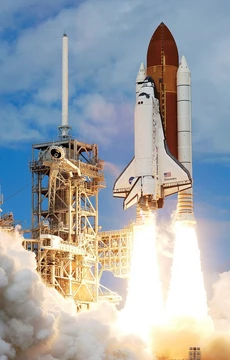
Magellan was launched on May 4, 1989, at 18:46:59 UTC from KSC Launch Complex 39B aboard Space Shuttle Atlantis during mission STS-30. Once in orbit, Magellan and its attached Inertial Upper Stage booster were deployed from Atlantis and launched on May 5, 1989 at 01:06:00 UTC, sending the spacecraft into a Type IV heliocentric orbit where it circled the Sun 1.5 times before reaching Venus 15 months later on August 10, 1990. Originally scheduled for launch in 1988 with a six-month trajectory, the mission was deferred after the Space Shuttle Challenger disaster in 1986.
Magellan had been planned to use a liquid-fueled Centaur G upper stage, but that program was canceled after Challenger, forcing modification to use the less-powerful Inertial Upper Stage. The next best launch opportunity was October 1989, but the Galileo mission to Jupiter, which included a Venus fly-by and required a mid-October launch, led to replanning Magellan for May 1989 into an orbit requiring one year and three months to reach Venus.
Scientists
Initial images and data from Magellan were restricted to a team of principal investigators from various universities and institutions, and the Magellan Project Science Team, who validated data, contributed input for spacecraft data acquisition, and interpreted results for public release. Data was shared with three visiting Soviet scientists—Alexander Basilevsky, Effaim Akim, and Alexander Zacharov—a first and sensitive issue for NASA as the Cold War was ending.
Notable guests during the mission included Margaret Thatcher. After the initial investigation stage, the full data set was released publicly. Other scientists included principal investigators and the three visiting Soviet scientists.
End of mission
On September 9, 1994, a press release outlined the termination of the Magellan mission, citing degradation of power output from solar arrays and onboard components, and completion of all objectives. The termination sequence began in late August 1994 with orbital trim maneuvers lowering the spacecraft into the outermost Venusian atmosphere for the Windmill experiment, which started on September 6, 1994 and lasted two weeks. Subsequent trim maneuvers further lowered the spacecraft.
On October 11, 1994, moving at 7 kilometers/second, a final trim maneuver placed the spacecraft 139.7 kilometers above the surface, well within the atmosphere, where ram pressure raised solar array temperatures. On October 13, 1994 at 10:05:00 UTC, communication was lost during radio occultation behind Venus; the team listened until 18:00:00 UTC, when the mission was determined concluded. Much of Magellan was expected to vaporize, with some wreckage thought to have hit the surface by 20:00:00 UTC.
Did You Know?
- The mission was originally named the Venus Radar Mapper program in 1983, then renamed Magellan in 1985 after the Portuguese explorer Ferdinand Magellan.
- Scientists first advocated for a radar mapping mission to Venus in the late 1970s, proposing the Venus Orbiting Imaging Radar (VOIR), which was canceled in 1982 due to budget constraints.
- The mission's primary objective was to obtain near-global radar images with a resolution equivalent to optical imaging of 1.0 km per line pair.
More in Spacecraft Launched by the Space Shuttle
Sources
Compiled from Wikipedia and the sources listed below. Text from Wikipedia is available under CC BY-SA 4.0; this entry is adapted from it.
- Wikipedia: Magellan (spacecraft) (CC BY-SA 4.0).
Spotted an error? Know more?
Reader corrections go straight into our review queue. Suggest an edit · How this site is sourced