TDRS-1
Communications satellite rescued after upper stage failure.
Last updated
TDRS-1, originally designated TDRS-A, was an American communications satellite built by TRW for NASA's Tracking and Data Relay Satellite System.
History
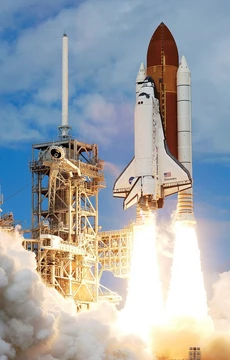
During that period, a severe storm contaminated TDRS-1 while it was inside the Payload Change-out Room on the Rotating Service Structure. The satellite was returned to its checkout facility for cleaning and rechecking. Challenger lifted off from Launch Complex 39A at 18:30:00 UTC on 4 April 1983. After deployment, an Inertial Upper Stage with two solid rocket motors was to raise TDRS-1 to geosynchronous orbit.
The first burn succeeded, but the second burn went out of control. TDRS-1 separated from the upper stage in a lower orbit than planned. Engineers from the Goddard Space Flight Center in Greenbelt, Maryland worked nearly three months using six one-pound thrusters to push the satellite 8600 miles higher. The failure was traced to a collapsed second-stage nozzle techroll seal.
Thirty-nine adjustment burns corrected the elliptical orbit to the desired 22300-mile geosynchronous orbit. On 26 November 1984, Goddard Space Flight Center honored 34 individuals with the Robert H. Goddard Award of Merit for the rescue. In 1989, a geomagnetic storm affected satellite operations. On 28 April 1999, TDRS-1 was used at the South Pole for the first pole-to-pole phone call, with an Iridium phone at the North Pole, recorded in Ripley's Believe It Or Not and Guinness World Records.
More in Spacecraft Launched by the Space Shuttle
Sources
Compiled from Wikipedia and the sources listed below. Text from Wikipedia is available under CC BY-SA 4.0; this entry is adapted from it.
- Wikipedia: TDRS-1 (CC BY-SA 4.0).
Spotted an error? Know more?
Reader corrections go straight into our review queue. Suggest an edit · How this site is sourced