Columbus (ISS module)
European Space Agency's largest single contribution to the ISS.
Last updated
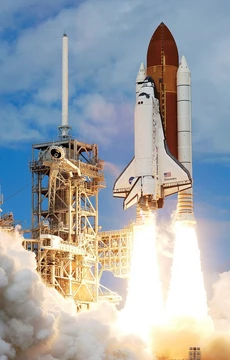
The European Space Agency's biggest single contribution to the International Space Station is the Columbus science laboratory. Built in Turin, Italy, by Thales Alenia Space (formerly Alcatel Alenia Space), its equipment and software came from Airbus Defence and Space (then EADS) in Bremen, Germany. Launched on 7 February 2008 aboard mission STS-122, Columbus is run from the Columbus Control Centre at the German Aerospace Center's facility in Oberpfaffenhofen, near Munich.
History
The Columbus module took much longer to build than first expected. Development problems, including a complicated division of responsibilities between the co-prime and overall prime contractors, along with design changes from ESA, were major reasons. Delays with the Space Shuttle also pushed back the launch by several years. The biggest design change was adding the External Payload Facility, or EPF, which happened because European payload organizations were more interested in experiments in outer space than inside the module.
Engineers studied adding a terminal for direct communication with the ground, which could have served as a backup for the ISS system, but it was dropped to save money. ESA picked EADS Astrium Space Transportation as the main contractor for the module's overall design, testing, and assembly. The structure, micrometeorite protection, active and passive thermal control, environmental control, wiring, and all related ground support equipment were designed and approved by Alcatel Alenia Space in Turin, Italy, following the PICA principle.
That hardware was pre-assembled and shipped as PICA to Bremen in September 2001. The laboratory was then built and tested at the system level at EADS Astrium Space Transportation's facilities in Bremen, Germany. Columbus was launched as part of a barter agreement between ESA and NASA. Under this deal, ESA gave NASA the fully assembled Harmony and Tranquility node modules, plus extra equipment and parts, in exchange for launching Columbus and its first payload on the Space Shuttle.
On 27 May 2006, Columbus was flown from Bremen to the Space Station Processing Facility at Kennedy Space Center inside an Airbus Beluga cargo plane. In November 2007, it was moved out of that facility and placed into the payload bay of the orbiter Atlantis for launch on ISS assembly flight 1E, also known as STS-122.
Research activities and payloads
The Columbus laboratory module is managed from the ground by the Columbus Control Center at DLR Oberpfaffenhofen in Germany, along with various User Support Operations Centres located across Europe. The module holds ten active International Standard Payload Racks (ISPRs) for scientific work. Under agreements with NASA, ESA gets 51% of the lab’s usage, which gives ESA five active rack slots and NASA the other five. Four active racks sit on the forward side of the deck, four on the aft side, and two are in overhead positions.
Three deck racks are taken up by life support and cooling systems, while the remaining deck rack and the two overhead racks serve as storage. The European ISPRs initially placed inside Columbus include the Fluid Science Laboratory (FSL), European Physiology Modules (EPM), Biolab, European Drawer Rack (EDR), European Drawer Rack Mark II (EDR2), and European Stowage Rack. Outside the starboard cone, four un-pressurized payload platforms can be attached to the Columbus External Payload Facility (CEPF).
Each external payload uses an adaptor that can hold small instruments and experiments weighing up to 230 kg. The first external payloads were installed by STS-122 crew members. Some of these external payloads are the European Technology Exposure Facility (EuTEF) platform, which carries nine instruments including TRIBOLAB, PLEGPAY, MEDET, EUFIDE, DEBIE-2, FIPEX, EUTEMP, EXPOSE, DOSTEL, and the Earth Viewing Camera; the Solar Monitoring Observatory (SOLAR); the NASA payload MISSE-6; ISS-RapidScat, installed in 2014 and operated until late 2016, which arrived on SpaceX CRS-4; the Atmosphere-Space Interaction Monitor (ASIM), installed in April 2018; the Atomic Clock Ensemble in Space (ACES), installed in April 2025; and the Columbus Ka-band Terminal (COLKa), a communications terminal using the European Data Relay System (EDRS), installed in January 2021.
A planned external payload is EXPORT. In 2026, the open-source virtualization platform Proxmox VE is scheduled to be deployed inside the Columbus module.
More in Spacecraft Launched by the Space Shuttle
Sources
Compiled from Wikipedia and the sources listed below. Text from Wikipedia is available under CC BY-SA 4.0; this entry is adapted from it.
- Wikipedia: Columbus (ISS module) (CC BY-SA 4.0).
Spotted an error? Know more?
Reader corrections go straight into our review queue. Suggest an edit · How this site is sourced