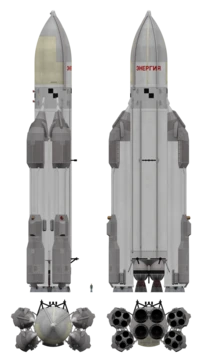
N1-L3
Soviet super-heavy rocket for crewed lunar landing.
The N1-L3 was the Soviet program to land a cosmonaut on the Moon, using the super-heavy N1 rocket and a lunar expedition complex consisting of the Soyuz 7K-LOK and LK spacecraft. It was pursued secretly in competition with the American Apollo program, but after a series of catastrophic N1 launch failures and the US Moon landing, the program was de facto terminated in 1974 and officially canceled in 1976.
Quick Facts
- Rocket
- N1
- Payload (initial)
- 75 tons
- Payload (later)
- 92-93 tons
- First stage engines (later)
- 30
- Spacecraft
- Soyuz 7K-LOK and LK
- Program termination (de facto)
- 1974
- Official cancellation
- 1976
Facts from the source article.
Early concepts
Sergei Korolev began developing the super-heavy N-1 rocket with a 75-ton payload, aiming for a heavy orbital station and crewed flights to Mars and Venus. His preliminary Moon plans included the Soyuz A-B-C circumlunar complex, which would assemble a lunar flyby vehicle in Earth orbit using multiple R-7 launches. From 1963, Korolev planned a Moon landing mission using three launches and docking, but later increased the N1 payload to 92-93 tons by lightening components, adjusting the parking orbit, and increasing first-stage engines from 24 to 30, enabling a single-launch mission. Other improvements, such as switching to liquid hydrogen in upper stages, were planned for later missions. Vladimir Chelomei proposed competing designs: a cislunar mission using the UR-500K (Proton) rocket and LK-1 spacecraft, and a Moon landing program with the super-heavy UR-700 rocket, LK-700 lander, and LK-3 spacecraft. The R-56, developed between April 1962 and June 1964, was also considered for the lunar program.
Reaction to Apollo
The Soviet government responded to the American Apollo challenge with Decree 655-268 in August 1964, instructing Korolev to develop a Moon landing program with a first flight by the end of 1967. After the change in leadership from Khrushchev to Brezhnev, a September 1965 decree assigned the flyby program to Korolev, who redesigned it to use his Soyuz 7K-L1 spacecraft on Chelomei's Proton rocket. Korolev died in January 1966, but a February 1967 decree scheduled the first crewed landing for the end of 1968. The crewed landing plan adopted a single-launch lunar orbit rendezvous method similar to Apollo. The L1 (Zond) spacecraft, launched by a 3-staged Proton, weighed 5.5 tons and performed a flight around the Moon without entering orbit, unlike the heavier Apollo command ship. In September 1968, Zond 5 carried the first Earth lifeforms around the Moon and returned safely. A planned crewed L1 mission for 8 December 1968 was canceled due to insufficient readiness. After Apollo 8 achieved lunar orbit in December 1968, Soviet political interest in the L1 program waned, and it was canceled by the end of 1970.
Later developments
After the US Moon landing in 1969, the justification for the Soviet lunar landing program largely evaporated, though development continued into the early 1970s. The LK was ready after three uncrewed test flights in low Earth orbit (Kosmos 379, Kosmos 398, Kosmos 434) during 1970-1971, and the LOK launched once as Kosmos 382 (a dummy 7K-L1E). The Krechet lunar spacesuit and support systems were tested. Four N1 test launches in 1969 (twice), 1971, and 1972 were all failures; the second launch on 3 July 1969 destroyed the rocket and entire launch complex, delaying the program for two years. The first two launches carried the 7K-L1S spacecraft; the third and fourth used a dummy 7K-LOK and a regular 7K-LOK with dummy LKs. A fifth launch, using a modified N1, was prepared for August 1974 with the complete L3 complex. If successful, it could have led to up to five crewed N1-L3 expeditions in 1976-1980, with modified N1F-L3M missions allowing more time on the Moon than Apollo. However, the N1-L3 program was canceled in May 1974, and Soviet crewed efforts shifted to space stations and Mars mission preparations. The launch pad and MIK were later redesigned for the Energia-Buran program. Five LKs and three LOKs remain, and nearly 150 N1F first-stage engines were later sold for other launchers.
More in Space Launch Vehicles of the Soviet Union
Spotted an error? Know more?
Reader corrections go straight into our review queue. Suggest an edit · How this site is sourced