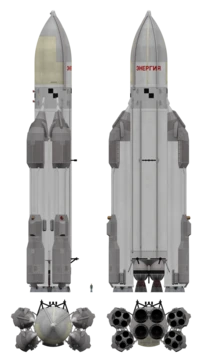
Energia (rocket)
Soviet super-heavy lift vehicle for Buran and heavy payloads.
Energia (Энергия; GRAU: 11K25, Sheldon: K-1, DoD: SL-17) was a super-heavy lift launch vehicle developed by NPO Energia in the Soviet Union during the 1980s. It was designed as part of the Buran program and could place about 100 tonnes into low Earth orbit, making it the world's second successful super-heavy lift vehicle after the US Saturn V. The rocket made only two flights before being discontinued, carrying the Polyus satellite in 1987 and the Buran orbiter in 1988.
Quick Facts
- Function
- Human-rated multi-purpose super heavy-lift launch vehicle
- Manufacturer
- NPO "Energia"
- Country-origin
- Soviet Union
- Mass
- 2,400,000 kg / 5,291,094 lb
- Height
- 58.765 m / 193 ft
- Diameter
- 17.65 m / 57 ft 11 in
- Stages
- 2
- Sites
- Baikonur
Facts from the source article.
Did You Know?
- The core stage of Energia burned liquid hydrogen as fuel, while the boosters burned kerosene.
- The Space Shuttle could bring a maximum 30 tonnes to LEO, while the Energia could bring a maximum 100 tonnes.
Development history
Work on the Energia/Buran system began in 1976 after the cancellation of the unsuccessful N1 rocket. Facilities and infrastructure built for the N1, including the large horizontal assembly building, were reused for Energia, similar to how NASA reused Saturn V infrastructure for the Space Shuttle. Energia also replaced the Vulkan concept, a design based on the Proton rocket using hypergolic propellants but much larger. The Energia was designed to launch the Buran reusable shuttle, carrying its payload mounted on the side of the stack rather than on top. This configuration allowed the booster to be used without Buran as a heavy-lift cargo vehicle, originally named Buran-T, which required an upper stage for orbital insertion. The first launch was in a heavy-lift configuration with the Polyus military satellite, though Polyus failed to achieve orbit. The program concluded after two launches due to the termination of the Buran program. The RD-170 engine family and the Zenit launcher, whose first stage resembles one Energia booster, are legacies of the project.
Launch history
The Energia rocket made its first test flight on May 15, 1987, carrying the Polyus spacecraft. Its upper stage used an FGB engine section originally built for a cancelled Mir module, as the planned Buran-T upper stage was still in development. The target orbit was 280 kilometers high at a 64.6-degree inclination. Soviet officials initially described the launch as a successful sub-orbital test with a dummy payload, but later admitted the goal was to put Polyus into orbit. While the Energia’s two stages performed correctly, a software error in Polyus’s attitude control system prevented its orbital insertion motor from firing. Polyus reentered the atmosphere over the Pacific Ocean. The second flight, on November 15, 1988, carried the uncrewed Buran shuttle and succeeded in reaching orbit. At its highest point, Buran performed a 66.7-meter-per-second burn to settle into a final orbit of 251 by 263 kilometers.
Discontinuation and potential revival
Production of Energia rockets ended with the end of the Buran shuttle project in the late 1980s and more certainly with the fall of the Soviet Union in 1991. Persistent rumors of production renewal have circulated, but political realities make it unlikely. The Zenit boosters, based on the Energia's strap-on boosters and using the same RD-170 engine, remained in use until 2017. Derivatives of the RD-170 include the two-chamber RD-180 used on the US Atlas III and Atlas V, the single-chamber RD-191 used on the Russian Angara and South Korean Naro-1, and the RD-181 used on the Antares 200 series. In August 2016, Roscosmos announced conceptual plans to develop a super heavy-lift vehicle from existing Energia components, particularly the RD-171 engine for side boosters, to support a permanent Moon base with simpler logistics. Tests of the updated RD-171MV engine were completed in September 2021 and may be used in the successor Soyuz-5 rocket.
Proposed variants
Three major design variants were conceptualized after the original configuration. The Energia-M, an early-1990s design, reduced the number of boosters to two, shortened the core stage, and fitted it with one RD-0120 engine. It was intended to replace the Proton rocket but lost a 1993 competition to the Angara rocket. A non-functional prototype of the Energia-M remains at the Dynamic Test Stand facility at Baikonur Cosmodrome. The Energia-2, studied in the 1980s, was a fully reusable evolution where the core could re-enter and glide to a landing, unlike the semi-reusable Energia-Buran. The largest variant, Vulkan, featured eight Zenit booster rockets and an Energia-M core as an upper stage, projected to launch up to 200 metric tonnes into a 200 km orbit at 50.7° inclination. Development of Vulkan and refurbishment of the Universal Test Stand and Launch Pad at site 250 were in progress from 1990 to 1993 but abandoned due to lack of funds and the collapse of the Soviet Union.
More in Space Launch Vehicles of the Soviet Union
Spotted an error? Know more?
Reader corrections go straight into our review queue. Suggest an edit · How this site is sourced