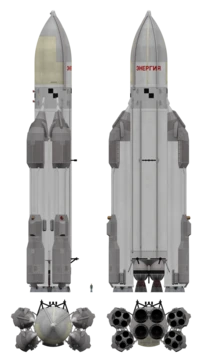
N1-L3 rocket
Soviet super heavy-lift rocket for crewed lunar landing.
The N1-L3 was a super heavy-lift launch vehicle developed by the Soviet space program for crewed lunar missions. It was designed by OKB-1 as the counterpart to the US Saturn V, but all four launch attempts between 1969 and 1972 failed. Its first stage, Block A, produced 45 meganewtons of thrust, a record that stood for over 50 years until surpassed by the SpaceX Super Heavy.
Quick Facts
- Height
- 105 m / 344 ft
- Diameter
- 17 m / 55 ft 9 in
- Mass (fully loaded)
- 2750 t
- First stage thrust
- 45400 kN
- First stage engines
- 30 NK-15
- First stage burn time
- 125 seconds
- First stage dry mass
- 180.8 tons
Facts from the source article.
History
In 1967, the space race between the United States and the Soviet Union was focused on being the first to put a person on the Moon. The Soviet N1/L3 program, formally approved in 1964, called for building the N1 rocket, a vehicle roughly the size of the American Saturn V. On November 25, 1967, just under three weeks after the first Saturn V flight during Apollo 4, the Soviets moved an N1 mockup to the new launch pad 110R at the Baikonur Cosmodrome in Soviet Kazakhstan. This vehicle, called the 1M1, was a Facilities Systems Logistic Test and Training Vehicle. Its purpose was to give engineers hands-on experience with moving the rocket to the pad, integrating it with launch systems, and rolling it back, much like the Saturn V’s SA-500F testing at Kennedy Space Center in mid-1966. Unlike the Saturn V, which was carried upright by a crawler, the N1 traveled horizontally and was then raised to a vertical position at the pad using a special Transporter Erector nicknamed Grasshopper. Using such transporters was normal for Soviet space operations. On December 11, after finishing various tests, the mockup was lowered and rolled back to the assembly building. The 1M1 was used again in later years for more pad integration tests. Though the test was secret, a U.S. reconnaissance satellite photographed the N1 on the pad shortly before it was rolled back. NASA Administrator James Webb saw this and other intelligence, which indicated the Soviets were seriously working on crewed lunar missions. That information helped shape several important U.S. decisions in the months ahead. The satellite images made it look like the USSR was nearly ready for a flight test of the N1, but they did not reveal that this particular rocket was only a mockup and that the Soviets were many months behind the U.S. in the race to land on the Moon. However, the CIA, the NRO, and President Lyndon B. Johnson did know it was a mockup, as noted in the daily presidential briefing on December 27, 1967. The Soviets hoped to conduct a test flight of the N1 in the first half of 1968, but due to various technical problems, that attempt did not happen for more than a year.
Description
The N1-L3 rocket, including its payload, was 105 meters tall and 17 meters wide. It had five stages: the first three placed the vehicle into low Earth orbit, and the final two handled the journey to the Moon and lunar orbit insertion. Fully fueled, the entire stack weighed 2,750 metric tons. The lower three stages formed a single cone shape, 17 meters across at the base, because of their internal tank layout: a smaller spherical kerosene tank sat above a larger liquid oxygen tank. Above this, the L3 section was mostly cylindrical and rode inside a shroud roughly 3.5 meters wide. An upgraded version called the N1F was developed with better engines, but it never flew before the program ended. The first stage, Block A, used 30 NK-15 engines arranged in two rings: an outer ring of 24 engines and an inner core of 6 engines at about half the diameter. Steering was done by throttling the outer ring engines differently for pitch and yaw; the inner core did not provide control. Block A also had four grid fins, a design later used on Soviet air-to-air missiles. Its planned burn time was 125 seconds. The stage alone had a dry mass of 180.8 tons. Block A generated 45,400 kilonewtons of thrust, far more than the Saturn V’s 33,700 kilonewtons. This record stood for over fifty years until SpaceX’s Super Heavy booster surpassed it in 2023.
Launch history
The N1-L3 rocket, serial number 3L, launched on February 21, 1969, carrying a modified Soyuz 7K-L1 spacecraft designated Zond L1S-1 for a lunar flyby mission. Shortly after liftoff, a brief voltage spike caused the KORD control system to shut down engine number 12. To keep thrust balanced, the KORD then also cut off engine number 24. Six seconds into the flight, pogo oscillations in engine number 2 tore components from their mounts and created a propellant leak. By 25 seconds, additional vibrations ruptured a fuel line, spilling RP-1 into the booster’s aft section. The fuel ignited upon contact with leaking gas, starting a fire that burned through power supply wiring. The resulting electrical arcing was detected by sensors, which the KORD misinterpreted as a turbopump pressurization problem. At 68 seconds, the KORD sent a command to shut down the entire first stage. This signal also locked the second and third stages, preventing any manual ground command from starting their engines. Telemetry indicated the rocket’s power generators kept functioning until the vehicle struck the ground 183 seconds after launch. The wreckage was found 52 kilometers from the launch pad. Vasily Mishin initially blamed the generators for the failure, unable to conceive another reason for all 30 engines to shut down simultaneously. However, telemetry data and the recovery of the generators from the crash site quickly disproved this. The generators survived intact, were returned to the Istra plant, refurbished, and worked without issue during bench testing. The investigation team did not offer any speculation on whether the burning first stage could have continued flying had the KORD not intervened.
More in Space Launch Vehicles of the Soviet Union
Spotted an error? Know more?
Reader corrections go straight into our review queue. Suggest an edit · How this site is sourced