From the Earth to the Moon
1865 novel about a Moon shot via giant cannon.

From the Earth to the Moon: A Direct Route in 97 Hours, 20 Minutes is an 1865 novel by Jules Verne. It recounts the efforts of the Baltimore Gun Club, a post–American Civil War society of weapons enthusiasts, to build an enormous Columbiad space gun and launch three people—the club's president, his Philadelphian armor-making rival, and a French poet—in a projectile aimed at the Moon. The novel is notable for Verne's rough calculations, some of which proved remarkably accurate given the limited empirical data of the time, though his space-gun concept was later deemed impractical for safe human space travel.
Quick Facts
- Title Orig
- fr · De la terre à la lune
- Author
- Jules Verne
- Illustrator
- Émile-Antoine Bayard and Alphonse-Marie de Neuville
- Country
- France
- Language
- French
- Series
- Voyages Extraordinaires #4 / Baltimore Gun Club #1
- Genre
- Science fiction
- Publisher
- Pierre-Jules Hetzel
- Release Date
- 1865
- English Pub Date
- 1867
- Media Type
- Print (Hardback)
- Preceded By
- Journey to the Center of the Earth
Facts from the source article.
Lore & Background
The story opens after the American Civil War, when Impey Barbicane, president of the Baltimore Gun Club, proposes building a cannon to shoot a projectile to the Moon. After securing support, the club decides on the cannon's dimensions, materials, and powder, and raises nearly five and a half million dollars from American and European countries. Captain Nicholl, a Philadelphian armor designer and old enemy of Barbicane, bets against the project's feasibility. Stone's Hill in Tampa Town, Florida, is chosen as the construction site, and the Columbiad cannon is built—a 900-foot-deep, 60-foot-wide hole. French adventurer Michel Ardan then volunteers to travel in the projectile, and after a duel between Barbicane and Nicholl is stopped by Ardan, all three agree to go together. The projectile is launched, but the fate of the astronauts is left unresolved until the sequel, Around the Moon.
Reader's Guide
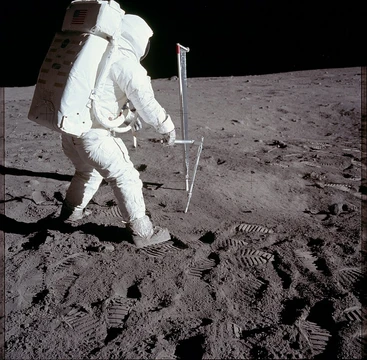
From the Earth to the Moon holds a significant place in the history of science fiction and popular culture. It was not the first literary journey to the Moon—predecessors include works by Lucian, Francis Godwin, Cyrano de Bergerac, John Wilkins, and Marie-Anne Robert—but Verne's attempt at rough calculations gave the story a veneer of scientific plausibility. The novel inspired the first science fiction film, Georges Méliès's A Trip to the Moon (1902), and later film adaptations in 1958 and 1967. In 1880, The Pall Mall Gazette described Verne's Columbiad as a 'space-ship', the first recorded use of that term. During the Apollo 11 return journey, Neil Armstrong referenced Verne's book, noting that his spaceship 'Columbia' took off from Florida and landed in the Pacific Ocean. The novel also influenced the 1995 Space Mountain roller coaster at Disneyland Paris, which was based loosely on the story. Its legacy extends to modern spaceflight commentary, as seen in the Artemis II splashdown broadcast in 2026.
Did You Know?
- The character Michel Ardan was inspired by the real-life photographer Félix Nadar.
- The novel inspired the first science fiction film, A Trip to the Moon (1902), by Georges Méliès.
- In 1880, The Pall Mall Gazette used the term 'space-ship' for Verne's Columbiad, the first recorded use of that term.
- During the Apollo 11 return, Neil Armstrong referenced Verne's book, noting its spaceship 'Columbia' took off from Florida and landed in the Pacific Ocean.
More in Space exploration novels 1-24
Spotted an error? Know more?
Reader corrections go straight into our review queue. Suggest an edit · How this site is sourced