Back to the Moon
A novel about a hijacked shuttle mission to the Moon.

Back to the Moon is a science fiction novel and the first fictional book by Homer Hickam, published in June 1999. Hickam wrote the novel using insider information he learned from NASA.
Quick Facts
- Author
- Homer Hickam
- Country
- United States
- Language
- English
- Genre
- Science fiction
- Publisher
- Delacorte Press
- Release Date
- June 1999
- Media Type
- Print (hardcover)
- Pages
- 447
- Isbn
- 0-385-33422-2
- Isbn Note
- (hardcover), 978-0-440-23538-5 (mass market paperback)
Facts from the source article.
Lore & Background
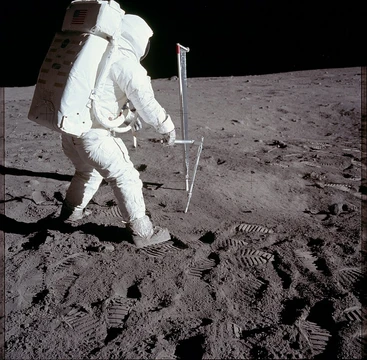
The novel opens with a dramatized account of the second EVA of Apollo 17, where astronaut Jack Schmitt discovers orange soil in Shorty Crater. Wernher von Braun watches the mission's end on TV with other NASA engineers, and Katrina Suttner, a young girl, is in on a secret involving the mission. Thirty years later, protagonist Jack Medaris prepares a private uncrewed mission to gather more orange soil, which appears to be a potential clean nuclear energy source. His probe is destroyed by unknown saboteurs, and it is revealed that Medaris is driven to recover a secret left by Katrina, who later became his wife and died in a test-stand accident.
Reader's Guide
Back to the Moon received mixed to positive reviews from CNN and The New York Times. The novel is significant as Homer Hickam's first work of fiction, drawing on his access to insider NASA knowledge. Its plot combines elements of space history, private enterprise, and thriller conventions, including a hijacked Space Shuttle, a smuggled rocket motor, and a bare-bones lunar lander. The story reflects themes of personal loss and the pursuit of lunar resources, while also incorporating contemporary concerns about sabotage and international interference in space missions.
Did You Know?
- The protagonist, Jack Medaris, hijacks the Space Shuttle Atlantis to reach the Moon.
- Medaris develops a new rocket motor that makes it possible to take Atlantis into lunar orbit.
- The orange soil discovered on the Moon appears to have enormous potential as a source of clean nuclear energy on Earth.
Political Genesis and the Cold War Stakes
The Apollo program was conceived in early 1960 under the Eisenhower administration as a natural successor to Project Mercury, but it was the political climate of 1961 that gave it its defining ambition. John F. Kennedy had campaigned on closing what he and fellow senators called the missile gap with the Soviet Union, and he wielded aerospace achievement as a symbol of national prestige, vowing American supremacy in space in absolute terms. Yet even after taking office, Kennedy hesitated. The financial commitment of a crewed lunar landing was staggering, and when NASA Administrator James Webb requested a thirty percent budget increase, Kennedy accelerated the large booster program but deferred a broader decision. The Soviet Union's Yuri Gagarin becoming the first human in space on April 12, 1961, sharpened American anxiety. A day later, members of the House Science Committee pledged backing for a crash program. Kennedy then committed publicly to landing a human on the Moon and returning him safely before the decade ended, a pledge he delivered to Congress on May 25, 1961.
Triumph, Tragedy, and the Edge of Disaster
Apollo's eleven-year span was shaped by extremes of achievement and loss. In 1967, a cabin fire during a ground test claimed the lives of the entire Apollo 1 crew, a catastrophe that forced a painful reckoning with safety. Yet the program pressed forward, and on July 20, 1969, Neil Armstrong and Buzz Aldrin set their Lunar Module down on the Moon's surface while Michael Collins circled overhead in the command and service module. Approximately 650 million viewers worldwide watched the historic moment on television, and the trio splashed down safely in the Pacific four days later. Five additional missions carried astronauts to the lunar surface, with Apollo 17 in December 1972 marking the final landing — twelve people in total had walked on the Moon. Apollo 13, however, nearly became a tragedy: an oxygen tank exploded en route, crippling the command module. The crew survived only by repurposing the Lunar Module as a lifeboat for the return journey.
Scientific Harvest and Technological Ripples
The program's most tangible scientific legacy was the 842 pounds of lunar rock it returned to Earth, a collection that profoundly expanded humanity's understanding of the Moon's composition and geological history. Beyond the laboratory, Apollo catalyzed advances in avionics, telecommunications, and computing — technologies developed for rocketry and crewed flight that rippled outward into civilian applications. The program also funded the construction of NASA's Johnson Space Center and Kennedy Space Center, establishing the institutional backbone for all subsequent American human spaceflight. The Saturn rocket family that lofted Apollo into space also powered the Apollo Applications Program, which delivered Skylab, a space station that hosted three crewed missions in 1973 and 1974, and the 1975 Apollo-Soyuz Test Project, a joint American-Soviet low Earth orbit flight that signaled a new chapter of international cooperation in space.
A Name Born at Home and a Program That Evolved
The program's name came from an intimate, domestic moment. NASA manager Abe Silverstein chose it one evening at home in early 1960, feeling that the mythological image of Apollo driving his chariot across the Sun matched the ambitious scope of what was being planned. He later likened the act of naming the spacecraft to naming a child. At that stage, Apollo was primarily about developing an advanced three-person crewed spacecraft to succeed Mercury's single-seat capsule, with possible missions including ferrying crews to a space station and circumlunar flights. A lunar landing was not yet the central objective; that focus arrived only in 1961. Feasibility study contracts were awarded in October 1960 to General Dynamics/Convair, General Electric, and the Glenn L. Martin Company, while NASA ran its own in-house design studies under Maxime Faget as an internal benchmark. Project Gemini was spun off to handle the intermediate crewed spaceflight testing that Mercury had left unfinished.
Frequently Asked Questions
Who wrote Back to the Moon?
Back to the Moon was written by Homer Hickam, best known for his nonfiction work on the rocketry pioneers of West Virginia. It marked his first venture into writing a work of fiction.
What is Back to the Moon about?
The novel centers on a Space Shuttle mission bound for the Moon that gets hijacked during its journey. The story follows the crew and the unfolding crisis as the mission goes awry.
When was Back to the Moon published?
The book hit shelves in June 1999, arriving as Hickam's debut in the science fiction genre.
What gives Back to the Moon its authenticity?
Hickam drew on firsthand, insider knowledge he gathered from NASA personnel while researching the project. That access allowed him to depict shuttle operations and mission protocols with a level of detail rare in fiction.
Why is Back to the Moon significant in Hickam's bibliography?
It represents the first time Hickam stepped outside his nonfiction roots to craft a full-length novel. For fans of his earlier work, it showed that his deep understanding of aerospace could translate into a compelling speculative narrative.
More in Space exploration novels 1-24
Spotted an error? Know more?
Reader corrections go straight into our review queue. Suggest an edit · How this site is sourced