Beyond Apollo
A controversial novel about a paranoid Venus expedition survivor.

Unknown author Unknown author or not provided · Public domain
Beyond Apollo is a science fiction novel by American author Barry N. Malzberg. It was released in hardcover by Random House in 1972. Malzberg has stated that the idea for the book came from "I Have My Vigil," a 1969 short story by fellow science fiction writer Harry Harrison.
The story follows Harry M. Evans, the only person to survive the first crewed mission to Venus. Evans is writing a novel about the failed expedition, but he proves to be an extremely unreliable narrator, frequently altering the details of his account. The reader soon suspects he may be insane, as his descriptions of absurd conversations with Venusian inhabitants are marked by a deep, almost comical paranoia. There are hints that Evans may have killed his fellow crew member. The novel concludes with a publisher offering to buy the rights to Evans's bizarre story.
Much of Malzberg's work, including this novel, sparked strong reactions upon release. *Beyond Apollo* received both high praise and harsh criticism. Joanna Russ called it "a passionate, fine, completely realized work," noting that Malzberg's repetitive use of certain words created "a kind of Greek chorus, a terrible, poignant insistence on something that is not quite in the story but yet comes through the story." Harlan Ellison said the book "put me out of commission for three days after reading it." In contrast, Bob Shaw wrote in *Foundation* that the novel was "the epitome of everything that has gone wrong with sf in the last ten years or so." In 1973, the novel won the inaugural John W. Campbell Memorial Award for Best Science Fiction Novel.
Quick Facts
- Author
- Barry N. Malzberg
- Cover Artist
- Roger Hane
- Country
- United States
- Language
- English
- Genre
- Science fiction
- Publisher
- Random House (original 1972 edition) & Pocket Books (1974 paperback edition)
- Release Date
- 1972
- Media Type
- Print (hardback & paperback)
- Pages
- 156 (Pocket Books edition)
- Isbn
- 0-671-77687-8
- Isbn Note
- (1974 paperback)
- Oclc
- 20792274
Facts from the source article.
Lore & Background
The novel's protagonist is Harry M. Evans, the lone survivor of the disastrous first crewed expedition to the planet Venus. Evans provides details of the doomed expedition as a novel in progress, and he proves to be a remarkably unreliable narrator, constantly changing the particulars of his story as it progresses. It quickly becomes apparent to the reader that he may be completely insane, as a feeling of deep (and comical) paranoia underlies Evans's descriptions of the absurd conversations that ensue with the Venusian inhabitants. There is some indication that Evans could very well have murdered his fellow crewmember. The novel ends with a publishing house offering to purchase the rights to Evans's outlandish tale.
Malzberg credits the inspiration for the novel to "I Have My Vigil", a 1969 short story by fellow science fiction writer Harry Harrison. Like much of Malzberg's work, Beyond Apollo was extremely controversial at the time of its publication, receiving both praise and scorn from literary critics.
Reader's Guide
Beyond Apollo holds significance as the winner of the first John W. Campbell Memorial Award for Best Science Fiction Novel, presented in 1973, marking it as a notable work in the genre's history. Its controversial reception reflects the divisive nature of Malzberg's style: Joanna Russ praised the novel as 'a passionate, fine, completely realized work,' noting that Malzberg's repetitive use of particular words transformed them into 'a kind of Greek chorus, a terrible, poignant insistence on something that is not quite in the story but yet comes through the story.' Harlan Ellison commented that 'Beyond Apollo put me out of commission for three days after reading it.' Conversely, Bob Shaw said in Foundation, 'Malzberg's Beyond Apollo is, to me, the epitome of everything that has gone wrong with sf in the last ten years or so.' The novel's legacy lies in its exploration of an unreliable narrator and psychological disintegration, themes that continue to provoke discussion about the boundaries of science fiction.
The Architecture of a Lunar Landing
The Saturn V rocket lifted off from Kennedy Space Center on the afternoon of July 16, 1969, carrying a spacecraft built from three distinct elements. The command module would shelter the crew and be the sole component to survive re-entry. Behind it, the service module supplied propulsion, electricity, oxygen, and water throughout the journey. The Lunar Module, split into a heavy descent stage and a lighter ascent stage, was designed exclusively for the two astronauts who would touch down. After three days of transit, Armstrong and Aldrin separated from Collins and guided the Eagle into the Sea of Tranquility on July 20. While Collins circled overhead in Columbia, the pair spent roughly two and a half hours on the surface—planting a flag, deploying instruments, and gathering nearly forty-eight pounds of rock and soil. More than twenty-one hours after touchdown, they fired the ascent engine to rejoin Collins in orbit. The crew splashed down safely in the Pacific on July 24, completing a round trip no machine had ever attempted before.
A Nation's Gamble Against the Soviets
The decision to send humans to the Moon was born from fear. When the Soviet Union launched Sputnik 1 in October 1957, the world learned that a rival superpower could project power across intercontinental distances. The resulting crisis pushed Eisenhower to create NASA and launch Project Mercury, yet the Soviets still claimed the first orbital flight with Gagarin in April 1961. Kennedy, recognizing that Soviet rockets already outperformed American ones, deliberately chose a destination beyond the reach of the existing launch generation so both nations would start from comparable footing. In a May 1961 address to Congress, he committed the entire country to landing a man on the Moon before the decade's end, framing it as a collective national endeavor rather than a single hero's feat. The program survived the tragic Apollo 1 fire of January 1967 and built upon lessons from Mercury and Gemini. By 1969, the Soviet Union could not match the Saturn V, and its Luna 15 probe crashed on the Moon just one day after the American crew landed.
The Walk That Captured the World
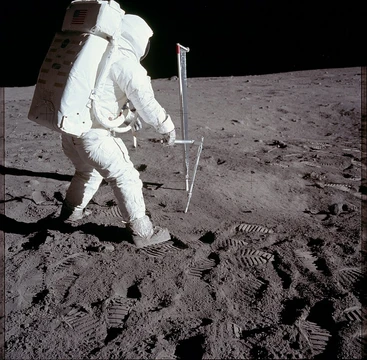
An estimated six hundred million people—roughly one in five humans alive at the time—watched Armstrong place his boot on the gray regolith, making the broadcast one of the most-viewed television events in history. His words, 'That's one small step for [a] man, one giant leap for mankind,' entered the global lexicon almost instantly. The walk itself was methodical: the pair planted an American flag, spoke live with President Nixon at the White House, set up scientific instruments, and collected twenty-one and a half kilograms of lunar rock and soil. The scientific payoff extended far beyond the mission. The returned samples yielded three minerals never before catalogued by geologists, and the instruments left on the surface kept transmitting data for years after the crew departed. The event transcended politics and technology, becoming a shared human memory that reshaped how the public understood what collective effort could achieve.
Three Astronauts, One Final Voyage
Neil Armstrong, Michael Collins, and Edwin 'Buzz' Aldrin each flew on Apollo 11 as their second and final spaceflight, a quiet coda to careers already marked by earlier missions. Armstrong, as commander, made the first step onto the Moon about six hours after the Eagle touched down; Aldrin followed nineteen minutes later. Collins, confined to the command module Columbia, spent the critical landing window in solitary lunar orbit, a role that demanded constant vigilance and communication. After the surface work was complete, the three reunited in orbit and began the long ride home. Their reception was extraordinary: ticker-tape parades, a world goodwill tour, and the Presidential Medal of Freedom from the White House. Today, Columbia rests in the National Air and Space Museum in Washington, D.C., while the Eagle's descent stage—its engine and fuel tanks still intact—sits undisturbed in the Sea of Tranquility, a permanent monument to a single afternoon in 1969.
Gallery



Frequently Asked Questions
What is Beyond Apollo?
Beyond Apollo is a 1972 science fiction novel by American writer Barry N. Malzberg, published in hardcover by Random House. It centers on the lone survivor of a disastrous first crewed mission to Venus.
What is the plot of Beyond Apollo?
The novel follows Harry M. Evans as he attempts to write a book recounting the failed Venus expedition he barely survived. His narration is deeply unreliable, with him constantly shifting, contradicting, and embellishing the details, leaving readers unsure what actually happened.
Who is the protagonist and what makes him notable?
Harry M. Evans is the sole survivor of the crewed Venus mission and the story's self-appointed narrator. He is portrayed as a paranoid, possibly insane figure whose wild and contradictory accounts make it impossible for the reader to trust any single version of events.
What award did Beyond Apollo win?
The novel was honored with the John W. Campbell Memorial Award for Best Science Fiction Novel in 1973.
What inspired Barry N. Malzberg to write Beyond Apollo?
Malzberg has said the concept grew out of Harry Harrison's 1969 short story "I Have My Vigil," which gave him the seed for a story about a maddened survivor recounting a catastrophic space mission.
More in Space exploration novels 1-24
Spotted an error? Know more?
Reader corrections go straight into our review queue. Suggest an edit · How this site is sourced