Darlah
A young adult novel about a sinister lunar mission.

Darlah, released in English as *172 Hours on the Moon*, is a young adult science fiction and horror novel by Norwegian writer Johan Harstad. First published in Norway by Cappelen Damm on September 15, 2008, it later appeared in an English translation from Little, Brown in New York City on July 10, 2012. The book has been licensed for publication in sixteen additional countries, and Harstad received a Brage Prize in 2008 for his work on it.
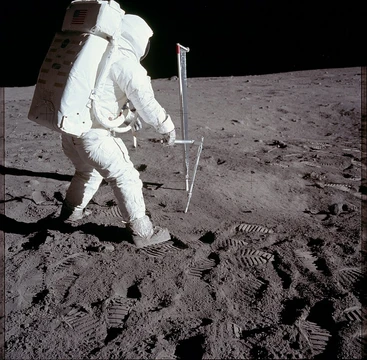
The story opens with a prologue set in 2010, then jumps to 2012. NASA announces a global contest for teenagers aged 14 to 18, offering three winners a place on a mission to the Moon. Publicly, this is a bid to boost funding and interest, but the true purpose is to investigate a sinister, mystical phenomenon discovered during the original Moon landings—the real reason NASA stopped sending people there in the 1970s.
Three teenagers—Mia from Norway, Midori from Japan, and Antoine from France—are thrilled to win the chance to visit the Moon and stay at the secret lunar base DARLAH 2, built in the 1970s under Operation DP7. Their excitement fades as they realize the base may become their tomb. They uncover the reason no one returns: doppelgänger beings, composed of an unknown inorganic material, that have appeared in Earth’s history before. These beings were harmless until a radio telescope received the signal “6EQUJ5,” prompting human investigation. The code follows the three teens after their selection: Mia sees “6E” on a hobo’s jacket, Antoine spots “QU” on a crashing plane that never existed, and Midori sees “J5” as her airport gate. Since the first Moon landing, the doppelgängers have attacked every astronaut, nearly killing the Apollo 13 crew. NASA, after analyzing a detached doppelgänger arm, learns the beings are not alive.
Meanwhile, a retired NASA custodian from the Moon landing era, now in a retirement home, slowly recalls the terrible secret that means the teens’ deaths if they go. On the Moon, the doppelgängers attack the base, and the teens and their chaperones are declared dead. One by one, they are killed: two engineers are locked in an airless room; Antoine and Mia’s brief romance ends when he disappears with the mission commander; the lunar module pilot is murdered by Antoine’s doppelgänger, leaving Mia and Midori alone. The retired custodian tries to alert the military but, unable to speak, fails and dies.
Quick Facts
- Author
- Johan Harstad
- Country
- Norway
- Language
- Norwegian
- Genre
- horror, science fiction
- Publisher
- Cappelen Damm, / Little, Brown
- Release Date
- September 15, 2008 (Norway), / July 10, 2012 (USA)
- Media Type
- Print (hardcover and electronic book) and audio-CD
- Pages
- 370
- Isbn
- 0375866566
- Congress
- PZ7.H26736Se 2012
Facts from the source article.
Lore & Background
The novel begins in 2012 after NASA announces a contest for teenagers aged 14 to 18, with three winners selected to join a mission to the Moon. The real reason for the mission is to study a mystical phenomenon discovered during the original Moon landings, which caused NASA to stop sending people to the Moon in the 1970s. Three teenagers—Mia from Norway, Midori from Japan, and Antoine from France—are excited to stay at the secret lunar base DARLAH 2, built in the 1970s during Operation DP7. They soon discover the base may become their tomb, as they encounter doppelgängers composed of an unknown inorganic material that have attacked astronauts since the first Moon landing. A retired NASA custodian slowly remembers the secret but fails to alert the military and dies. The doppelgängers kill most of the crew, and Mia and Midori attempt to escape to an escape pod in DARLAH 1. Midori is revealed to be a doppelgänger, and Mia escapes alone, crash-landing on Earth. The Mia on Earth is revealed to be a doppelgänger, which kills her family and everyone in a hotel. A mission report from 2081 finds the bodies of the original crew on the Moon.
Reader's Guide
Darlah is significant as a work that blends science fiction and horror for a young adult audience, winning the 2008 Brage Prize for children's literature. The novel's plot incorporates real historical elements, such as the '6EQUJ5' signal, and explores themes of identity and survival. Its US marketing campaign was extensive, including a website that pretended the Moon mission was real, social media accounts for the protagonists, and YouTube videos. The book received positive reviews from The Guardian, The Hollywood Reporter, Kirkus Reviews, and Publishers Weekly, with Publishers Weekly noting that the lack of deep character development added to the atmosphere. The novel's rights were sold to sixteen countries, indicating international interest. Its legacy includes being a notable example of transmedia marketing in young adult publishing.
Did You Know?
- The novel's original Norwegian title is Darlah, and its English title is 172 Hours on the Moon.
- The code '6EQUJ5' appears throughout the story, seen by the three teenagers in different forms.
- The doppelgängers are composed of an unknown inorganic material, not living tissue.
- The US marketing campaign included custom-designed Space ice cream with the phrase 'This could be your last meal'.
More in Space exploration novels 1-24
Spotted an error? Know more?
Reader corrections go straight into our review queue. Suggest an edit · How this site is sourced