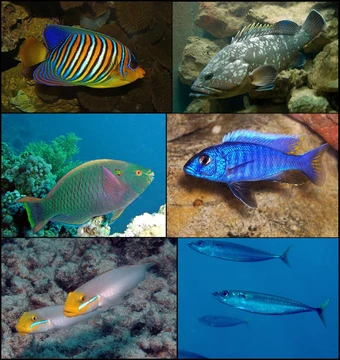
Lutjanus fulviflamma
A wide-ranging Indo-Pacific snapper with a distinctive black lateral spot.

Lutjanus fulviflamma, known commonly as the dory snapper, blackspot snapper, or Moses perch, is a species of marine ray-finned fish belonging to the family Lutjanidae, the snappers. It has a wide Indo-Pacific distribution and is notable for its distinctive black spot on the lateral line and narrow yellow horizontal stripes.
Quick Facts
- Taxon
- Lutjanus fulviflamma
Facts from the source article.
Lore & Background
Lutjanus fulviflamma was first formally described in 1775 as Sciaena fulviflamma by the Swedish-speaking Finnish-born explorer and naturalist Peter Forsskål, with the type locality given as the Red Sea. The specific name fulviflamma is a compound of fulvus, meaning 'brownish yellow' or often just 'yellow', and flamma, meaning 'fire', possibly referring to the vivid yellow upper body and tail visible on some individuals.
The body varies from moderately deep to relatively slender, with a standard length 2.5 to 2.9 times its depth. The preoperculum has a poorly developed incision and knob. Vomerine teeth may be arranged in a triangular patch with a posterior extension or in a rhombus, and there is a patch of grain-like teeth on the tongue. The dorsal fin has 10 spines and 12-14 soft rays, the anal fin 3 spines and 8 soft rays. The caudal fin can be truncate or slightly emarginate. The pale body is marked with 5-7 narrow yellow horizontal stripes of equal width, the longest extending through the eye onto the snout, and a quadrilateral black spot on the lateral line three-quarters of the distance between the head and the caudal fin.
Reader's Guide
Lutjanus fulviflamma is a common target species for subsistence fisheries and frequently appears in fish markets, typically fresh. It is caught mostly with handlines, traps, and gill nets. In the Persian Gulf, this species is particularly important in Abu Dhabi as part of the Emirates coastal demersal fishery, taken using intertidal fence nets and dome-shaped wire traps. The dory snapper is also targeted as an important commercial quarry in the inshore waters of Tanzania. Adults frequently form large mixed-species schools with the bluestripe snapper (Lutjanus kasmira) and the bigeye snapper (Lutjanus lutjanus). They are predators feeding on fishes and crustaceans. Spawning occurs in spring and summer from August to March off eastern Africa and New Caledonia, with an extended spawning period from November to April or May in the western Indian Ocean. They are discontinuous spawners, with females laying between 51,000 and 460,000 eggs in batches during a season. A single record from the Mediterranean Sea, from Malta, had an eastern African origin as shown by phylogenetic analysis.
Did You Know?
- The specific name fulviflamma combines Latin words meaning 'brownish yellow' and 'fire', possibly referring to vivid yellow coloration on some individuals.
- This species has a quadrilateral black spot on the lateral line three-quarters of the distance from the head to the caudal fin.
- A single record from the Mediterranean Sea, near Malta, was traced to an eastern African origin via phylogenetic analysis.
More in Snappers and Grunts, Part 2 1-24
Spotted an error? Know more?
Reader corrections go straight into our review queue. Suggest an edit · How this site is sourced