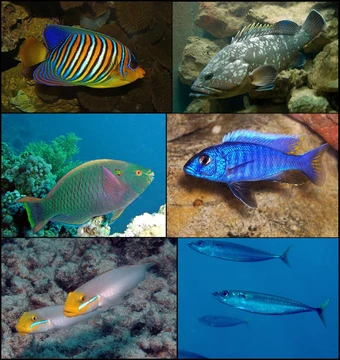
Lutjanus bohar
A large Indo-Pacific snapper with two silvery spots.

Lutjanus bohar, known as the two-spot red snapper, red bass, twinspot snapper, or bohar snapper, is a species of marine ray-finned fish in the family Lutjanidae. It has a wide Indo-Pacific distribution and is not to be confused with the unrelated Australian snapper.
Quick Facts
- Taxon
- Lutjanus bohar
Facts from the source article.
Lore & Background
Lutjanus bohar was first formally described as Sciaena bohar in 1775 with no type locality given, though it is thought to be the Red Sea. The description is attributed to the Finnish-born Swedish explorer Peter Forsskål by FishBase, but the Catalog of Fishes attributes it to Fabricius in Niebuhr (ex Forsskål) 1775. The specific name bohar is the Arabic word used for this fish in the Red Sea.
These large reddish tropical snappers show darker fins, a rounded profile of head, and a groove running from the nostrils to the eyes. Juveniles and some adults have two silvery-white spots on the back close to their dorsal fins, while larger adults lose the spots and become mostly red. Large adults may cause ciguatera poisoning.
It is a long-lived and slow-growing species that reaches maturity at 8–9 years. Adult snappers often form large schools on outer reefs or above sandy areas, mainly to form spawning aggregations. Small brownish juveniles mimic damselfishes of the genus Chromis in order to approach their prey.
Reader's Guide
Lutjanus bohar is a commercially important species and is also sought after as a game fish. It is native to the Indian Ocean and widespread in the Indo-Pacific from the east African coast, north to the Red Sea, to the western Pacific Ocean, north to the Ryukyu Islands, south to Australia. It inhabits coral reefs at depths from 4 to 180 m, though usually between 10 and 70 m. The species is carnivorous, mostly feeding on other fishes, crustaceans and molluscs. The chambered nautilus, Nautilus pompilius, is known to scavenge deceased snappers; a pair of nautiluses recorded feeding on a snapper at 703 metres below the surface constitutes the deepest recorded sighting of any nautilus species. This species is not to be confused with the unrelated Australian snapper.
More in Snappers and Grunts, Part 2 1-24
Spotted an error? Know more?
Reader corrections go straight into our review queue. Suggest an edit · How this site is sourced