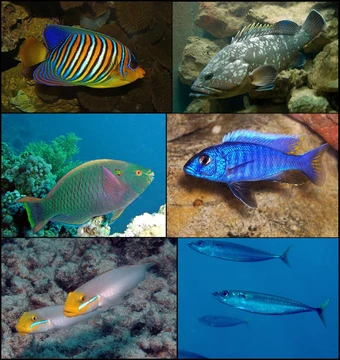
Dog snapper
A commercially important snapper with visible canine-like teeth.

The dog snapper (Lutjanus jocu) goes by several common names, including dogtooth snapper, pargue, and snaggletooth snapper. This marine ray-finned fish belongs to the snapper family Lutjanidae and is found in the Atlantic Ocean. It holds commercial value as a food fish and is also frequently kept in public aquariums.
German naturalists Marcus Elieser Bloch and Johann Gottlob Schneider first described the species in 1801, naming it *Anthias jocu*. No specific location was given for the type specimen, though it is believed to have come from Havana. The species name *jocu* comes from the local Cuban name for the fish, as recorded by Portuguese naturalist Antonio Parra.
The body of the dog snapper is relatively deep and compressed. It has long pectoral fins, a slightly forked tail fin, a rounded anal fin, and a dorsal fin divided into two lobes. Its nostrils are simple tubes arranged in front and rear pairs. The mouth is fairly large, with an upper jaw that can be pushed forward slightly and slides under the cheekbone when closed. Two enlarged, canine-like teeth in the upper jaw remain visible even when the mouth is shut. The teeth on the vomer bone form a chevron or crescent shape, with a long extension toward the rear that gives an anchor-like appearance. Additional tooth patches sit on each side of the roof of the mouth. The preoperculum has a weakly developed notch and knob. The dorsal fin has 10 spines and 14 to 15 soft rays, while the anal fin has 3 spines and 8 soft rays. The long pectoral fin reaches as far as the anus and contains 16 to 17 rays. The maximum recorded total length is 128 cm (50 in), though 60 cm (24 in) is more typical, and the heaviest published weight is 28.6 kg (63 lb). Adults have olive green upper flanks and backs, sometimes marked with thin, light-colored bars. The lower flanks and belly are pale red and copper. A white triangular bar sits beneath each eye. The pectoral, pelvic, and anal fins, along with the outer parts of the soft-rayed portion of the dorsal fin and the tail fin, are reddish; the rest of the dorsal and tail fins are olive green. Juveniles have a blue line running lengthwise under the eye and onto the gill cover, which breaks into a line of spots in adults.
In the western Atlantic, the dog snapper ranges from Massachusetts south to São Paulo, Brazil, including Bermuda, the Caribbean Sea, and the Gulf of Mexico.
Quick Facts
- Taxon
- Lutjanus jocu
Facts from the source article.
Lore & Background
The dog snapper was first formally described in 1801 by German naturalists Marcus Elieser Bloch and Johann Gottlob Schneider as Anthias jocu, with no type locality given, though it is thought to be Havana. The specific name jocu is the local Cuban name for this species, according to Portuguese naturalist Antonio Parra. The species has a relatively deep, compressed body, long pectoral fins, and a pair of very enlarged canine-like teeth in the upper jaw that remain visible when the mouth is closed. Adults have olive green upper flanks and backs, sometimes marked with slender light-colored bars, while the lower flanks and abdomen are pale red and copper. A white triangular bar is present beneath the eyes. Juveniles have a longitudinal blue line under the eye that breaks into a line of spots in adults.
The dog snapper is mainly found in the western Atlantic from Massachusetts south to São Paulo, Brazil, including Bermuda, the Caribbean Sea, and the Gulf of Mexico, and in the eastern Atlantic from Saint Paul's Rocks south to Principe. A first single record was reported in the Mediterranean Sea in 2005 in Ligurian waters, Italy. Adults are generally found around rocky outcrops or coral reefs, while juveniles remain primarily within estuaries and occasionally within rivers. They occur at depths in excess of 100 m but are more frequent at 5 to 30 m. Dog snappers tend to be solitary, aggregating to spawn in early spring.
Reader's Guide
The dog snapper is a valued food fish in areas where ciguatoxicity is rare, though larger specimens are known to be ciguatoxic, reducing fishing interest in affected regions. It is caught using handlines, gill nets, traps, seines, and spears, and the catch is sold fresh or frozen. The species appears to be overexploited in parts of its range, and juvenile mangrove habitat is threatened by coastal development. Because most of its range lacks catch data, and due to perceived decline and habitat loss, the IUCN has classified this species as Data Deficient. It is also displayed in public aquaria. The dog snapper is a nocturnal predator, feeding on smaller fish and benthic invertebrates including crustaceans (crabs and shrimps), gastropods, and cephalopods. Its main breeding grounds are off Jamaica and in the northeastern Caribbean, where it typically spawns during March, though it spawns elsewhere in its range. Off Brazil, it spawns twice a year with gonads most developed between June and October. Spawning aggregations may be mixed with Cubera snappers. The species has planktonic eggs and larvae spread by currents. Known parasites include monogenean worms from the genus Euryhaliotrema on the gills, copepods of the genus Caligus, the acanthocephalan worm Gorgorhynchus cablei, and digeneans in the genera Hamacreadium, Helicometrina, and Metadena.
Did You Know?
- The dog snapper was first formally described in 1801 as Anthias jocu by Bloch and Schneider.
- It has a pair of enlarged canine-like teeth in the upper jaw that stay visible when the mouth is closed.
- The dog snapper is known to be ciguatoxic, especially larger specimens.
More in Snappers and Grunts, Part 2 1-24
Spotted an error? Know more?
Reader corrections go straight into our review queue. Suggest an edit · How this site is sourced