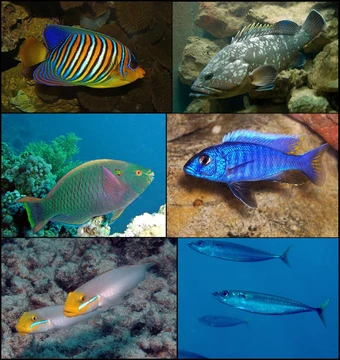
Cubera snapper
A large predatory snapper known for ciguatera risk.

The cubera snapper, also called the Cuban snapper, is a marine ray-finned fish in the snapper family Lutjanidae. It lives in the western Atlantic Ocean and is important for fishing, both commercially and for sport. However, eating it can sometimes cause ciguatera poisoning.
French zoologist Georges Cuvier first described this species in 1828, naming it *Mesoprion cyanopterus* based on a specimen from Brazil. The name *cyanopterus* combines the Greek words for "blue" and "fin," because Cuvier noted the bluish-black membranes on its median fins.
This snapper has an oval, streamlined body that is less deep than many other snappers. It has two pairs of simple nostril holes on its snout, a large mouth with thick lips, and strong canine teeth—one enlarged pair is visible even when the mouth is closed. On the roof of the mouth, the vomerine teeth form a crescent or triangular patch without a central backward extension, and there are tooth patches on each side. The preoperculum has a weak knob and notch. It has long pectoral fins, a continuous dorsal fin, and a truncated tail fin. The dorsal fin has 10 spines and 14 soft rays; the anal fin has three spines and seven or eight soft rays, sometimes with a notch behind the spiny part. The largest recorded cubera snapper was 160 cm (63 in) long, though 90 cm (35 in) is more typical, and the heaviest weighed 57 kg (126 lb). Its color ranges from grey to dark brown, with pale to dark-grey sides; some fish have a slight reddish tint. The tail fin is light grey, the pectoral fins may be translucent or pale grey, and the anal, pectoral, and pelvic fins have a bluish hue. Juveniles have a faint barred pattern on their sides.
The cubera snapper ranges across the western Atlantic, from Nova Scotia south to Santa Catarina in Brazil, including the Caribbean Sea, Gulf of Mexico, and Bermuda. It has also been recorded near the Flores Islands in the Azores. It lives at depths from 1 to 85 m (3 to 279 ft). Juveniles hide in seagrass beds or mangroves in shallow waters and have even been found in freshwater. Adults move offshore to rocky ledges and reefs.
Adults are solitary and can live up to 55 years. As the largest snapper species, it is a predator that mainly eats other fish and some crustaceans. Its large canine teeth let it tackle big prey like lobsters and crabs. It hunts near the bottom or around hard structures.
Quick Facts
- Taxon
- Lutjanus cyanopterus
Facts from the source article.
Lore & Background
The cubera snapper was first formally described as Mesoprion cyanopterus in 1828 by French zoologist Georges Cuvier, with the type locality given as Brazil. Its specific name is a compound of cyano meaning 'blue' and pterus meaning 'fin', referring to the bluish-black membranes on its median fins. The species has an oval-shaped, elongate body that is less deep than many other snappers, with a pair of front and rear nostrils, a relatively large mouth with thick lips, and enlarged canine teeth visible when the mouth is closed. Its vomerine teeth form a crescent-shaped or triangular patch with no central posterior extension. The preoperculum has a weakly developed knob and notch, and the fish has long pectoral fins, a continuous dorsal fin, and a truncated caudal fin. The dorsal fin contains 10 spines and 14 soft rays, while the anal fin has three spines and seven or eight soft rays. Overall color is grey to dark brown with pale to dark-grey flanks, sometimes with a slight reddish hue; the caudal fin is light grey, pectoral fins may be translucent to pale grey, and a bluish hue appears on the anal, pectoral, and pelvic fins. Juveniles show an indistinct barred pattern on their flanks.
Reader's Guide
The cubera snapper is the largest species of snapper and is a predatory fish, feeding mainly on other fishes and some crustaceans, including lobsters and crabs, using its large canine teeth. It forages near the bottom or around hard structures. Adults are solitary and have a maximum longevity of 55 years. The species spawns from May to August, gathering into large spawning aggregations of up to 10,000 fish over shallow offshore sites such as outer reef slopes and sandy drop-offs, with timing determined by lunar cycles. Eggs hatch within a day, and larvae are pelagic. The whale shark feeds on the newly laid pelagic spawn, while larger cubera snappers are prey to moray eels, barracudas, groupers, other snappers, and large sharks. The cubera snapper is considered good-quality food fish, but larger fish in some areas cause ciguatera poisoning. It is caught by hook-and-line, bottom longlines, gill nets, bottom trawls, and occasionally spearfishing. In areas where larger fish are ciguatoxic, no fishery exists or only smaller fish are consumed. In the United States, bag and size limits apply. Predictable spawning aggregations make it vulnerable to overfishing; catch decreased by over 60% off the U.S. Atlantic coast in the 20 years up to 2015, and numbers spawning off Cuba and Brazil have also decreased. Some Brazilian stocks are commercially extinct. The IUCN lists the species as Vulnerable, predicting further declines unless aggregations are protected.
Did You Know?
- The cubera snapper was first described in 1828 by French zoologist Georges Cuvier as Mesoprion cyanopterus.
- It is the largest species of snapper, reaching a maximum total length of 160 cm (63 in) and weight of 57 kg (126 lb).
- Spawning aggregations can include up to 10,000 fish and are determined by lunar cycles.
More in Snappers and Grunts, Part 2 1-24
Spotted an error? Know more?
Reader corrections go straight into our review queue. Suggest an edit · How this site is sourced