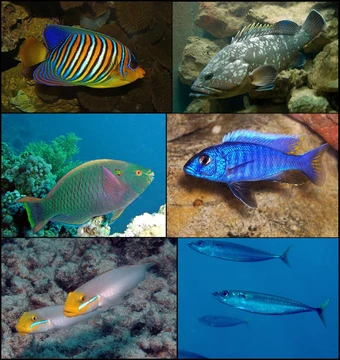
African brown snapper
A large West African snapper with taxonomic uncertainties.

The African brown snapper (Lutjanus dentatus) is a marine ray-finned fish in the snapper family Lutjanidae, found in the eastern Atlantic Ocean along the West African coast.
First described in 1861 by French zoologist Auguste Duméril as *Mesoprion dentatus*, the species was based on a specimen from Gorée, Senegal. Its scientific name *dentatus* means "toothed," a reference to its large teeth. There is taxonomic uncertainty: a comparison of a vagrant cubera snapper from the Azores with a vagrant African brown snapper from Gran Canaria suggested they might be the same species, which would make *L. dentatus* a junior synonym of *Lutjanus cyanopterus*. Additionally, some authorities consider the little-known Guinea snapper (*Lutjanus endecacanthus*) synonymous with this species.
The African brown snapper has a fairly deep body and a slightly rounded head. Its mouth reaches to the center of the eye and has thick lips. The notch and knob on the preoperculum are weak. Adult vomerine teeth form a triangular patch, while juveniles have a chevron shape; adults sometimes have a small rearward extension. The dorsal fin has 10 spines and 13–14 soft rays, and the anal fin has 3 spines and 8 soft rays. In adults, the pectoral fins do not reach the anus and have 17 rays. The maximum recorded total length is 150 cm (59 in), though 50 cm (20 in) is more typical, and the maximum published weight is 50 kg (110 lb). Adults have dusky grey backs and upper flanks, fading to whitish-pink on the lower flanks and belly. Juveniles display alternating light and dark vertical bars of roughly equal width on their sides.
This species occurs in the eastern Atlantic from Senegal to Angola, including Bioko and São Tomé and Príncipe, and has been recorded in the Canary Islands. It inhabits relatively shallow waters between 2 and 50 m (6.6 to 164 ft), typically over rocky and coral reefs, but also in brackish lagoons, mangroves, and occasionally rivers.
Little is known about its biology, though it feeds on smaller fish and crustaceans.
The African brown snapper is caught by commercial fisheries alongside other snappers. It commands high prices but is less sought after than the African red snapper (*Lutjanus agennes*). Separate catch data for this species is not collected, but West African fish stocks are known to be overexploited.
Quick Facts
- Taxon
- Lutjanus dentatus
Facts from the source article.
Lore & Background
The African brown snapper was first formally described in 1861 as Mesoprion dentatus by the French zoologist Auguste Duméril, with the type locality given as Gorée in Senegal. The specific name dentatus means 'toothed' and refers to the large teeth possessed by this species. An examination of a specimen of a vagrant cubera snapper (Lutjanus cyanopterus) from Flores Island in the Azores with a vagrant specimen of this species from Gran Canaria suggested that these may be conspecific; if that is the case, then L. dentatus will be a junior synonym of L. cyanopterus. The little known Guinea snapper (Lutjanus endecacanthus) is considered by some authorities to be synonymous with L. dentatus.
The African brown snapper has a relatively deep body with a slightly rounded head. Its mouth extends as far as the centre line of the eye and has thick lips. The notch and knob on the preoperculum are weak. The vomerine teeth are arranged in a triangular patch in adults, chevron shaped in juveniles, and adults sometimes have a small rearwards extension. The dorsal fin contains 10 spines and 13-14 soft rays, while the anal fin has 3 spines and 8 soft rays. In adults the pectoral fins do not extend as far as the anus and contain 17 rays. The back and upper flanks of adults are dusky grey in colour fading to whitish pink on the lower flanks and abdomen. Juveniles have alternating light and dark vertical bars of roughly equal widths on their flanks.
The species is found in the eastern Atlantic Ocean along the western coast of Africa from Senegal to Angola, including Bioko and São Tomé and Príncipe, and has occurred in the Canary Islands. It inhabits relatively shallow waters at depths between 2 and 50 m, normally over rocky and coral reefs, but is also found in brackish lagoons, mangroves, and occasionally in rivers. Its biology is little known; it is known to feed on smaller fishes and crustaceans.
Reader's Guide
The African brown snapper is fished for by commercial fisheries, along with its congeners. Although it commands high prices, it is not as sought after as the African red snapper (Lutjanus agennes). Separate data is not collected on the catch of this species, but the fish stocks in West Africa are known to be overexploited. Both commercial trawlers and artisanal fishers fish for this species, and some of the catch is exported to Europe. It is also likely that spawning aggregations of snappers are being targeted. The IUCN classifies this species as Data Deficient because no separate data is available, but they do consider that because of intense fishing pressure and declines in all West African snapper stocks, it may actually be Near Threatened or Vulnerable. The taxonomic uncertainty surrounding this species—its possible synonymy with the cubera snapper and the Guinea snapper—adds complexity to its conservation assessment and management.
Did You Know?
- Its specific name dentatus means 'toothed', referring to its large teeth.
- It may be conspecific with the cubera snapper (Lutjanus cyanopterus), which would make L. dentatus a junior synonym.
Frequently Asked Questions
What is the African brown snapper?
It is a large marine snapper in the family Lutjanidae, native to the eastern Atlantic waters off West Africa. The species epithet 'dentatus' is a nod to its notably large teeth.
How big can the African brown snapper grow?
Most individuals hover around 50 cm (roughly 20 inches), but the species is capable of reaching a maximum total length of about 150 cm (59 inches).
Where does the African brown snapper live?
Its core range runs along the eastern Atlantic coast of West Africa, though rare vagrant specimens have been recorded as far away as the Azores and Gran Canaria.
Who first described the African brown snapper and when?
French zoologist Auguste Duméril named the species Mesoprion dentatus in 1861, working from a specimen collected at Gorée, Senegal.
Is the African brown snapper actually the same species as the cubera snapper?
That question is still unresolved. A vagrant African brown snapper caught near Gran Canaria looked so similar to a vagrant cubera snapper from the Azores that some researchers proposed they could be one and the same, but no consensus has been reached.
More in Snappers and Grunts, Part 2 1-24
Spotted an error? Know more?
Reader corrections go straight into our review queue. Suggest an edit · How this site is sourced