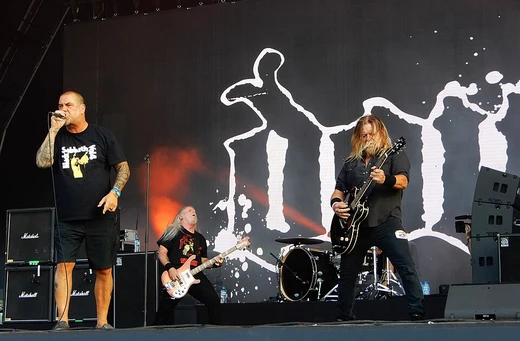
The Ocean (band)
German post-metal collective with a revolving lineup and geological concepts.

The Ocean (often called the Ocean Collective) is a German post-metal band founded in 2001 by guitarist Robin Staps. In the first two years, roughly 40 musicians cycled through the lineup before it stabilized. Their first concert took place in July 2002 at Berlin’s now-closed Eimer Club. Soon after, they released their demo *Islands/Tides*, a single 30-minute track that formed the core of their early live sets.
After a short tour with Swedish crust punk band Coma in early 2003, they signed to Make My Day Records, which released their first commercial album, *Fogdiver*, on 1 September 2003. This five-song instrumental record—despite having at least two singers on stage—earned significant critical praise across multiple genres.
During winter and spring 2004, the band recorded material intended for two albums. The calmer, more atmospheric half became *Fluxion* (August 2004), released jointly by Make My Day and Throne Records. The addition of vocalist Meta made the music more accessible to some, but critics often saw it as a step back in originality compared to *Fogdiver*. The band responded in interviews by accusing reviewers of closed-mindedness and an inability to handle the harsh, anti-Christian and anti-theistic vocals.
After signing to Metal Blade Records in summer 2005, the remaining songs from those sessions were released as *Aeolian*. Originally planned as a double CD with a mellow and a brutal part—a plan that fell through—*Aeolian* sounded very different from *Fluxion*. It used few classical instruments or electronic sounds, giving it a minimalistic feel. While *Fluxion* had one singer, *Aeolian* featured seven, including Nate Newton, Sean Ingram, and Tomas Hallbom, whose names were heavily promoted. The band said Meta’s voice on *Fluxion* created a monotony they wanted to avoid, so they added second vocalist Nico Webers. The album was released in North America in March 2006, and later that year Throne Records issued a joint vinyl version of *Fluxion* and *Aeolian* on three colored records. Around this time, Meta left and was replaced by Mike Pilat.
In late 2007, the band released the two-disc album *Precambrian*. A few months later, Nico Webers left to join War from a Harlots Mouth, leaving Mike Pilat as the sole vocalist.
Quick Facts
- Background
- group_or_band
- Alias
- The Ocean Collective
- Origin
- Berlin, Germany
- Genre
- Post-metal · progressive metal · sludge metal · extreme metal · avant-garde metal
- Years Active
- 2001–present
- Label
- Metal Blade · Make My Day · Throne
- Current Members
- Robin Staps / Mattias Hägerstrand / Jordi Farré / Enrico Tiberi / Lane Shi / Emmanuel Jessua / Marco Gennaro
Facts from the source article.
Lore & Background
The Ocean was founded in 2001 by guitarist Robin Staps. Over the next two years, about 40 musicians joined and left before a stable lineup formed. Their first concert was in July 2002 at Berlin's defunct Eimer Club. The band released the demo Islands/Tides, a 30-minute song, and later signed to Make My Day Records for the instrumental album Fogdiver (2003), which received considerable acclaim. In 2004, they recorded material for two albums: the calmer Fluxion (2004) and the more brutal Aeolian (2006), originally planned as a double CD. Fluxion featured vocalist Meta, while Aeolian had seven vocalists, including Nate Newton and Sean Ingram. After signing to Metal Blade Records, Aeolian was released in 2006, and a joint vinyl version of both albums followed. Vocalist Meta left and was replaced by Mike Pilat.
In 2007, the band released the two-disc album Precambrian. After lineup changes, including the departure of vocalist Nico Webers, the band toured with Intronaut, Opeth, and At the Gates in 2008. In 2009, Mike Pilat left, and Loïc Rossetti became the new vocalist. The Ocean released two albums in 2010, Heliocentric and Anthropocentric, which together critique Christianity. In 2013, they released Pelagial, a double album with vocal and instrumental versions. Subsequent lineup changes included the departure of guitarist Jonathan Nido and drummer Luc Hess, replaced by Paul Seidel and Damian Murdoch. The band released Phanerozoic I: Palaeozoic in 2018 and Phanerozoic II: Mesozoic & Cenozoic in 2020. In 2023, they released Holocene. In 2026, after a hiatus, the band announced the album Solaris and added four new members: Enrico Tiberi, Lane Shi, Emmanuel Jessua, and Marco Gennaro.
Reader's Guide
The Ocean's significance lies in their conceptual ambition and stylistic range, blending post-metal, progressive metal, sludge, extreme metal, and avant-garde elements. Their work often critiques organized religion, as seen in the Heliocentric/Anthropocentric diptych, and explores deep time through geological album titles (Precambrian, Phanerozoic, Holocene). The band's 'collective' model, with a rotating cast of musicians around founder Robin Staps, has allowed for diverse contributions while maintaining a cohesive artistic vision. Their 2020 album Phanerozoic II was preceded by the naming of a fossil brittle star, Ophiacantha oceani, in their honor, reflecting their impact on popular culture. The Ocean's legacy includes a dedicated following in the metal underground and critical recognition for their thematic depth and musical evolution.
Did You Know?
- The band's first concert was in July 2002 at Berlin's now defunct semi-legal Eimer Club.
- The album Fogdiver (2003) is instrumental, despite the band having at least two singers on stage.
- In 2020, the fossil brittle star Ophiacantha oceani was named in honor of the band.
- The band's 2026 album Solaris was announced alongside the addition of four new members.
Frequently Asked Questions
Who is The Ocean (band)?
The Ocean, also referred to as the Ocean Collective, is a German post-metal and sludge metal project founded by guitarist Robin Staps in 2001. They are known for blending extreme, progressive, and avant-garde elements into dense, conceptually driven compositions.
What are The Ocean's geological albums?
The band structured a multi-part album cycle around Earth's geological time periods, releasing works titled after the Precambrian, Phanerozoic, and Holocene eras. This framework gave each record a distinct sonic palette while tying the series together as a unified narrative.
How did The Ocean get started?
After Staps founded the project in 2001, roughly forty different musicians rotated through the lineup before it settled. Their first live performance was at Berlin's Eimer Club in July 2002, followed shortly by the single-track demo *Islands/Tides*.
Why does The Ocean have a revolving lineup?
The collective deliberately embraces a fluid membership model, so no single fixed roster defines the group across releases. This approach lets Staps recruit specialists for each album's particular sonic demands rather than locking in a permanent band.
What makes The Ocean important in sludge and post-metal?
They pushed the sludge/post-metal boundary by pairing heavy, distorted riffs with progressive structures and explicitly conceptual themes, including albums that critique Christian theology. Their geological series and collaborative, ever-shifting lineup set a template that many later post-metal acts have cited as influential.
More in Sludge metal musical groups 1-24
Spotted an error? Know more?
Reader corrections go straight into our review queue. Suggest an edit · How this site is sourced