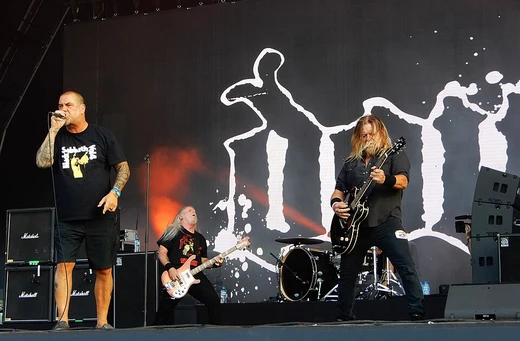
Monarch (French band)
French doom metal band known for slow, loud, and minimalist sound.

Monarch (often written as Monarch! in the United States) was a French doom metal band that started in Bayonne in 2002. Their debut release came in 2004, a double CD containing three tracks. Over the years, they put out a steady stream of albums, EPs, singles, and split records with groups such as Moss, the Grey Daturas, and Elysiüm. Most of their work appeared on the Spanish label Throne Records, though they also signed with the US imprint At A Loss Recordings, which issued the album *Omens*. In early 2010, the band performed in Australia alongside Wolves in the Throne Room, and between 2010 and 2011 they toured North America, Japan, and Australia.
The band cited doom and sludge metal acts like Noothgrush, Corrupted, Burning Witch, and The Melvins as key influences, but they always stressed the special importance of Black Sabbath—a point underlined by the title of their 2010 album *Sabbat Noir*, French for Black Sabbath. AllMusic’s Eduardo Rivadavia compared their sound to drone metal bands such as Khanate and Rigor Sardonicous, though often harsher. British magazine *Rock-A-Rolla* described them as rooted in modern doom metal. Monarch also acknowledged influence from Norwegian black metal band Darkthrone and several D-beat groups, including Discharge, Disclose, and Aghast, and they covered songs by Turbonegro and Discharge, among others.
The band’s concept remained consistent from the start. Guitarist Kaïdine explained: “The main idea was to play slow and loud as fuck. We were all playing in fast bands so we wanted to play something very different, something new and challenging for us.” Monarch tracks typically ran about 20 minutes, with the longest being “Amplifire Death March” at 58 minutes and 27 seconds, released in 2006 on a split. The length of their songs led the band to release albums almost every year for a stretch.
Songwriting was not systematic; it left room for randomness and improvisation. Bassist MicHell noted: “The raw material we work with emanates directly from our amps.
Quick Facts
- Landscape
- yes
- Origin
- Bayonne, France
- Genre
- Drone metal · sludge metal
- Years Active
- 2002−2021
- Label
- Profound Lore · MusicFearSatan
- Past Members
- Emilie "Eurogirl" Bresson / Shiran Kaïdine / MicHell Bidegain / Boubi Sablon / Stéphane Miollan / Felix Buff / Guillaume Lestage / Stephane Torre-Trueba / Robert Macmanus / Rob Shaffer
Facts from the source article.
Lore & Background
Monarch formed in 2002 in Bayonne, France. Their debut in 2004 was a double CD with three tracks. The band released albums, EPs, singles, and splits with Moss, the Grey Daturas, and Elysiüm. They worked with various labels, notably Spanish Throne Records and US label At A Loss Recordings, which released their album Omens. In early 2010, they played alongside Wolves in the Throne Room in Australia and toured North America, Japan, and Australia between 2010 and 2011.
The band's concept, as described by guitarist Kaïdine, was to play slow and loud, a departure from members' previous fast bands. Their tracks are often around 20 minutes long, with the longest being 'Amplifire Death March' at 58:27 minutes, released in 2006 on a split. Songwriting was not systematic, relying on improvisation and the physical response of amplifiers. Bassist MicHell noted that the raw material came directly from the amps, and songwriting required being in front of loud stacks.
Reception was mixed: Lords of Metal called them a 'deep black minimalistic, slow, humongous doom monster,' while some critics accused them of copying bands like Khanate. Vampster praised their 2010 album Sabbat Noir for pushing doom toward noise, and Village Voice described a 2010 New York concert as 'a focused, intense performance, utterly lacking the catharsis that's metal's usual stock-in-trade.'
Reader's Guide
Monarch's significance lies in their extreme, minimalist approach to doom metal, blending sludge, drone, and noise elements. Their music, often characterized by long tracks and heavy reliance on amplifier feedback, challenged conventional song structures. The band's influences—from Black Sabbath to Darkthrone and D-beat bands—created a unique sound that critics alternately praised as innovative or dismissed as derivative. Their international tours and releases on notable labels helped solidify their place in the underground doom scene. The death of guitarist Shiran Kaïdine in 2026 marked the end of an era for the band, whose legacy includes a discography of albums, EPs, and splits that continue to influence extreme metal.
Did You Know?
- Monarch's longest song, 'Amplifire Death March,' is 58 minutes and 27 seconds long, released in 2006 as part of a split.
- Guitarist Shiran Kaïdine died from cancer on 17 April 2026, at age 44.
- The band's 2010 album is titled Sabbat Noir, French for 'Black Sabbath.'
Origins and the Birth of a New Sound
Discharge emerged from Stoke-on-Trent, Staffordshire, in 1977, when Terence "Tezz" Roberts and Royston "Rainy" Wainwright joined forces. They quickly brought in Roberts's younger brother Anthony "Bones" Roberts on lead guitar, Nigel Bamford on bass, and Anthony "Akko" Axon on drums. Their early material drew heavily from the wave of 1977-era punk, channeling the energy of the Sex Pistols, the Damned, and the Clash. With manager Tanya Rich guiding them, the group cut their first demo and began opening for established acts like The Ruts and The Clash. However, the band's identity would soon fracture and reform. Axon and Bamford departed within a year, and the group made a pivotal decision: they brought in roadie Kelvin "Cal" Morris as vocalist, shifted Tezz Roberts behind the kit, and moved Wainwright to bass. This restructuring marked the death of their melodic punk phase and the birth of something far more abrasive and politically charged.
A Sound Forged in Distortion and Fury
Discharge's musical philosophy was deliberately stripped down to its most aggressive essentials. Anthony Roberts wielded his guitar with a heavy, distorted, grinding approach that produced what critics have likened to a "grave-black aural acid assault." Morris delivered vocals not as sung melodies but as raw, shouted declarations reminiscent of a political orator addressing a crowd. The bass, played by Wainwright, roared with an immense, gurgling, overdriven tone that anchored the entire mix. Over roughly a year, the tempo of their compositions climbed steadily, and the overall texture grew darker and more punishing. What made this combination revolutionary was its refusal to choose between sonic weight and ideological conviction. As one reviewer noted, the group proved that a hardcore band could harness the sheer sonic power of heavy metal without surrendering its anger or its politics. The distinctive drum pattern they developed became so iconic that an entire sub-genre—D-beat—was named in their honor.
Politics as the Engine of the Music
Discharge never treated their lyrics as mere decoration. Their songwriting fixated on anarchist and pacifist themes, the devastation wrought by nuclear warfare, and the social damage inflicted by capitalism. They openly embraced anarchism, displaying the anarchist symbol alongside their music much like the band Crass did. This commitment extended into their visual identity: album and EP artwork relied on stark black-and-white photography depicting the horrors of war. One of the most striking images they used was the "Impaled Dove," adapted from a 1930s John Heartfield anti-war poster showing a dove skewered on a bayonet. The Why EP went further, its cover photos displaying the corpses of dead civilians. This unflinching political stance helped drag British hardcore punk away from its pub-rock roots and into what observers called "dangerous and provocative" anti-establishment leftist territory. Their attitude was described as genuinely revolutionary and activist, setting a template for politically motivated bands that would follow in their wake.
An Influence That Spanned Genres and Generations
The ripple effect of Discharge's work on extreme music is, as one writer put it, incalculable. They are credited with paving the way for thrash metal, black metal, crust punk, and grindcore, and their "brutal, extremist approach" is widely recognized as a direct precursor to the thrash genre. The 1982 debut album Hear Nothing See Nothing Say Nothing was later voted the number one punk album of all time by Terrorizer magazine, and in 2015 Anthrax guitarist Scott Ian remarked that it still sounded as heavy and brutal as anything on the market. The band's influence is further cemented by the sheer number of metal superstars who have covered their songs as tribute, including Metallica, Anthrax, Machine Head, Sepultura, Soulfly, Prong, and Arch Enemy. Tom G. Warrior of Celtic Frost recalled hearing their early records and being completely blown away, noting that to a young musician they sounded less like punk and more like metal. Discharge's footprint stretches across at least two generations of heavy music.
Frequently Asked Questions
Who is Monarch (French band)?
Monarch, sometimes written as Monarch! in the United States, is a French doom and sludge metal band that formed in Bayonne in 2002. They are recognized for an intentionally slow, loud, and stripped-back approach to heavy music.
What does Monarch's sound like?
Their music is built around extremely slow tempos, thick distorted guitar tones, and minimalist song structures that favor raw atmosphere over technical complexity. The overall effect is a wall of heavy, droning noise that leans into both classic doom and crusty sludge textures.
Who are Monarch's key musical influences?
The band has pointed to Black Sabbath, Noothgrush, Corrupted, Burning Witch, The Melvins, and Darkthrone as major sonic touchstones. Those influences surface in their blend of Sabbath-era riffing with lo-fi, aggressive sludge production.
What labels has Monarch released music on?
The bulk of their catalog—including albums, EPs, singles, and splits with groups like Moss, the Grey Daturas, and Elysiüm—appeared on the Spanish label Throne Records. They also signed with the US imprint At A Loss Recordings, which issued their album *Omens*.
What is Monarch's debut release?
Their first record dropped in 2004 as a double CD containing only three tracks. Since then the band has maintained a steady stream of full-lengths, EPs, and collaborative split records across both European and American labels.
More in Sludge metal musical groups 1-24
Spotted an error? Know more?
Reader corrections go straight into our review queue. Suggest an edit · How this site is sourced