
Jets'n'Guns 2
A 2D side-scrolling shoot 'em up with extensive ship upgrades.

Rake in Grass · CC0
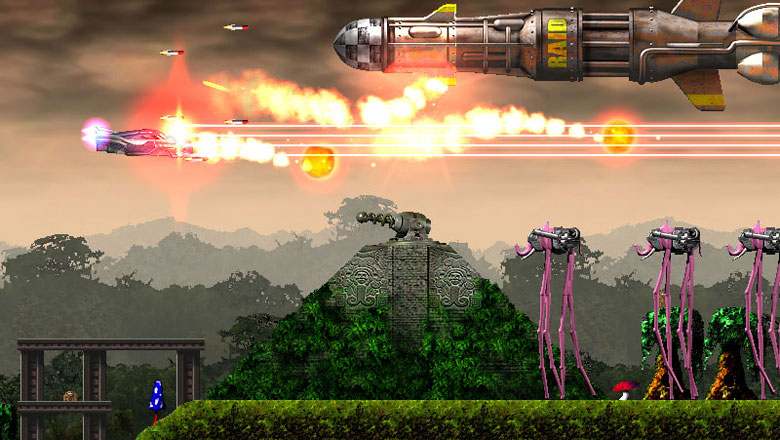
Jets'n'Guns 2 is a side-scrolling shoot 'em up from Czech developer Rake in Grass, following up their 2004 original. It launched for Windows on 24 July 2020, for Nintendo Switch on 26 August 2020, and for PlayStation 4 and 5 on 24 August 2023.
The core gameplay stays close to its predecessor: players fly through levels from left to right, blasting enemies and reaching the stage's end. Between missions, they can buy ship upgrades. Important ones boost health, armor, and cooling. A free paint job is available, and the Atarix 5000 gadget lets players unlock crates dropped by destroyed transport ships. Defensive options like shields and nanomachines provide slow armor regeneration. Other upgrades grant bounties for killing specific enemies or bonuses for wiping out groups. Players can also set up five custom weapon profiles, switchable mid-game, and adjust weapon angles to suit changing situations.
As the game progresses, more weapons and items become accessible. The starting fighter has slots for three front weapons, four G.E.M.s, an antimatter device, a missile slot, a rear weapon, and a bombing system. Unlike the first game, the ship's appearance can be changed but not its hull. The weapon selection is broad, including flamethrowers, electro-balls, and acid guns. Most weapons can be upgraded, boosting power, projectile speed, fire rate, or attack behavior. Each weapon's status screen shows meters for power, heat generation, and speed.
Firing most weapons generates heat, shown on a gauge. Heat fades when not firing. If the gauge enters the orange and then red zones, the ship overheats and cannot fire until it cools back below orange. This makes cooling upgrades essential, as they delay overheating and speed up cooldown. Missiles and bombs produce no heat; missile fire rate depends on upgrade level. Bombs are the only weapon limited by a slowly refilling meter, with each bomb's consumption decreasing through upgrades.
The game was announced in November 2016. An early access version hit Steam on 11 December 2018, with the full soundtrack by Machinae Supremacy. The PlayStation 5 version received generally favorable reviews, according to Metacritic.
Quick Facts
- Title
- Jets'n'Guns 2
- Developer
- Rake in Grass
- Composer
- Machinae Supremacy
- Released
- Windows / 24 July 2020 / Switch / 26 August 2020
- Genre
- Scrolling shooter
- Modes
- Single-player
- Platforms
- Windows, Switch, PlayStation 4, PlayStation 5
Facts from the source article.
Lore & Background
Jets'n'Guns 2 was announced in November 2016 as a sequel to the 2004 video game. An early access version was released on Steam on 11 December 2018. The soundtrack for the game is provided by Machinae Supremacy. The full version was released on 24 July 2020 for Windows, on 26 August 2020 for Nintendo Switch, and on 24 August 2023 for PlayStation 4 and PlayStation 5.
Reader's Guide
Gameplay in Jets'n'Guns 2 is very similar to the previous game. It is a 2D side-scrolling shoot 'em up in which the player's task is to reach the end of the level. Between levels, players can buy upgrades for their ship. Vital upgrades include health/armor and cooling. Players can also give their ship a new paint job for free. The Atarix 5000 gives players a chance to unlock crates found when they destroy transport ships during a mission. Upgrades that boost defense and provide slow armor regeneration include shields and nanomachines. Other upgrades give bounties for killing certain enemies and bonuses for mass killings. Players can customize up to five different weapon profiles, switchable mid-game, and change the angle of their weapons. As the game progresses, more weapons and items become available. The starting fighter has slots for 3 front weapons, 4 G.E.M.s, an antimatter device, a missile slot, a rear weapon slot, and a bombing system slot. Players can only change how the ship looks, not the ship itself. Weapons range from flamethrowers to electro-balls to acid guns, and most can be upgraded to enhance power, projectile velocity, rate of fire, or attack nature. Most weapons generate heat when fired, indicated by a heating gauge. If the needle passes the orange and then red zones, the ship overheats and cannot fire until it cools. Upgrading the cooling system is essential. Missiles and bombs do not generate heat; bomb usage is limited by a slowly replenishing bomb meter.
Did You Know?
- The soundtrack is provided by Machinae Supremacy.
- The PlayStation 5 version received generally favorable reviews from critics, according to Metacritic.
From Electro-Mechanical Targets to a Defining Arcade Era
The shoot 'em up genre did not emerge from a single moment of invention. Its lineage stretches back to mid-twentieth-century electro-mechanical target-shooting cabinets, but it only crossed into the digital realm with Spacewar! in 1962. The true watershed came in 1978 when Space Invaders hit arcades, popularising a template—rows of descending enemies, a single player craft, and escalating difficulty—that immediately spawned a wave of imitators. The following year, Asteroids and Galaxian pushed the formula further, introducing physics-based movement and more complex enemy behaviour. Throughout the 1980s and into the early 1990s, the genre was a mainstream staple, branching out into scrolling shooters, run-and-gun titles, and rail shooters. By the mid-1990s, however, that broad commercial dominance had faded. The genre contracted into a specialist niche, its conventions locked in by the design language of the 1980s, and its most devoted audience concentrated in Japan, where the abbreviation STG became the standard shorthand for the category.
The Core Loop: Reaction, Pattern, and Survival
At its heart, a shoot 'em up asks the player to do two things simultaneously: fire at a swarm of threats and dodge the return fire. The avatar—most often a spacecraft or vehicle—is perpetually under attack, and the objective is to blast through waves of enemies, survive to the end of the level, and confront a boss. Success depends almost entirely on raw reaction speed and the ability to memorise the predictable attack patterns that enemy units follow. These titles sit among the fastest-paced in all of video gaming. Designers deliberately keep physics simple: characters reverse direction instantly with no inertia, projectiles travel in straight lines at constant speed, and energy beams may snap at right angles or home in on targets. Ammunition is rarely tracked, so players fire indiscriminately, and their weapons only register damage on legitimate foes. Power-ups—extra lives, shields, health, upgraded guns—drop in to keep the pressure manageable, and different weapons are often matched to different enemy types. The result is a genre defined by speed, pattern recognition, and relentless forward momentum.
Taxonomy of Movement: How You Move Defines the Game
Shoot 'em ups are most commonly sorted by the freedom of movement they grant the player and the camera angle they employ. Fixed shooters lock action to a single screen and restrict the player to one axis—typically sliding left and right along the bottom, as in Space Invaders, Galaxian, Phoenix, and Galaga. Pooyan flipped that axis to vertical. Centipede and Gorf allowed a small vertical range within an invisible boundary. Multidirectional shooters, by contrast, grant full 360-degree freedom; Asteroids and Mad Planets are classic examples, and the twin-stick arrangement popularised by Robotron: 2084 lets the player aim independently of movement. Space shooters, a thematic subset, dominated the late 1970s and early 1980s. Tube shooters like Tempest and Gyruss send the craft through an abstract tunnel while retaining a single axis of motion. Rail shooters follow a fixed route with an into-the-screen perspective—Space Harrier, Star Fox, Panzer Dragoon—while light-gun variants such as Virtua Cop and Time Crisis add physical aiming hardware to the equation.
Niche, Cult, and the Bullet Hell Legacy
By the mid-1990s the shoot 'em up had shed its mainstream arcade dominance and settled into a dedicated niche, particularly in Japan, where the genre's conventions—established firmly during the 1980s—were preserved and refined by specialist developers and enthusiasts. The definition itself remains contested. Mark Wolf narrows it to games with multiple antagonists, reserving the term combat game for one-on-one shooting. Others broaden the scope to include on-foot protagonists, robots, and run-and-gun mechanics. What is no longer disputed is the genre's inward-looking identity: it is no longer simply any game where you shoot things but a specific family of design conventions. Within that family, the bullet hell subgenre stands out for its overwhelming walls of enemy projectiles arranged in visually striking formations, demanding that players memorise dense, intricate patterns to survive. This subgenre, along with the broader STG tradition, has sustained a passionate global community well beyond the genre's commercial peak, ensuring that the design language of Space Invaders and its descendants continues to evolve in dedicated, if smaller, circles.
Gallery
Frequently Asked Questions
What is Jets'n'Guns 2?
Jets'n'Guns 2 is a 2D horizontally scrolling shooter made by the Czech studio Rake in Grass, serving as the long-awaited sequel to their 2004 original. Players pilot a ship from the left edge of the screen to the right, blasting through enemy formations to reach each stage's end.
Who developed and published Jets'n'Guns 2?
Rake in Grass handles both the development and publishing roles for the title. The same Czech team is behind the first Jets'n'Guns, which shipped back in 2004.
What platforms is Jets'n'Guns 2 available on?
The game first appeared on Microsoft Windows on 24 July 2020, then came to Nintendo Switch on 26 August 2020, and finally reached PlayStation 4 and PlayStation 5 on 24 August 2023.
How does the ship upgrade system work in Jets'n'Guns 2?
Between missions you can spend earned currency on improvements like extra health, added armor, and enhanced cooling. A free paint job is also available for cosmetic tweaks, and the Atarix 5000 gadget lets you open supply crates that drop from destroyed enemy transports.
What genre and core loop does Jets'n'Guns 2 follow?
It is a classic side-scrolling shoot 'em up where the primary objective is to survive a left-to-right flight while mowing down waves of hostile craft. The progression layer comes from the extensive upgrade tree you build out between stages, letting you tailor your ship's survivability and firepower.
More in Shoot 'Em Ups 1-23
Spotted an error? Know more?
Reader corrections go straight into our review queue. Suggest an edit · How this site is sourced