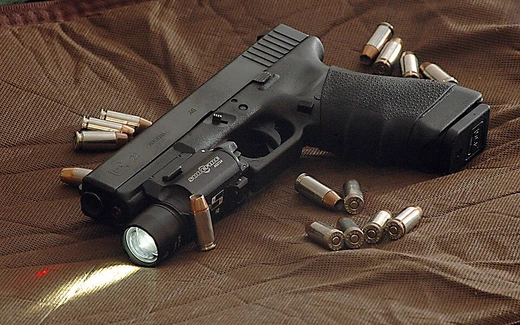
Semi-automatic pistol
A self-loading handgun firing one round per trigger pull.

A semi-automatic pistol, also called a self-loading pistol, autopistol, or autoloading pistol, is a repeating handgun that automatically ejects and loads cartridges into its chamber after every shot fired, but fires only one round each time the trigger is pulled. Its fire control group disconnects the trigger mechanism from the firing pin or striker until the trigger has been released and reset manually, distinguishing it from fully automatic pistols. Most semi-automatic pistols rely on a removable box magazine inserted into the grip, though some receiver-style designs have the magazine inserted separately.
- Operation
- Short recoil, blowback, or gas operation
- Magazine type
- Removable box magazine (typically in grip)
- Trigger types
- Single-action (SA), double-action (DA), double-action/single-action (DA/SA), double-action only (DAO)
- Example dao pistol
- Kel-Tec P-11
- Example da/sa pistol
- Beretta 92F/FS
- Example sa pistol
- M1911
- Example gas-operated pistol
- Desert Eagle
Lore & Background
Semi-automatic pistols recycle part of the energy from propellant combustion to move the bolt, usually housed inside the slide. After firing, the spent casing is extracted and ejected as the slide moves rearward under recoil, the hammer or striker is cocked, and a new round from the magazine is chambered when the slide returns forward under spring tension. Most pistols use short recoil operation, but some use simple blowback or gas operation mechanisms. The first round is typically manually loaded by pulling back and releasing the slide.
Reader's Guide
Semi-automatic pistols are notable for allowing faster reloading and storing a larger number of cartridges than revolvers. Their mode of operation generally permits a higher ammunition capacity and quicker follow-up shots. The terminology surrounding 'automatic', 'semi-automatic', and 'self-loading' can cause confusion; in popular American usage, 'automatic pistol' is often used as a synonym for any self-loading pistol, though technically it refers to a fully automatic machine pistol. Machine pistols are very rare on the market, so in colloquial usage these terms usually imply a semi-automatic handgun fed by a removable magazine. The design has evolved to include various trigger mechanisms—single-action, double-action, double-action/single-action, and double-action only—each with distinct carry modes and safety considerations. The Glock range of pistols optimizes preset triggers similar to DAO but with a partially cocked striker, allowing shorter trigger pulls.
Did You Know?
- The Desert Eagle is a rare example of a semi-automatic pistol that uses gas operation instead of short recoil.
- The Mauser M712 Schnellfeuer is a notable example of a true machine pistol, capable of fully automatic fire.
- In double-action pistols, the first trigger pull requires roughly twice as much pressure as subsequent firings.
- The half-cocked hammer position on many SA pistols prevents firing if the trigger is squeezed or the gun is dropped.
Browning's Design Philosophy and Mechanical Division
The ACP cartridge family reflects John Moses Browning's methodical approach to semi-automatic pistol ammunition, developed specifically for firearms he engineered for Colt and Fabrique Nationale. Between 1899 and 1908, five distinct rounds were introduced, all sharing a common visual language: straight-sided cases that appear as scaled iterations of one another. This uniformity in profile made the family instantly recognizable as a cohesive group. Beneath that visual similarity, however, lies a critical mechanical split. The smaller calibers—.25 ACP, .32 ACP, and .38 ACP—employ a semi-rimmed construction where the chamber headspaces against the rim. In contrast, the .380 ACP and .45 ACP are rimless, relying instead on the mouth of the case for headspacing. This distinction mirrors the different mechanical demands placed on smaller-bore versus larger-bore semi-automatic platforms, and it remains the primary functional differentiator among otherwise visually similar cartridges.
The Five Calibers and Their Introduction Timeline
The five ACP cartridges are most commonly identified by their inch-based caliber designations, though European markets frequently reference them using metric measurements that specify both bore diameter and case length. The .32 ACP (7.65×17mmSR) was the first to appear in 1899, followed by the .38 ACP (9×23mmSR) in 1900. The .25 ACP (6.35×16mmSR) and .45 ACP (11.43×23mm) both entered the lineup in 1905, while the .380 ACP (9×17mm) rounded out the family in 1908. The "SR" suffix in the metric designations of the semi-rimmed rounds distinguishes them from rimless counterparts of similar dimensions. This staggered introduction over roughly a decade allowed Browning to refine each platform incrementally, pairing each round with a purpose-built pistol rather than retrofitting a single design to accommodate multiple calibers.
Colt's Pistol Lineage and Production Spans
Colt's manufacturing history with ACP ammunition reveals a clear evolution of semi-automatic pistol design. The M1900, produced from 1900 to 1902, was the first self-loading Colt pistol and was chambered exclusively for the .38 ACP. It was succeeded by the Model 1903 Pocket Hammer, which also used the .38 ACP and remained in production from 1902 through 1928. On the military front, the M1905 was built for the .45 ACP between 1905 and 1912, eventually giving way to the M1911, which stayed in production until 1970. For smaller calibers, the Model 1903 Pocket Hammerless served the .32 ACP market from 1903 to 1941, while the Model 1908 handled the .380 ACP over the same period. The Model 1908 Vest Pocket pistol, chambered for the .25 ACP, also ran from 1908 to 1941, giving each small-bore round a dedicated compact platform.
Cartridge-to-Pistol Pairing and Service Longevity
Each ACP cartridge was conceived not as a standalone round but as an integral component of a specific pistol design, a philosophy Browning carried through his work for both Colt and Fabrique Nationale. The .45 ACP, for instance, was purpose-built for the M1905 military pistol, which served from 1905 to 1912 before being succeeded by the M1911—a platform that remained in production for nearly six decades, until 1970. This extraordinary service life underscores the durability and reliability of Browning's .45 ACP pairing. Similarly, the .38 ACP powered two distinct Colt models spanning nearly three decades of combined production, while the .32 ACP and .380 ACP each anchored a dedicated pocket pistol that remained in manufacture for over thirty-five years. The .25 ACP found its home in the compact Vest Pocket design. This one-to-one pairing philosophy ensured each round's ballistics were fully exploited within its intended platform.
Frequently Asked Questions
Who is Semi-automatic pistol?
A semi-automatic pistol is a repeating handgun that cycles a fresh round into the chamber after every shot yet fires only one round per trigger pull. It goes by several nicknames, including self-loading pistol, autopistol, and autoloading pistol.
What are Semi-automatic pistol's powers and role?
After each discharge, the action automatically ejects the spent casing and chambers the next cartridge, but the shooter must release and re-pull the trigger for the following round. Most models feed ammunition through a removable box magazine seated in the grip, and they operate via short recoil, blowback, or gas systems.
Why is Semi-automatic pistol important?
It occupies the middle ground between a single-shot revolver and a fully automatic weapon, delivering rapid follow-up shots while keeping every discharge under deliberate trigger control. That balance of speed and restraint is why it became the dominant design across military, law-enforcement, and civilian handguns.
What's the difference between Semi-automatic pistol and Fully Automatic pistol?
A semi-automatic pistol's fire-control group disconnects the trigger from the firing pin or striker, forcing the shooter to release and re-pull the trigger for each round. A fully automatic pistol keeps that connection engaged, so it keeps cycling as long as the trigger is held down.
More in Semi-Automatic Pistols 1-24
Spotted an error? Know more?
Reader corrections go straight into our review queue. Suggest an edit · How this site is sourced