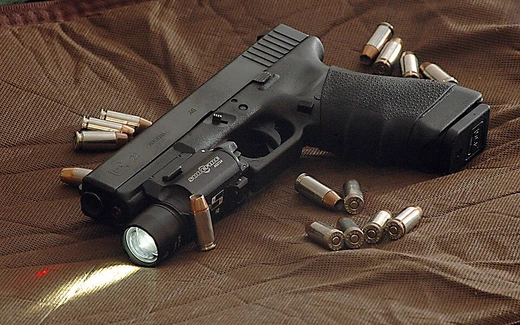
Pocket pistol
Small semi-automatic pistol designed for concealed carry in a pocket.

A pocket pistol is any small, pocket-sized semi-automatic pistol suitable for concealed carry in a pocket or similar small space. The term is purely descriptive, though related terms such as "mouse gun" (especially for smallest calibers) and "Saturday night special" are often pejorative. Pocket pistols are sometimes categorized as smaller than sub-compact pistols, but the distinction is not clear-cut.
- Origin
- Mid-17th century as a small, concealable flintlock (Queen Anne pistol, coat pistol, or pocket pistol)
- Early notable model
- Philadelphia Deringer (19th-century vest-sized pocket pistol)
- Early semi-automatic examples
- FN Model 1905 (.25 ACP), Colt Model 1908 Vest Pocket, Baby Browning
- Notable european models
- Mauser Model 1910 (.25 ACP), Mauser Model 1914 (.32 ACP), Walther PP (1929), Walther PPK
- Notable american models
- Colt Model 1903 Pocket Hammerless (.32 ACP), Colt Model 1908 Pocket Hammerless (.380 ACP)
Lore & Background
The pocket pistol originated in the mid-17th century as a small, concealable flintlock known as the Queen Anne pistol, the coat pistol, or the pocket pistol. It evolved from a weapon reserved for the wealthy to a common sidearm by the start of the 19th century. The original 19th-century vest-sized pocket pistol was the Philadelphia Deringer, and the advent of the metallic cartridge produced the classic double-barrel .41 Rimfire Remington Model 95, which became synonymous with the word "Derringer."
In the late 19th and early 20th centuries, manufacturers produced small revolvers marketed as "bicycle guns" for cyclists to ward off aggressive dogs. Snubnosed revolvers such as the Colt "Banker Special," "Sheriff's Model," and "Shopkeeper Special" appeared, as did hammerless designs like the Smith & Wesson Safety Hammerless (1887–pre-World War II) and the Colt Model 1903 Pocket Hammerless, which had a covered hammer to avoid snagging. The first widely used semi-automatic .25 ACP pocket pistols were the FN Model 1905, Colt Model 1908 Vest Pocket, and later the Baby Browning.
Pocket pistols were popular in the United States until the 1960s and 1970s, when most states passed laws limiting or prohibiting concealed carry. The passage of "shall issue" permits in the 1980s and 1990s led to a resurgence in popularity, creating new markets for small, simple, reliable concealed-carry firearms.
Reader's Guide
Pocket pistols have a long history dating back to the mid-17th century, but their modern significance is tied to concealed carry laws in the United States. After being popular until the 1960s and 1970s, when most states restricted concealed carry, the passage of "shall issue" permit laws in the 1980s and 1990s revived demand for small, simple, reliable firearms suitable for pocket carry. This resurgence created new markets for such weapons.
Notable early semi-automatic pocket pistols include the FN Model 1905, Colt Model 1908 Vest Pocket, and Baby Browning in .25 ACP, as well as the Colt Model 1903 and 1908 Pocket Hammerless in .32 ACP and .380 ACP. European designs such as the Walther PP and PPK (introduced in 1929) became standard issue for much of Europe into the 1970s and were also used by the German military during World War II. The Mauser Model 1910 and 1914 were popular civilian small handguns, with the .32 ACP version used by the Kriegsmarine and Third Reich security forces.
The term "pocket pistol" remains purely descriptive, though it is sometimes associated with pejorative terms like "mouse gun" or "Saturday night special." The distinction between pocket pistols and sub-compact pistols is not clear-cut, as some small sub-compacts may be categorized as pocket pistols and vice versa.
Did You Know?
- The term 'pocket pistol' originated in the mid-17th century with small concealable flintlocks known as Queen Anne pistols.
- The Walther PP (Polizeipistole) series, introduced in 1929, were among the world's first successful double-action blowback semi-automatic pistols.
- Pocket pistols were popular in the United States until the 1960s–1970s, when most states limited concealed carry; their popularity resurged after 'shall issue' permit laws in the 1980s–1990s.
The Self-Cycling Mechanism
The defining characteristic of a semi-automatic pistol, as a recognized category of handgun, lies in how it harnesses the very energy released when a cartridge is discharged. Rather than requiring the shooter to manually manipulate the action between shots, the weapon channels the force generated by the fired round to drive the cycling of its internal mechanism. This self-actuated process simultaneously ejects the spent casing and pulls a fresh cartridge from the magazine into the chamber, positioning it ready for the next shot. The elegance of this design means the shooter's primary physical input is limited to pulling the trigger, while the mechanical work of reloading is performed autonomously by the energy of the preceding round. This principle of using the cartridge's own discharge energy to prepare the weapon for subsequent fire is what distinguishes the semi-automatic pistol from other handgun types and forms the mechanical foundation upon which the entire category operates.
One Trigger Pull, One Round
A fundamental operational rule governing the semi-automatic pistol is that exactly one round is discharged for each individual pull of the trigger. This distinguishes the weapon's firing behavior from fully automatic mechanisms, where a single sustained trigger press can release multiple rounds. In the semi-automatic design, the shooter must release and re-engage the trigger for every subsequent shot, creating a deliberate, controlled pace of fire. Each trigger pull initiates the firing sequence, and the energy from that discharge then cycles the action to load the next cartridge into position. However, that next round will not fire until the trigger is pulled again. This one-to-one relationship between trigger actuation and round expenditure is a core defining feature of the semi-automatic pistol as a handgun category, ensuring that each shot is a discrete, intentional act by the operator rather than a continuous stream.
A Distinct Category Within Handguns
The semi-automatic pistol occupies a specific and well-defined place within the broader family of handguns. It is classified as a type of handgun, meaning it is a compact, hand-held firearm designed to be operated with one hand, as opposed to longer firearms that require two-handed support. Within that handgun family, the semi-automatic pistol is set apart by its method of action cycling: it relies on the energy of the fired cartridge to operate its mechanism, rather than on purely manual manipulation. This places it in a distinct mechanical category among the various handgun types. The designation 'semi-automatic' specifically describes the degree of automation in the weapon's cycling process—it is automatic in its reloading action but semi-automatic in that it does not fire continuously. This classification framework helps shooters, collectors, and reference authors organize and distinguish the many handgun designs that exist in the modern firearms landscape.
Catalogued in the Reference Literature
The semi-automatic pistol, and by extension the pocket pistol as a subcategory of compact handguns, has been documented and recognized across a range of authoritative reference works. Several well-known gun recognition guides and illustrated directories have devoted entries to these weapons, helping enthusiasts, collectors, and professionals identify and understand the various models. Notable publications in this space include Terry Gander's Guns Recognition Guide, first published in May 2005; David Miller's Illustrated Directory of 20th Century Guns, released in June 2003; and Richard D. Jones's Jane's Gun Recognition Guide, which came out in June 2008. These works, along with broader texts such as World Guns, form the backbone of the bibliographic record for handgun identification. Their existence underscores that the semi-automatic pistol is a well-studied and widely catalogued category within firearms literature, with multiple authors and editions contributing to its documentation over the years.
Frequently Asked Questions
What exactly is a pocket pistol?
A pocket pistol is a small semi-automatic handgun built to slip into a clothing pocket for discreet, everyday carry. The name is purely a size-and-use descriptor, not a manufacturer's brand or a specific model designation.
When did the pocket pistol concept first emerge?
The idea of a tiny, concealable handgun goes back to the mid-1600s, when flintlock-era makers produced miniature 'Queen Anne' or 'coat' pistols meant to hide in a coat or vest. The 19th-century Philadelphia Deringer is one of the earliest widely recognized examples of a vest-sized pocket handgun.
Which early semi-automatic models are considered classic pocket pistols?
Among the first semi-automatic designs in this niche are the FN Model 1905 in .25 ACP, the Colt Model 1908 Vest Pocket, and the Baby Browning. In Europe, the Mauser Model 1910 and 1914, along with Walther's PP and PPK lines, became iconic pocket-carry options.
How is a pocket pistol different from a sub-compact pistol?
Some enthusiasts draw a line where pocket pistols are even smaller than sub-compacts, but there is no universally agreed-upon boundary between the two categories. In practice the overlap is significant, and the distinction is largely a matter of convention rather than a strict technical rule.
Why do some people use terms like 'mouse gun' or 'Saturday night special' instead?
Those labels are generally derogatory slang aimed at the smallest-caliber pocket pistols, implying they are underpowered or of poor quality. The neutral, descriptive term 'pocket pistol' avoids that negative connotation and is preferred in technical and historical discussion.
More in Semi-Automatic Pistols 1-24
Spotted an error? Know more?
Reader corrections go straight into our review queue. Suggest an edit · How this site is sourced