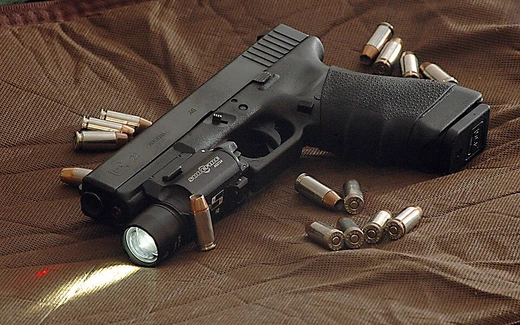
Glock 17
The first commercially successful polymer-framed pistol.

The Glock 17 is a polymer-framed, short-recoil-operated, locked-breech semi-automatic pistol designed and produced by Austrian manufacturer Glock GmbH. It entered Austrian military and police service in 1982 as the P80 after outperforming established competitors in reliability and safety tests, becoming the first commercially successful line of pistols with a polymer frame.
Quick Facts
- Origin
- Austria
- Is Ranged
- yes
- Service
- 1982–present
- Designer
- Gaston Glock
- Design Date
- 1979–1982
- Manufacturer
- Glock GmbH
- Number
- 20,000,000 as of 2020
- Cartridge
- 9×19mm Parabellum / 10mm Auto / .22 LR / .357 SIG / .380 ACP / .40 S&W / .45 ACP / .45 GAP
- Action
- Short recoil, locked breech, tilting barrel (straight blowback for Glock 25, 28, and 44)
- Feed
- 6-, 10-, 13-, 15-, 17-, 19-, 24-, 25-, 31-, 33-, or 40-round detachable box magazine, or 50- or 100-round detachable drum magazine
- Sights
- Iron sights
Facts from the source article.
Lore & Background
The Glock 17 was developed after the Austrian Armed Forces sought a new duty pistol to replace their Walther P38 handguns. Glock assembled a team of European handgun experts and within three months produced a working prototype that combined proven mechanisms with extensive use of synthetic materials. The pistol was named either for its 17-round magazine capacity or because it was the 17th patent procured by the company. After passing exhaustive endurance tests—including firing 15,000 rounds followed by an overpressure test—the Glock 17 outperformed eight pistols from five established manufacturers and was adopted as the Pistole 80. The design uses Glock's proprietary Safe Action system, consisting of three independent internal safeties: the trigger safety, the firing pin safety, and the drop safety. Its resistance to corrosion was originally achieved through a ferritic nitrocarburizing surface treatment known as Tenifer.
Reader's Guide
The Glock 17's significance lies in its role as the first commercially successful polymer-framed pistol, overcoming initial market resistance due to its 'plastic' construction. Its adoption by the Austrian military and police in 1982 sparked international interest, leading to service in at least 48 countries including the FBI and most U.S. police agencies. The pistol became a standard NATO-classified sidearm with a NATO Stock Number. The design has evolved through six generations, with the Glock 17 remaining the foundational model. In the 2020s, the pistol faced scrutiny over illegal aftermarket 'Glock switches' that convert it into a machine pistol, leading to lawsuits and legislation. In October 2025, Glock announced a 'right-sizing' initiative that ceased production of over thirty variants and introduced redesigned components to mitigate full-auto conversion.
Did You Know?
- Gaston Glock had no experience in firearms design before prototyping the Glock 17.
- The Glock 17 was named either for its 17-round magazine capacity or as the company's 17th patent.
- The pistol's Tenifer surface treatment was Glock's introduction of ferritic nitrocarburizing to the firearms industry.
- The Glock 17 outperformed eight pistols from five manufacturers in the Austrian trials.
From Polymer Expert to Pistol Pioneer: The 1982 Austrian Trial
Gaston Glock, born in 1929, had no prior experience in firearms design when he set out to build a pistol. His deep expertise in advanced synthetic polymers would prove to be the decisive advantage. In 1980, the Austrian Armed Forces issued a tender to replace their World War II-era Walther P38 handguns, laying out 17 demanding criteria: NATO 9mm caliber, self-loading operation, no magazine-loading assistance, no accidental discharge from a two-meter drop onto a steel plate, 15,000 rounds of standard fire followed by an overpressure test at 5,000 bar—nearly double the normal 9mm maximum of 2,520 bar. Glock assembled a team of European handgun experts drawn from military, police, and sport-shooting circles, and within three months produced a working prototype. In early 1982, samples were submitted for assessment. The Glock outperformed eight rivals from five established manufacturers—Heckler & Koch, SIG Sauer, Beretta, FN Herstal, and Steyr Mannlicher. Friedrich Dechant, former head of the Austrian Armaments and Defence Technology Agency, called it clearly superior in performance, handling, charging capacity, and price. It was adopted as the P80 with an initial order of 25,000 units.
Safe Action, Polymer Frames, and the Tenifer Breakthrough
The Glock 17's most distinctive engineering feature is its proprietary Safe Action system, which embeds three independent internal safety mechanisms directly into the trigger and firing-pin assembly: a trigger safety, a firing pin safety, and a drop safety. Together they prevent accidental discharge without requiring the shooter to manipulate any external on-off switch, a philosophy that prioritized operational simplicity and speed. Equally revolutionary was the decision to build the frame from polymer rather than metal, making the Glock the first commercially successful line of pistols with a polymer frame, despite early market resistance from buyers who dismissed the construction as merely plastic. The metal components received a ferritic nitrocarburizing surface treatment called Tenifer, a process Glock introduced to the firearms industry, granting the weapon notable corrosion resistance. Combined with a high magazine capacity relative to overall weight, these engineering choices made the platform both durable and practical for sustained duty use.
From One Nation to Forty-Eight: The Global Spread and Generational Evolution
What began as a single Austrian military contract rapidly expanded into a worldwide phenomenon. The Glock 17 is now supplied to armed forces, security agencies, and police departments in at least 48 countries. In the United States, it serves the FBI and the majority of police agencies. After joint Norwegian and Swedish trials running from 1983 to 1985, the pistol was adopted as the P80 in Norway in 1985 and as the Pistol 88 in Sweden in 1988, where it surpassed all prior NATO durability standards and earned a NATO Stock Number. The product line has since evolved through six distinct generations of design refinement, from Gen 1 through Gen 6. Caliber options span 9×19mm Parabellum, .40 S&W, 10mm Auto, and .45 ACP, while sizes range from the full-sized Glock 17 down to the subcompact Glock 26 and the slimline Glock 43. The pistols have become Glock GmbH's most profitable product line.
The Glock Switch Crisis and the 2025 Right-Sizing Response
The Glock's sheer ubiquity has made it a recurring flashpoint in gun-control debates. In the 2020s, particular scrutiny fell on so-called Glock switches—illegal aftermarket auto sears that convert the semi-automatic pistol into a machine pistol. The proliferation of these devices prompted the states of Minnesota and New Jersey to file lawsuits in 2024, and California enacted Assembly Bill 1127 in 2025, legislation designed to force design changes that would prevent such conversions. In response, Glock announced a major right-sizing initiative in October 2025, ceasing production of more than thirty variants to streamline manufacturing. The company also introduced redesigned components specifically aimed at mitigating full-auto conversion. This episode illustrates how the very design choices that made the Glock 17 a global success—its modular architecture and widespread availability—also made it a target for regulatory and legal challenges across multiple jurisdictions.
Frequently Asked Questions
Who is Glock 17?
The Glock 17 is a semi-automatic handgun designed by Austrian engineer Gaston Glock and produced by Glock GmbH. It was introduced in 1982 and is chambered in 9×19mm Parabellum.
What is Glock 17's role?
It serves as a short-recoil, locked-breech sidearm that cycles in a semi-automatic fashion. Austrian military and police units adopted it as the P80 after it beat established rivals in rigorous reliability and safety evaluations.
What makes Glock 17 unique?
Its polymer frame made it the first commercially successful pistol to replace a traditional metal frame with a synthetic one. It also features a system called Safe Action, which builds in three separate internal safety mechanisms.
How did Glock 17's story begin?
The design was developed in the early 1980s and entered Austrian armed-forces and law-enforcement service in 1982. It secured that role by outperforming long-standing competitors in demanding tests of dependability and trigger safety.
Why is Glock 17 important to the genre?
It proved that a polymer-framed handgun could meet military-grade reliability and safety standards, breaking the long-held assumption that metal was essential. Its 1982 adoption effectively kicked off the modern polymer-pistol era that dominates the field today.
More in Semi-Automatic Pistols 1-24
Spotted an error? Know more?
Reader corrections go straight into our review queue. Suggest an edit · How this site is sourced