Mechanical repeating pistol
Manual repeating pistols bridged revolvers and semi-automatic pistols.

A mechanical repeating pistol is a handgun that can fire multiple times before needing a reload, but the shooter must manually work a mechanism—like a lever or trigger guard—between each shot to load the next round. This sets it apart from semi-automatic pistols, which harness the energy from firing to automatically cycle the action. These guns are also called lever-action pistols or manual repeating pistols.
Most of these pistols appeared during the mid-to-late 1800s, when gun designers were trying to boost the rate of fire in handguns before smokeless powder and reliable self-loading systems existed. Despite their ingenuity, the vast majority never sold well or saw military use. They were eventually replaced by semi-automatic pistols in the 1890s, and they represent a distinct bridge between revolvers and self-loading handguns.
Attempts to build mechanical repeating handguns go back as far as the 1600s, but poor manufacturing and technology made those early efforts impractical, and they had almost no impact on later designs. By the mid-1800s, revolvers were already common repeating handguns, thanks to Samuel Colt’s early patented models like the Paterson, Walker, and Dragoon. Colt’s company held a monopoly on revolvers in the United States at the time. However, reloading those revolvers was slow and messy, since they used loose powder, pistol balls, and percussion caps, and most held only five or six rounds.
The Volcanic pistol, developed in the 1850s by Horace Smith and Daniel B. Wesson (Smith & Wesson), is one of the first important mechanical repeating pistol designs. It borrowed from earlier repeating rifle mechanisms and shared many features with the Volcanic rifle. These guns were made by the short-lived Volcanic Repeating Arms Company, which later gave way to the more famous Winchester Repeating Arms Company and Smith & Wesson Revolver Company. Smith & Wesson based their Volcanic pistol on Walter Hunt’s Rocket Ball ammunition and lever action. The Rocket Ball was an early metallic cartridge that combined bullet and powder in a single metal case. The Volcanic pistol used a spring-driven tubular magazine under the barrel, along with a breech bolt and lifter that moved cartridges into the chamber.
- Era
- Mid-19th to late 19th centuries
- Notable example
- Volcanic pistol (developed 1850s)
- Key developers
- Horace Smith, Daniel B. Wesson
- Ammunition type
- Rocket Ball (early metallic cartridge)
- Magazine type
- Spring-driven tubular magazine beneath the barrel
- Primary limitation
- Black powder fouling causing unreliability
Lore & Background
Attempts to create mechanical repeating handguns date back to the 17th century, but manufacturing and technological limitations made them largely impractical, with virtually no influence on later pistols. By the mid-19th century, revolvers—popularized by Samuel Colt's early patented designs such as the Colt Paterson, Walker, and Dragoon series—were already widespread. However, reloading these revolvers was tedious, as they used loose powder, pistol ball, and percussion caps, and most held only five or six rounds.
The Volcanic pistol, developed in the 1850s by Horace Smith and Daniel B. Wesson, is one of the first significant mechanical repeating pistol designs. It used a spring-driven tubular magazine beneath the barrel, a breech bolt, and a lifter to move cartridges into the chamber, with a lever integrated into the trigger guard. The design was limited by its black powder ammunition, which caused fouling that made the pistol unreliable and gave poor ballistics due to the small powder charge. Production ceased in 1860.
Influenced by the Volcanic pistol, European gunsmiths independently developed several mechanical repeating pistol designs in the late 19th century, most using a forward-moving trigger guard/lever. Notable designers included Marius Berger, Rudolf Osterreich, Josef Schulhof, Paul Mauser, Karel Krnka, Erwin Reiger, Franz Passler and Ferdinand Seidl, Joseph Laumann, Louis Schlegelmilch, Gustav Bittner, and Philippe H. Counet. These designs originated mainly from Austria-Hungary, particularly Bohemia, with some from Germany, France, and Belgium. They used various feeding systems: tubular magazines, rotary magazines, or Mannlicher-style en-bloc clips. The 7.7mm Bittner model of 1893 was the most widely distributed and successful of the European mechanical repeater pistols.
Reader's Guide
Mechanical repeating pistols represent a distinct transitional stage between revolvers and semi-automatic pistols. They appeared mainly during the mid-19th and late 19th centuries, when firearms designers sought to increase the rate of fire of handguns before smokeless powder and reliable self-loading mechanisms had been developed. Black powder fouling was the main obstacle limiting both mechanical repeating pistols and early semi-automatic pistols, as residue jammed moving parts. These designs did not secure military contracts and were produced in limited quantities for the commercial market. The earliest semi-automatic pistol models—the Schönberger-Laumann 1892, Salvator Dormus pistol, Roth–Theodorovic pistol, and Mannlicher M1894—originated from Austria-Hungary, which emerged as an important center of early automatic pistol development. The Schönberger-Laumann 1892 was a simple blowback self-loading adaptation of Laumann's 1891 mechanical repeating pistol. Ultimately, mechanical repeating pistols were not commercially successful due to the appearance of truly self-loading pistols using cleaner smokeless powder, such as the Borchardt C‑93, Bergmann 1896, Mauser C96, and FN M1900.
Did You Know?
- The Volcanic pistol was developed by Horace Smith and Daniel B. Wesson, who later founded Smith & Wesson.
- The Volcanic pistol used Walter Hunt's Rocket Ball ammunition, an early metallic cartridge design.
- The Schönberger-Laumann 1892 semi-automatic pistol was a direct adaptation of Laumann's 1891 mechanical repeating pistol.
The Recoil-Driven Cycle
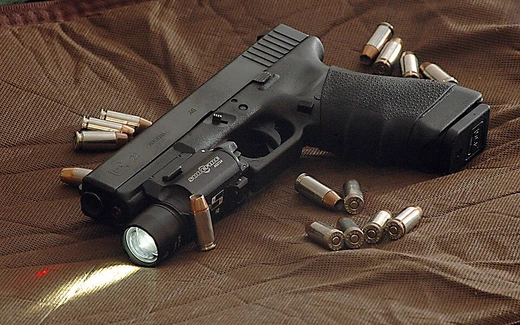
The fundamental operating principle of a semi-automatic pistol centers on harnessing a portion of the energy generated when propellant combusts. That energy drives the bolt—typically housed within the slide—rearward. As the bolt travels back, it simultaneously extracts the spent casing, ejects it, and cocks the hammer or striker. A spring then drives the bolt forward again, pushing a fresh cartridge from the magazine into the chamber. Once the bolt reaches its forward, locked position (termed "in battery"), the pistol is ready for the next trigger pull. Most designs achieve this through short recoil operation, though some employ simple blowback or gas-operated mechanisms. Critically, the fire control group severs the connection between the trigger and the firing pin until the shooter manually releases and resets the trigger, distinguishing this from fully automatic firearms where the cycle continues without human intervention.
A Tangle of Names
The vocabulary surrounding these firearms creates persistent confusion. Technically, "automatic pistol" designates a fully automatic machine pistol capable of discharging multiple rounds with a single sustained trigger pull. Yet in everyday American parlance, the same phrase commonly refers to any self-loading handgun, the overwhelming majority of which are semi-automatic. Because true machine pistols are exceedingly rare in commercial availability, most people using "automatic pistol," "semi-automatic pistol," or "self-loading pistol" are in fact describing the same object: a magazine-fed handgun that fires exactly one round per trigger pull. The distinction matters in technical and legal contexts, where "semi-automatic" precisely describes the mechanism that disconnects the trigger from the striker until a manual reset, while "automatic" implies continuous cyclic firing. This gap between technical precision and colloquial shorthand means that even among informed enthusiasts, the terminology can obscure rather than clarify the mechanical differences at play.
Trigger Philosophies
Semi-automatic pistols offer several distinct trigger philosophies. Double-action-only (DAO) designs, exemplified by the Kel-Tec P-11, require every trigger pull to both cock and release the hammer or striker in a single continuous motion, demanding uniform pressure each time. This consistency makes DAO actions popular for small, concealable self-defense pistols but less suited to target or hunting applications. The Glock line represents a notable hybrid: its striker is partially cocked as the slide closes, yielding a shorter trigger pull than pure DAO, and the trigger spring can be swapped for a lighter unit paired with a low-strength sear connector to further reduce pull weight, as seen in models like the G34 and G35. Standard double-action/single-action (DA/SA) pistols, such as the Beretta 92F/FS, demand roughly twice the trigger pressure on the first shot to cock the hammer, after which subsequent pulls operate in single-action mode. Pure single-action pistols like the M1911 require the hammer to be manually cocked or the slide racked before the first shot, though the mechanism automatically re-cocks with each subsequent cycle.
Carry Conditions and Practical Considerations
How a semi-automatic pistol is carried and prepared for use reveals important design trade-offs. Single-action pistols are traditionally carried in what Jeff Cooper popularized as "condition 1"—magazine full, a round chambered, the hammer fully cocked, and the thumb safety engaged. This configuration, however, works most naturally for right-handed shooters, since the thumb safety sits on the left side of the frame. Double-action pistols are more commonly carried with a full magazine, a round in the chamber, the gun uncocked, and the external safety disengaged. The Taurus PT145 illustrates an interesting variant: it has no decocker, so the striker is primed the moment a round is chambered, entering double-action mode only if a round fails to fire on pin impact. A practical caution applies to all these designs: manually inserting a round into the chamber should be avoided, as semi-automatic firearms are engineered to load cartridges from the bottom via the magazine, and forced manual insertion can cause excessive wear on the extractor.
Frequently Asked Questions
What is a mechanical repeating pistol?
It is a mid-to-late 19th-century handgun that allows several consecutive shots, but the shooter must physically work a lever or similar mechanism after every round to chamber the next one. The design is also commonly called a lever-action or manual repeating pistol.
Who are the key figures behind the mechanical repeating pistol?
Horace Smith and Daniel B. Wesson are most closely linked to the concept, especially through their 1850s work on the Volcanic pistol. Their experiments with the Rocket Ball cartridge and a spring-loaded tubular magazine beneath the barrel set the stage for later self-loading designs.
How does a mechanical repeating pistol differ from a true semi-automatic?
The core difference is that a mechanical repeater still demands a deliberate hand motion to cycle the action between shots, while a semi-automatic uses the energy of the fired round to eject the spent casing and seat a fresh one on its own. In short, one keeps a manual step in the firing cycle; the other removes it entirely.
What was the biggest weakness of mechanical repeating pistols?
Black powder residue clogged the internal mechanisms rapidly, rendering the guns unreliable after only a few rounds. That fouling problem was a primary reason the design never displaced the revolver in everyday carry or military service.
Why do mechanical repeating pistols matter in handgun history?
They acted as the missing link between the single-action revolver and the fully self-loading semi-automatic, demonstrating that sequential feeding from a tubular magazine was feasible in a pocket-sized firearm. Their shortcomings—manual cycling and powder fouling—became the exact engineering hurdles that later designers, such as John Browning, set out to eliminate.
More in Semi-Automatic Pistols 1-24
Spotted an error? Know more?
Reader corrections go straight into our review queue. Suggest an edit · How this site is sourced