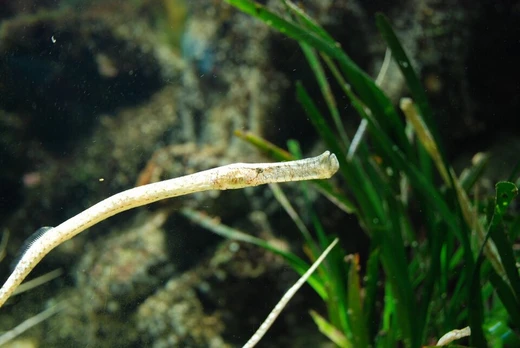
Hippocampus nalu
First pygmy seahorse discovered in African waters.
Last updated

[Photo: Richard Smith / oceanrealmimages.com] Short G, Claassens L, Smith R, De Brauwer M, Hamilton H, Stat M, Harasti D (2020) Hippocampus nalu, a new species · via Wikipedia: Hippocampus nalu · CC BY 4.0
It is the first pygmy seahorse known to live in African coastal waters.[1][2] Adults reach a maximum length of just 2 centimeters.[3][2] The Sodwana pygmy seahorse, also called the African pygmy seahorse or Honeypot seahorse, belongs to the Syngnathidae family and is found in South African waters.[4]
Scientific classification
- KingdomAnimalia
- PhylumChordata
- ClassActinopterygii
- DivisionTeleostei
- OrderSyngnathiformes
- FamilySyngnathidae
- GenusHippocampus
- SpeciesHippocampus nalu
Named by Short, Claassens, R. Smith, De Brauwer, Hamilton, Stat and Harasti, 2020
Close relatives
Other species of Hippocampus with a Codexery entry.
- Hippocampus pontohi Hippocampus pontohi
- Barbour's seahorse Hippocampus barbouri
- Big-belly seahorse Hippocampus abdominalis
- Denise's pygmy seahorse Hippocampus denise
- Dwarf seahorse Hippocampus zosterae
- Flat-faced seahorse Hippocampus trimaculatus
- Giraffe seahorse Hippocampus camelopardalis
- Great seahorse Hippocampus kelloggi
Sources: Wikipedia taxobox: Hippocampus nalu (CC BY-SA 4.0) · order, family and genus agree with WoRMS AphiaID 1437127 (CC BY 4.0)
Conservation status
Near Threatened (NT)
- LC
- NT▲ this species
- VU
- EN
- CR
- EW
- EX
Source: IUCN Red List assessment · GBIF copy of the Red List category
Where the hippocampus nalu has been recorded
Map: drawn by Codexery. Data: Natural Earth basemap (public domain) · place coordinates: Wikipedia (CC BY-SA 4.0)
Biology and range
The species inhabits shallow coastal waters at depths between 12 and 17 meters.[5] Its habitat includes flat sandstone-based coral reefs and short algal turfs.[5] Hippocampus nalu is currently only known from Sodwana Bay in South Africa.[6][1] Adults have honey-brown skin with white irregular reticulation and a reddish tail.[7]
Juveniles are darker in colouration than adults.[7] The species is physically and genetically distinct from the seven known pygmy seahorse species.[2] Hippocampus nalu diverged from the ancestors of all known pygmy seahorses more than 12 million years ago.[8] Juveniles are about 10 mm long, and adults grow up to 2 centimetres.[7]
Like other syngnathids, this species uses its coloration to blend in with algae and the surrounding environment.[7]
What the specialist sources record
The Smithsonian Magazine account states that diving instructor Savannah Nalu Olivier first spotted the seahorse in Sodwana Bay in 2017.[3] The Phys.org article reports that a team of researchers discovered the species after a tip-off from a local diver.[1] The National Geographic article notes that the name "nalu" translates to "here it is" in Xhosa and Zulu.[8] The Phys.org article adds that "nalu" also means "surging surf" in Hawaiian, reflecting the habitat.[1]
The Critter Research account states that Hippocampus nalu is the 45th seahorse species to be described.[2] The WoRMS database records the species as accepted, with authority Short, Claassens, Smith, De Brauwer, Hamilton, Stat & Harasti, 2020.[9]
References
- University of Leeds, "Meet Africa's first pygmy seahorse species", Phys.org, 2020-05-20. facts only, no text reused. phys.org
- "pygmy seahorse", critter research, 20 May 2020. facts only, no text reused. crittersresearch.com
- McGreevey, "Newly Discovered Pygmy Seahorse Species Is the Size of a Fingernail", Smithsonian Magazine, May 29, 2020. facts only, no text reused. smithsonianmag.com
- Wikipedia, "Hippocampus nalu" (CC BY-SA 4.0), which cites: Short, "Hippocampus nalu, a new species of pygmy seahorse from South Africa, and the first record of a pygmy seahorse from the Indian Ocean (Teleostei, Syngnathidae)", ZooKeys, 2020, p. 141–156; Short, "Press Release: New Pygmy Seahorse Species South Africa", Dr Richard Smith, 2020-05-19; Short, "Hippocampus nalu, a new species of pygmy seahorse from South Africa, and the first record of a pygmy seahorse from the Indian Ocean (Teleostei, Syngnathidae)", ZooKeys, 2020, p. 141–156; Short, "Hippocampus nalu, a new species of pygmy seahors en.wikipedia.org
- Wikipedia, "Hippocampus nalu" (CC BY-SA 4.0), which cites: Short, "Hippocampus nalu, a new species of pygmy seahorse from South Africa, and the first record of a pygmy seahorse from the Indian Ocean (Teleostei, Syngnathidae)", ZooKeys, 2020, p. 141–156 (original not read by us) en.wikipedia.org
- Wikipedia, "Hippocampus nalu" (CC BY-SA 4.0), which cites: University of Leeds, "Meet Africa's first pygmy seahorse species", Phys.org, 2020-05-20 (we also read that source) en.wikipedia.org
- Wikipedia, "Hippocampus nalu" (CC BY-SA 4.0), which cites: Short, "Hippocampus nalu, a new species of pygmy seahorse from South Africa, and the first record of a pygmy seahorse from the Indian Ocean (Teleostei, Syngnathidae)", ZooKeys, 19 May 2020, p. 156; Short, "Hippocampus nalu, a new species of pygmy seahorse from South Africa, and the first record of a pygmy seahorse from the Indian Ocean (Teleostei, Syngnathidae)", ZooKeys, 2020, p. 141–156; McGreevey, "Newly Discovered Pygmy Seahorse Species Is the Size of a Fingernail", Smithsonian Magazine, May 29, 2020 (we also read that source) en.wikipedia.org
- Main, "New pygmy seahorse discovered, first of its kind in Africa", National Geographic, 2020-05-20. facts only, no text reused. nationalgeographic.com
- World Register of Marine Species, Hippocampus nalu (AphiaID 1437127). CC BY 4.0. marinespecies.org
Each numbered sentence above was checked against the source it cites before publication. Sentences citing Wikipedia adapt text from the English Wikipedia article Hippocampus nalu (contributors), used under CC BY-SA 4.0; this entry is available under the same licence. Other sources were used for facts only; no text or images are copied from them.
More in Seahorses and Pipefish
Sources
Compiled from Wikipedia and the sources listed below. Text from Wikipedia is available under CC BY-SA 4.0; this entry is adapted from it.
- Wikipedia: Hippocampus nalu (CC BY-SA 4.0).
- Classification: the source article's taxobox; order, family and genus checked against WoRMS, the World Register of Marine Species (CC BY 4.0).
- Conservation status: IUCN Red List assessment.
- Occurrence records: GBIF (CC0 / CC BY). Basemap: Natural Earth (public domain).
- Word definitions: the Codexery glossary, each quoted from its Wikipedia article.
Spotted an error? Know more?
Reader corrections go straight into our review queue. Suggest an edit · How this site is sourced