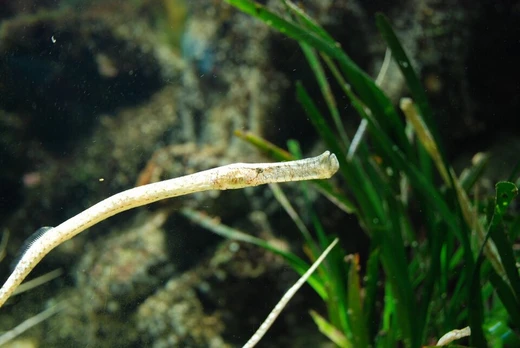
Tiger tail seahorse
A striped seahorse used in traditional medicine, threatened by overfishing.
Last updated

MartinThoma · via Wikipedia: Tiger tail seahorse · CC0
It reaches a maximum total length of around 15 cm, with a snout length of 2.2 in head length.[1][2] Belonging to the order Syngnathiformes and the family Syngnathidae, the tiger tail seahorse is a marine organism.[3]
Scientific classification
- KingdomAnimalia
- PhylumChordata
- ClassActinopterygii
- DivisionTeleostei
- OrderSyngnathiformes
- FamilySyngnathidae
- GenusHippocampus
- SpeciesHippocampus comes
Named by Cantor, 1850
Close relatives
Other species of Hippocampus with a Codexery entry.
- Barbour's seahorse Hippocampus barbouri
- Big-belly seahorse Hippocampus abdominalis
- Denise's pygmy seahorse Hippocampus denise
- Dwarf seahorse Hippocampus zosterae
- Flat-faced seahorse Hippocampus trimaculatus
- Giraffe seahorse Hippocampus camelopardalis
- Great seahorse Hippocampus kelloggi
- Hedgehog seahorse Hippocampus spinosissimus
Sources: Wikipedia taxobox: Tiger tail seahorse (CC BY-SA 4.0) · order, family and genus agree with WoRMS AphiaID 275191 (CC BY 4.0)
Conservation status
Endangered (EN)
- LC
- NT
- VU
- EN▲ this species
- CR
- EW
- EX
Source: IUCN Red List assessment · GBIF copy of the Red List category
How big is it?
Largest length in the source, 0.19 m, next to a 1.8 m person.
Diagram: drawn by Codexery, schematic shapes to scale (not a likeness). Length: Wikipedia: Tiger tail seahorse
Where the tiger tail seahorse has been recorded
Each dot is a place where the species has been observed and reported (407 records, half-degree grid) — not a modelled range. 13 inland records left out (institution coordinates). 1 isolated far-off record not drawn.
Map: drawn by Codexery. Data: GBIF occurrence search (records CC0 / CC BY) · Natural Earth basemap (public domain)
Biology and range
Its climate is tropical, between 15°N and 1°N.[1] Their diet consists of plankton, small shrimp, coral, and small fish.[1] This seahorse species is active during the night.[1] A brood pouch on the male's chest carries between 1 and 2,000 eggs, with the gestation period lasting from 1 to 4 weeks.[1]
In captivity, the lifespan ranges from 0 to 1.5 years, whereas in the wild it is between 1 and 5 years.[4] Bony rings cover the body: there are 11 rings on the trunk and between 33 and 37 rings on the tail.[5] Each cheek has two spines, a prominent spine is located on the nose, and the coronet features five knobs.[5]
What the specialist sources record
GBIF holds 552 occurrence records for this taxon as of 7 October 2026.[6] The WoRMS database records Hippocampus comes Cantor, 1849 as an accepted marine species in the class Teleostei.[3] A 1999 identification guide notes the species reaches a maximum total length of around 15 cm and has yellow saddle shapes on the upper surface.[2] The same 2006 paper reports the species has 11 trunk rings and 33 to 37 tail rings.[5]
References
- Wikipedia, "Tiger tail seahorse" (CC BY-SA 4.0) en.wikipedia.org
- Wikipedia, "Tiger tail seahorse" (CC BY-SA 4.0), which cites: Lourie, "Seahorses: An Identification Guide to the World's Species and Their Conservation", Project Seahorse, 1999 (we also read that source) en.wikipedia.org
- World Register of Marine Species, Hippocampus comes (AphiaID 275191). CC BY 4.0. marinespecies.org
- Wikipedia, "Tiger tail seahorse" (CC BY-SA 4.0), which cites: "Hippocampus comes. The IUCN Red List of Threatened Species 2026", 2026, p. e.T41008A254567190 (original not read by us) en.wikipedia.org
- Wikipedia, "Tiger tail seahorse" (CC BY-SA 4.0), which cites: Morgan, "Threatened Fishes of the World: Hippocampus comes Cantor 1850 (Syngnathidae)", Environmental Biology of Fishes, March 2006, p. 311–313 (original not read by us) en.wikipedia.org
- GBIF Backbone Taxonomy and occurrence index, Hippocampus comes (taxon key 5201144). CC BY 4.0 (backbone); counts are facts. gbif.org
Each numbered sentence above was checked against the source it cites before publication. Sentences citing Wikipedia adapt text from the English Wikipedia article Tiger tail seahorse (contributors), used under CC BY-SA 4.0; this entry is available under the same licence. Other sources were used for facts only; no text or images are copied from them.
More in Seahorses and Pipefish
Test yourself
Three questions drawn from this entry’s sources. Pick an answer to check it.
Answers checked against the source article
Sources
Compiled from Wikipedia and the sources listed below. Text from Wikipedia is available under CC BY-SA 4.0; this entry is adapted from it.
- Wikipedia: Tiger tail seahorse (CC BY-SA 4.0).
- Classification: the source article's taxobox; order, family and genus checked against WoRMS, the World Register of Marine Species (CC BY 4.0).
- Conservation status: IUCN Red List assessment.
- Occurrence records: GBIF (CC0 / CC BY). Basemap: Natural Earth (public domain).
- Word definitions: the Codexery glossary, each quoted from its Wikipedia article.
Spotted an error? Know more?
Reader corrections go straight into our review queue. Suggest an edit · How this site is sourced