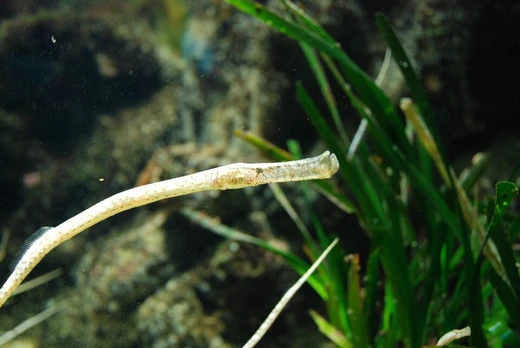
Pacific seahorse
The only seahorse in the eastern Pacific.
Last updated

LASZLO ILYES from Cleveland, Ohio, USA · via Wikipedia: Pacific seahorse · CC BY 2.0
The Pacific seahorse (Hippocampus ingens) is a fish in the family Syngnathidae and is the only seahorse species found in the eastern Pacific Ocean.[1] It is one of the largest seahorses, reaching up to 36 cm in length.[2]
Scientific classification
- KingdomAnimalia
- PhylumChordata
- ClassActinopterygii
- DivisionTeleostei
- OrderSyngnathiformes
- FamilySyngnathidae
- GenusHippocampus
- SpeciesHippocampus ingens
Named by Girard, 1859
Close relatives
Other species of Hippocampus with a Codexery entry.
- Slender seahorse Hippocampus reidi
- Barbour's seahorse Hippocampus barbouri
- Big-belly seahorse Hippocampus abdominalis
- Denise's pygmy seahorse Hippocampus denise
- Dwarf seahorse Hippocampus zosterae
- Flat-faced seahorse Hippocampus trimaculatus
- Giraffe seahorse Hippocampus camelopardalis
- Great seahorse Hippocampus kelloggi
Sources: Wikipedia taxobox: Pacific seahorse (CC BY-SA 4.0) · order, family and genus agree with WoRMS AphiaID 275197 (CC BY 4.0)
Conservation status
Vulnerable (VU)
- LC
- NT
- VU▲ this species
- EN
- CR
- EW
- EX
Source: IUCN Red List assessment · GBIF copy of the Red List category
How big is it?
Largest length in the source, 0.3 m, next to a 1.8 m person.
Diagram: drawn by Codexery, schematic shapes to scale (not a likeness). Length: Wikipedia: Pacific seahorse
Where the pacific seahorse has been recorded
Each dot is a place where the species has been observed and reported (850 records, half-degree grid) — not a modelled range. 75 inland records left out (institution coordinates).
Map: drawn by Codexery. Data: GBIF occurrence search (records CC0 / CC BY) · Natural Earth basemap (public domain) · place coordinates: Wikipedia (CC BY-SA 4.0)
Biology and range
After a gestation period of 14 to 15 days, the male gives birth to live young.[2] Pacific seahorses reach sexual maturity at 8 to 10 months, with a lifespan of 3 to 5 years.[2] The species is distributed from San Diego in California to Peru, including the Galapagos Islands.[2] Pacific seahorses are active at night and live in various underwater environments close to the shore, going no deeper than 60 m.[2]
They blend in with gorgonians and black corals by hiding among their branches.[2] Mysids, small crustaceans, and other planktonic creatures that live near the seafloor make up the food they eat.[2] Using her ovipositor, a female places her eggs into the male's brood pouch, where fertilization happens and the opening is closed.[2] The top sellers of Pacific seahorses are Mexico and Peru, each moving over one dry ton per year.[2]
What the specialist sources record
The MarineBio Conservation Society account states that Pacific seahorses are listed as Vulnerable on the IUCN Red List.[2] According to the MarineBio account, Mexico has listed giant seahorses as a species subject to special protection.[2] The GBIF backbone taxonomy accepts Hippocampus ingens and holds 1,027 occurrence records for this taxon.[3] According to the same source, more than 20 million seahorses are traded annually for use in traditional remedies, as aquarium specimens, and as dried ornaments.[2]
The WoRMS database lists Hippocampus ingens as a valid species belonging to the Syngnathidae family.[4]
References
- Wikipedia, "Pacific seahorse" (CC BY-SA 4.0), which cites: "Pacific Seahorses ~ MarineBio Conservation Society", 2017-05-18; Saarman, "Genetic differentiation across eastern Pacific oceanographic barriers in the threatened seahorse Hippocampus ingens", Conservation Genetics, 2010, p. 1989–2000 (we also read that source) en.wikipedia.org
- "Pacific Seahorses ~ MarineBio Conservation Society", 2017-05-18. facts only, no text reused. marinebio.org
- GBIF Backbone Taxonomy and occurrence index, Hippocampus ingens (taxon key 5201050). CC BY 4.0 (backbone); counts are facts. gbif.org
- World Register of Marine Species, Hippocampus ingens (AphiaID 275197). CC BY 4.0. marinespecies.org
Each numbered sentence above was checked against the source it cites before publication. Sentences citing Wikipedia adapt text from the English Wikipedia article Pacific seahorse (contributors), used under CC BY-SA 4.0; this entry is available under the same licence. Other sources were used for facts only; no text or images are copied from them.
More in Seahorses and Pipefish
Test yourself
Three questions drawn from this entry’s sources. Pick an answer to check it.
Answers checked against the source article
Sources
Compiled from Wikipedia and the sources listed below. Text from Wikipedia is available under CC BY-SA 4.0; this entry is adapted from it.
- Wikipedia: Pacific seahorse (CC BY-SA 4.0).
- Classification: the source article's taxobox; order, family and genus checked against WoRMS, the World Register of Marine Species (CC BY 4.0).
- Conservation status: IUCN Red List assessment.
- Occurrence records: GBIF (CC0 / CC BY). Basemap: Natural Earth (public domain).
- Word definitions: the Codexery glossary, each quoted from its Wikipedia article.
Spotted an error? Know more?
Reader corrections go straight into our review queue. Suggest an edit · How this site is sourced